On this page
With frontier AI overwhelmingly dominated by US and Chinese laboratories—plus France's Mistral in Europe—few global developers get an unvarnished look at where Russian foundation models actually stand. On November 26, 2026, Sber (Russia's largest bank, publishing under the Hugging Face organization ai-sage) open-sourced GigaChat 4 in two sparse hybrid Mixture-of-Experts sizes: a flagship GigaChat4-708B-A41B and a compact GigaChat4-37B-A4B, accompanied by a detailed technical report. Auditing the primary model cards, file trees, and license texts reveals both a surprisingly modern 1M-context architecture and a deliberate licensing twist that directly impacts local builders.
Architecture & Openness: 3:1 Linear-Sparse Hybrid Attention, 1M Context & Intermediate Checkpoints
**Modern Open Recipes Consolidated Into a Single Switchable Checkpoint: **Unlike GigaChat 3.5, which shipped separate instant and reasoning checkpoints, GigaChat 4 unifies Instant and Reasoning modes in a single model toggled per request via chat_template_kwargs.reasoning, with both sizes supporting a native 1,048,576-token context window. Architecturally, Sber pairs Gated DeltaNet (GDN) linear attention with DeepSeek Sparse Attention (DSA, selecting top-2,048 tokens per query) in a 3:1 ratio: GigaChat4-708B-A41B (tallied at 710B in HF's sidebar) spans 64 layers (48 GDN + 16 DSA, 3 dense FFN layers, 256 routed experts activating 8 plus 1 shared, approx. 41B active); GigaChat4-37B-A4B (38B sidebar) spans 32 layers (24 GDN + 8 DSA, 1 dense FFN layer, 192 routed experts activating 8 plus 1 shared, approx. 4B active). The 708B model targets approx. 20T pretraining tokens over a 15.35T corpus anchored in English and Russian alongside Chinese, Japanese, European, and post-Soviet languages plus 400+ programming languages, using progressive residual warm-up (ProRes), dynamic learning-rate rescaling (DLR), Muon optimization (with μP transfer from a 4B proxy on the 37B build), multi-teacher on-policy distillation (MOPD), and dual speculative decoding (1 recurrent MTP layer plus an optional 5-layer BF16 DFlash2 drafter). Notably, Sber published five repositories per size—FP8, BF16, GGUF, Base, and rare intermediate pretraining checkpoints.
The Split License Twist: MIT for the 708B Giant, Noncommercial Only for the 37B Build
**Cluster-Scale Weights Are Permissive While the 23.3 GB Local GGUF Bars Commercial Use: **Inspecting the Hugging Face metadata and LICENSE files confirms a stark legal split: GigaChat4-708B-A41B is released under the permissive MIT License, whereas GigaChat4-37B-A4B (including its FP8, BF16, and GGUF repos) is restricted to the Noncommercial License for individuals 1.0, prohibiting commercial product use. Hardware requirements sharpen the irony: Sber's documented SGLang and vLLM FP8 deployment recipe for 708B uses two nodes of eight H100 80GB GPUs (16x80GB, TP16). By contrast, 37B FP8 weights occupy approx. 40 GB (fitting a single H100 80GB TP1 before caches), and the official 4-bit quantized file GigaChat4-37B-A4B-Q4_K_M.gguf measures exactly 23.3 GB. On a 24GB consumer GPU, 23.3 GB leaves virtually no VRAM margin for KV caches, recurrent states, and long context—making a 32GB GPU, 32GB–64GB unified-memory Mac, or CPU-RAM offloading via llama.cpp the realistic path for personal noncommercial experimentation.
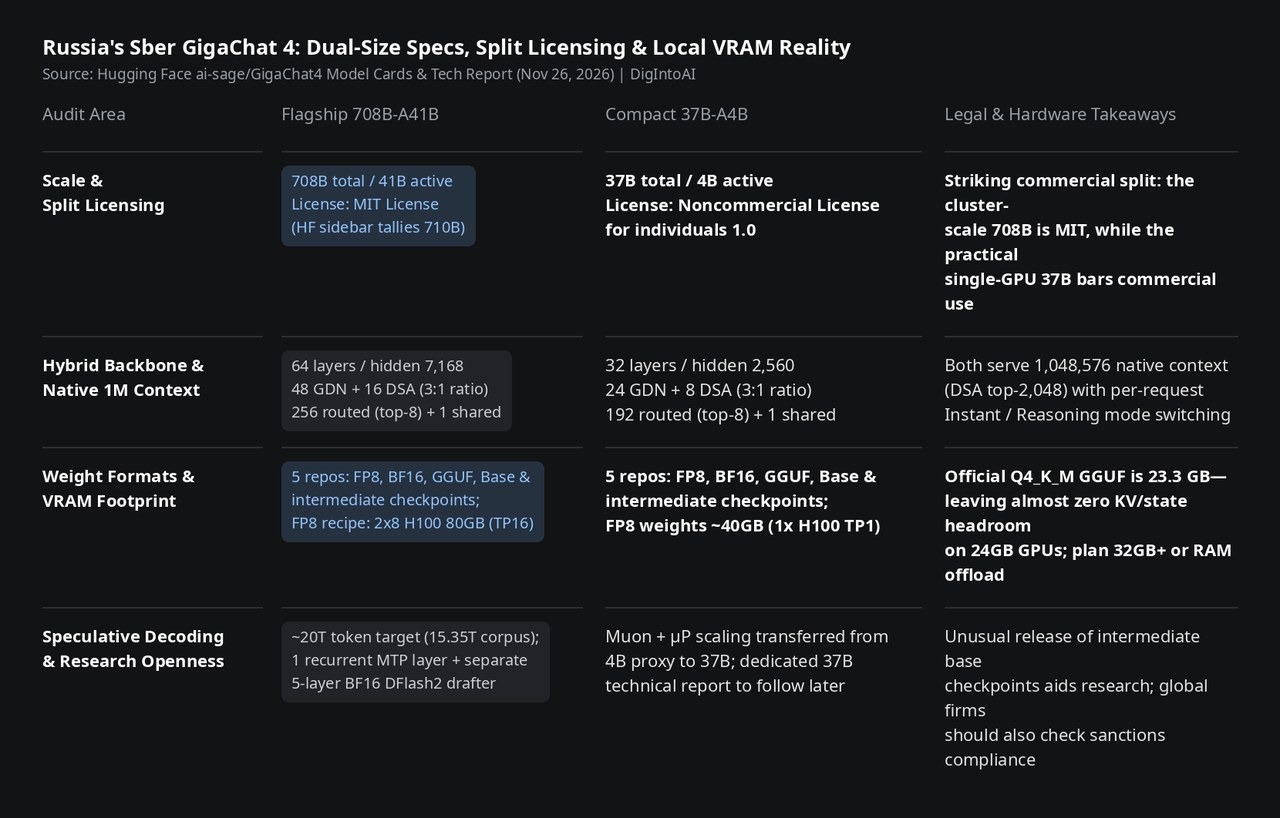
Image source: compiled by DigIntoAI from Hugging Face ai-sage/GigaChat4 model cards, GGUF files, and tech report (Nov 26, 2026).
How Does Russia's Best Stack Up Against Chinese and European Open Models?
**Competitive Coding & Tool Calling, Clear Gaps on Hard STEM: **Sber's self-reported evaluation tables paint a clear profile of strengths and weaknesses. In coding and tool-use benchmarks, 708B Reasoning hits 80.89% on SWE-bench Verified (and 80.82% even in Instant mode), sitting close to DeepSeek V4 Flash 0731 (81.80%) and ahead of Mistral 4 Large (79.60%) and Qwen 3.5 397B (73.00%), alongside 88.82% on LiveCodeBench v6, 71.26% on Terminal-Bench 2.0 (up from 30.30% on GigaChat 3.5 Ultra), 79.55% on BFCL v4, 83.00% on CoworkBench, and 80.33% on IFBench. The 37B Reasoning build hits 85.00% on LiveCodeBench v6 (vs. Qwen3.6-35B-A3B's 65.00%) and 70.80% on SWE-bench Verified (beating both Qwen3.6-35B-A3B's 67.80% and Sber's prior 432B Ultra's 64.70%). However, on hard STEM and deep scientific reasoning, both models trail frontier Chinese and European peers: 708B scores 82.83% on GPQA Diamond (vs. DeepSeek V4 Flash 91.00%, GLM-5.3 90.40%, Mistral 4 Large 87.37%), 23.91% on text-only HLE without tools (vs. DeepSeek 4.1 43.42%, GLM-5.3 39.62%), and 35.40% on DeepSWE; similarly, 37B trails Qwen3.6-35B-A3B on GPQA Diamond (70.00% vs. 80.00%), HLE (9.00% vs. 20.00%), and Terminal-Bench 2.0 (38.20% vs. 48.30%).
Three Mandatory Caveats Before Judging or Adopting GigaChat 4
**Self-Reported 7-Hour Timeouts, Pending 37B Report & Compliance Review: **Three objective boundaries apply: first, all scores are self-reported by ai-sage using Harbor/Pier runners with a 7-hour timeout on agentic suites, no independent evaluator has replicated them yet, and the dedicated 37B technical report is still forthcoming; second, we have not independently benchmarked live FP8 or 23.3 GB GGUF speed or multilingual quality; and third, beyond respecting the MIT versus individual-noncommercial license split, organizations in jurisdictions with sanctions or export-control rules should verify internal compliance policies before adopting assets from a Russian state-affiliated bank. Even with those caveats, GigaChat 4 is a striking proof point that frontier-scale 700B open-weight engineering now extends beyond the US-China axis.
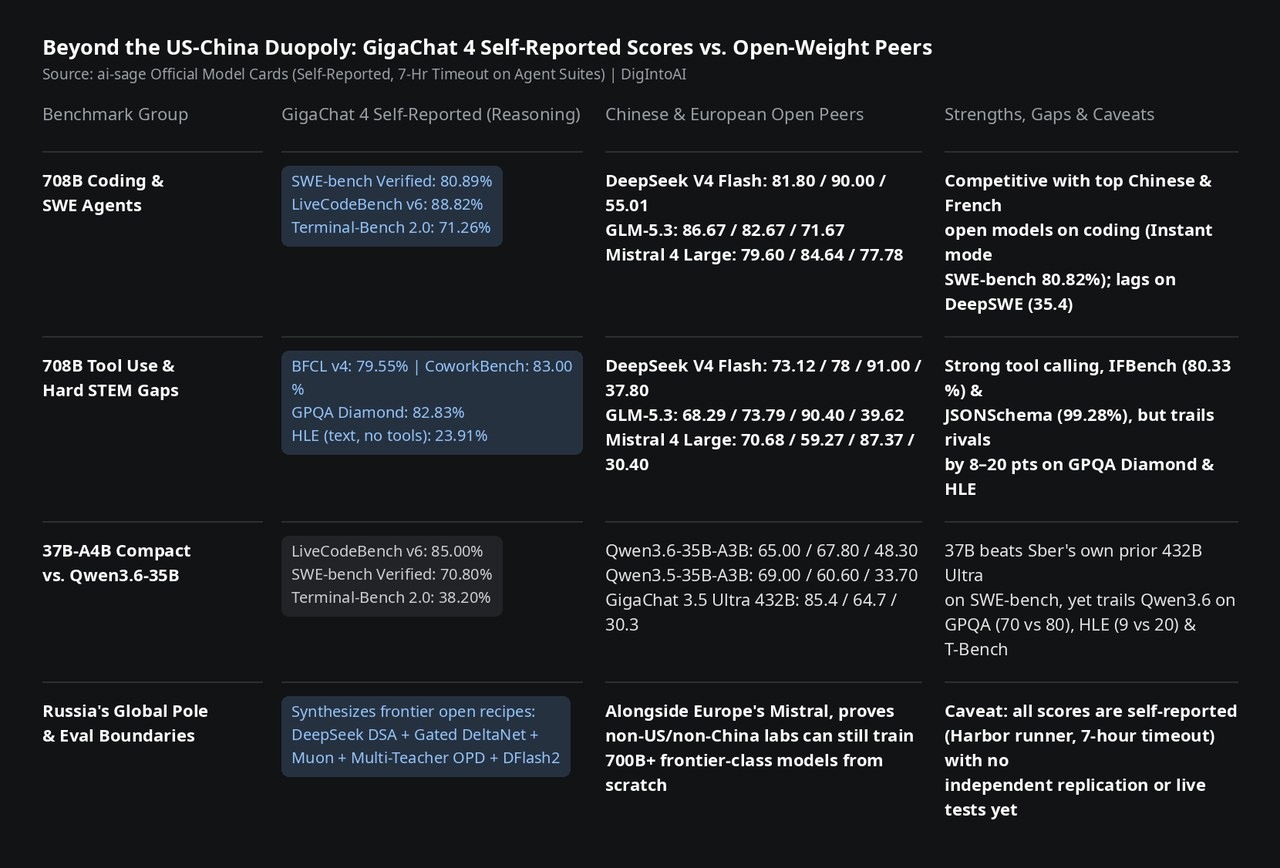
Image source: compiled by DigIntoAI from ai-sage official model card evaluation tables (Nov 26, 2026).