
During Alibaba Group's Q2 FY2027 earnings call on November 19, 2026 (covering the quarter ended September 30, 2026), CEO Eddie Wu disclosed that Alibaba has begun training its next-generation flagship Qwen model on proprietary AI chips designed by its T-Head semiconductor subsidiary, according to AFP, Nikkei Asia, and Reuters coverage of the call.
Post-2027 Shift to T-Head Silicon Amid New U.S. Overseas Rental Curbs
**Prioritizing Flagship Training & Targeting Q1 2027 Zhenwu V900 Mass Production: **Wu told analysts that after 2027, 'the vast majority of our new AI chip supply should consist primarily of our own domestic T-Head chips,' noting that Alibaba will prioritize its proprietary flagship silicon for foundation model training and iteration (as well as close partners) while purchasing other domestic chips for internal inference demand. The roadmap builds on T-Head's Zhenwu V900 AI chip unveiled in September 2026, which targets mass production in Q1 2027. Wu also warned that new U.S. Commerce Department rules requiring licenses for overseas data centers—including in Singapore, Malaysia, and Indonesia, with a 90-day transition window—to rent large-scale AI compute to China-headquartered firms will affect Alibaba's 2027 products and services and introduce 'very big uncertainty' across global supply chains.
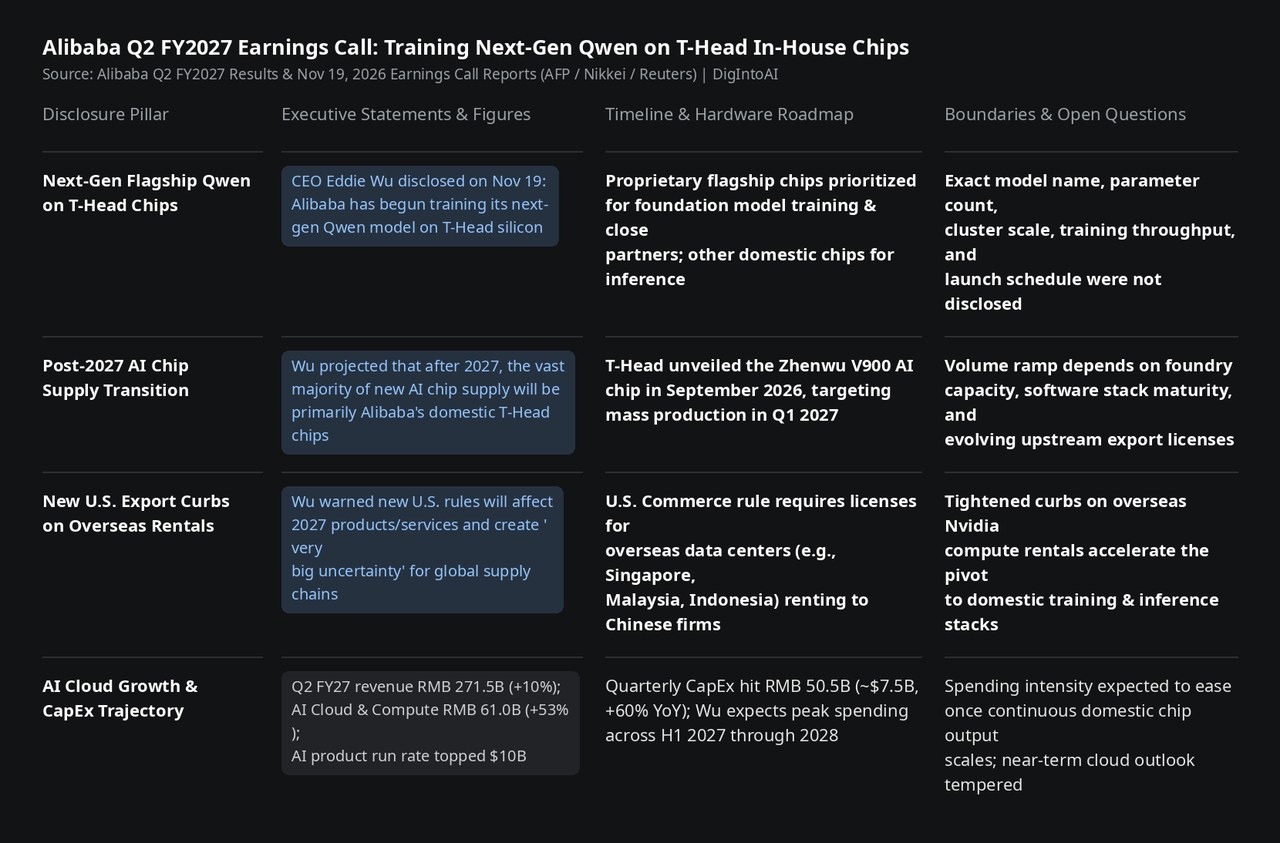
Image source: compiled by DigIntoAI from Alibaba Group's Q2 FY2027 results and AFP / Nikkei Asia reporting.
AI Cloud Financials, RMB 50.5B CapEx & Disclosure Boundaries
**Strong Cloud Demand Meets Unspecified Technical Benchmarks: **For the September quarter, Alibaba reported total revenue up 10% YoY to RMB 271.5 billion (approx. $40.5–$40.7 billion), with AI Cloud and Compute Services growing 53% YoY to RMB 61.0 billion and AI-related product revenue reaching RMB 17.9 billion (exceeding a $10 billion annual run rate). Quarterly CapEx jumped 60% YoY to RMB 50.5 billion (approx. $7.5 billion), with Wu expecting peak investment from H1 2027 through 2028 before easing once domestic chip output scales continuously. Notably, Alibaba did not disclose the exact name, parameter scale, cluster size, training throughput, or release date of the next-gen Qwen model running on T-Head silicon, leaving real-world mass production and software stack maturity in 2027 as the key metrics to watch.