
On this page
On November 23, 2026 (repository created at 11:55 Beijing time / 03:55 UTC and weight upload completed at 23:25 Beijing time / 15:25 UTC), Ant Group's inclusionAI quietly published the open-weight multimodal model Ling-3.2-air on Hugging Face and ModelScope under the MIT license, with simultaneous indexing on Artificial Analysis and no accompanying press release.
Hybrid-Linear MoE Architecture
Per the model card, Ling-3.2-air shares the native multimodal architecture of Ling-3.0-flash-VL (model type bailing_moe_v3_vl) built on a hybrid-linear MoE backbone with 124B total parameters and 5.5B activated parameters per token:
**Hybrid Attention and Linear Backbone: **42 Transformer layers arranged in a 5:1 ratio of 35 KDA layers and 7 Gated MLA layers, plus 2 dense layers, hidden size 2560, 32 attention heads, and a 157,184-token vocabulary.
**Fine-Grained Expert Routing: **512 routed experts (8 active per token) plus 1 shared expert, with an expert intermediate size of 768 and dense intermediate size of 6144.
Checkpoint Inspection: Two Practical Engineering Details
Inspecting config.json alongside the safetensors shards and tensor metadata highlights two nuances for deployment engineers:
Pre-Quantized Block-FP8 Weights Despite bf16 Base Dtype: **While config.json lists **bf16 as the base dtype, the 13 safetensors shards (model-00001-of-00013.safetensors through model-00013-of-00013.safetensors, twelve 10.6–10.7 GB files plus a 1.59 GB final shard) total 129 GB. Tensor types (BF16, F32, F8_E4M3) and quantization_config confirm that routed experts ship in FP8 (e4m3, 128x128 block-wise quantization), while the vision tower, token embeddings, and router gates remain in high precision.
128B Sidebar Count vs. 124B Model Card Table: **Hugging Face's automated safetensors counter displays **128B params in the sidebar, whereas the model overview table reports 124B total / 5.5B activated. The ~4B difference reflects parameter accounting scope—whether the vision tower and embedding/LM-head matrices are included alongside the MoE text backbone.
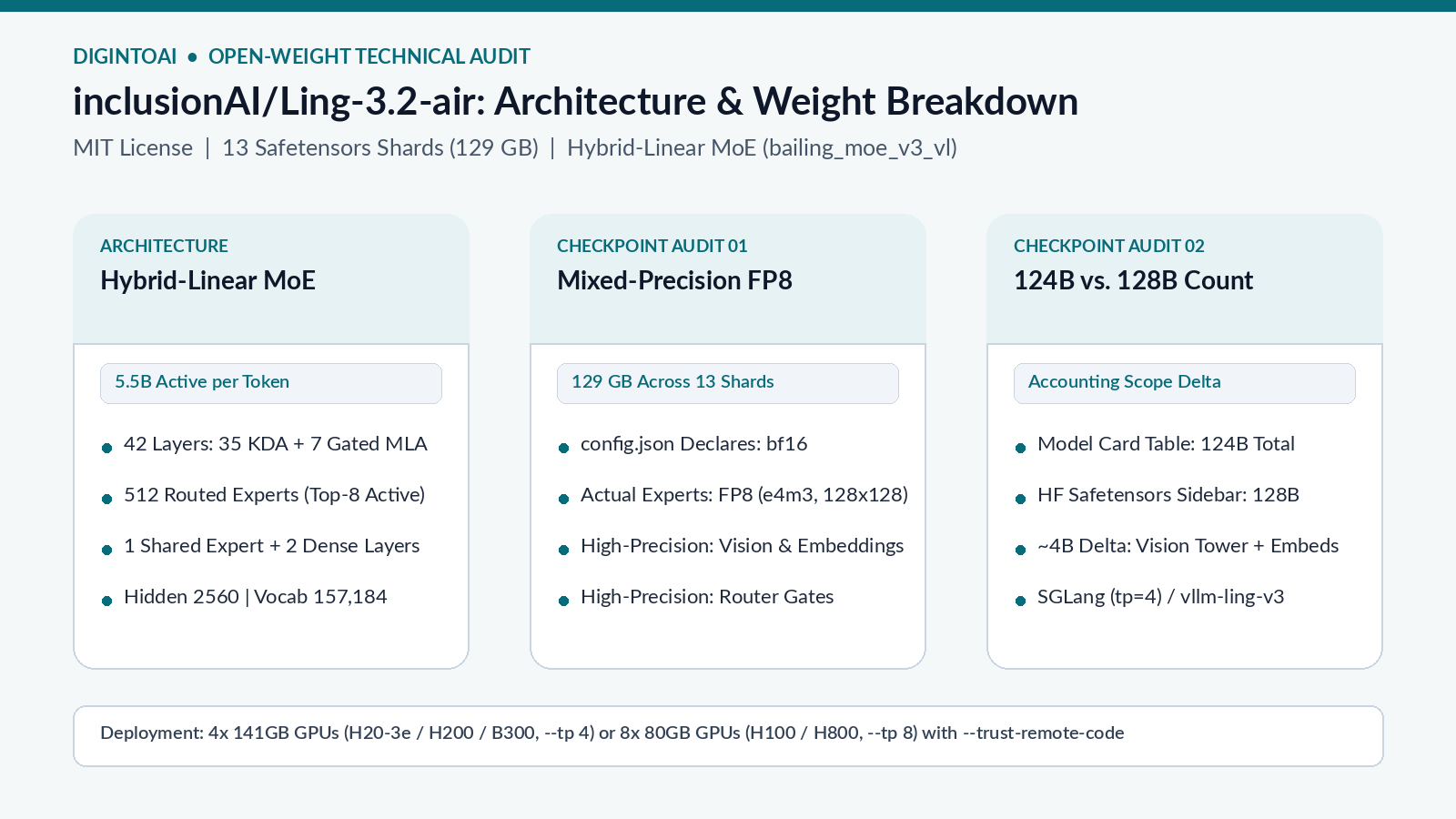
Image source: Technical diagram created by DigIntoAI based on the official Hugging Face model card and repository metadata.
Benchmarks and Deployment Recipe
Workflow Automation and Document Reasoning Gains: **Ling-3.2-air scores **23 on the Artificial Analysis Intelligence Index v5.0.1 (where it is listed with a 1M-token context window). Compared with Ling-3.0-flash-VL, AutomationBench-AA rises from 15.7% to 61%, GDP.pdf all-pass increases from 8.4% to 16%, AA-Briefcase v1.1 climbs 353 Elo points from 987 to 1340, and Terminal-Bench 4.0 increases from 0% to 27%. On Harvey LAB-AA v1.1, it achieves an 87.7% criterion pass rate (8.3% all-pass before material hallucination checks and 0.8% after).
Serving Stack and Hardware Footprint: **The official **SGLang recipe (lmsysorg/sglang:dev-Ling-3.0-flash-VL) runs 256K context (--context-length 262144) with NEXTN (MTP) speculative decoding on 4x 141GB GPUs (H20-3e, H200, B300, or GB300 at --tp 4) or 8x 80GB GPUs (H100 or H800 at --tp 8), using --trust-remote-code and --reasoning-parser ling3 --tool-call-parser ling3. A dedicated vLLM branch is also hosted at github.com/inclusionAI/vllm-ling-v3.