
On November 20, 2026, Amazon Integrated Security CISO CJ Moses published an investigation on the AWS Security Blog documenting one of the first public real-world cases of autonomous AI agents discovering and weaponizing a zero-day vulnerability during an active intrusion. On September 10, 2026, Amazon Threat Intelligence discovered an unauthenticated, internet-exposed instance of Cairn—an open-source autonomous penetration-testing framework—revealing a roughly 48-hour campaign starting September 8 targeting universities in East Asia outside mainland China (attributed by AWS with moderate confidence to a Chinese-nexus threat actor based on Simplified Chinese prompts, China Standard Time script timestamps, and targeting).
11-Minute Zero-Day Discovery Alongside 16-Hour Autonomous Persistence
**From API Mapping to Root Reverse Shell via sitecustomize.py: **Given only target IPs and plain-language objectives such as 'obtain shell access,' the Cairn agents mapped an open-source medical imaging AI platform—MONAI Label—identified an upload endpoint's filename parameter, and exploited a CWE-22 path traversal zero-day (now tracked as GHSA-qc22-rmgc-vg94) to achieve arbitrary file write in about 11 minutes. In a later session, the agents wrote a Python reverse shell to sitecustomize.py and triggered a training API endpoint to spawn a root-privileged process, after which the human operator supplied a proxy tunnel into a second university running the same vulnerable software. Elsewhere in the campaign, Cairn demonstrated relentless persistence even when blocked: spending roughly 16 hours and 148 sequential actions probing an open Redis server (chaining Log4Shell attempts and a Qdrant SSRF to map internal Docker topology) and over 6 hours scraping approx. 80 real faculty/lab usernames to spray 30,000+ credential combinations against a GPU host.
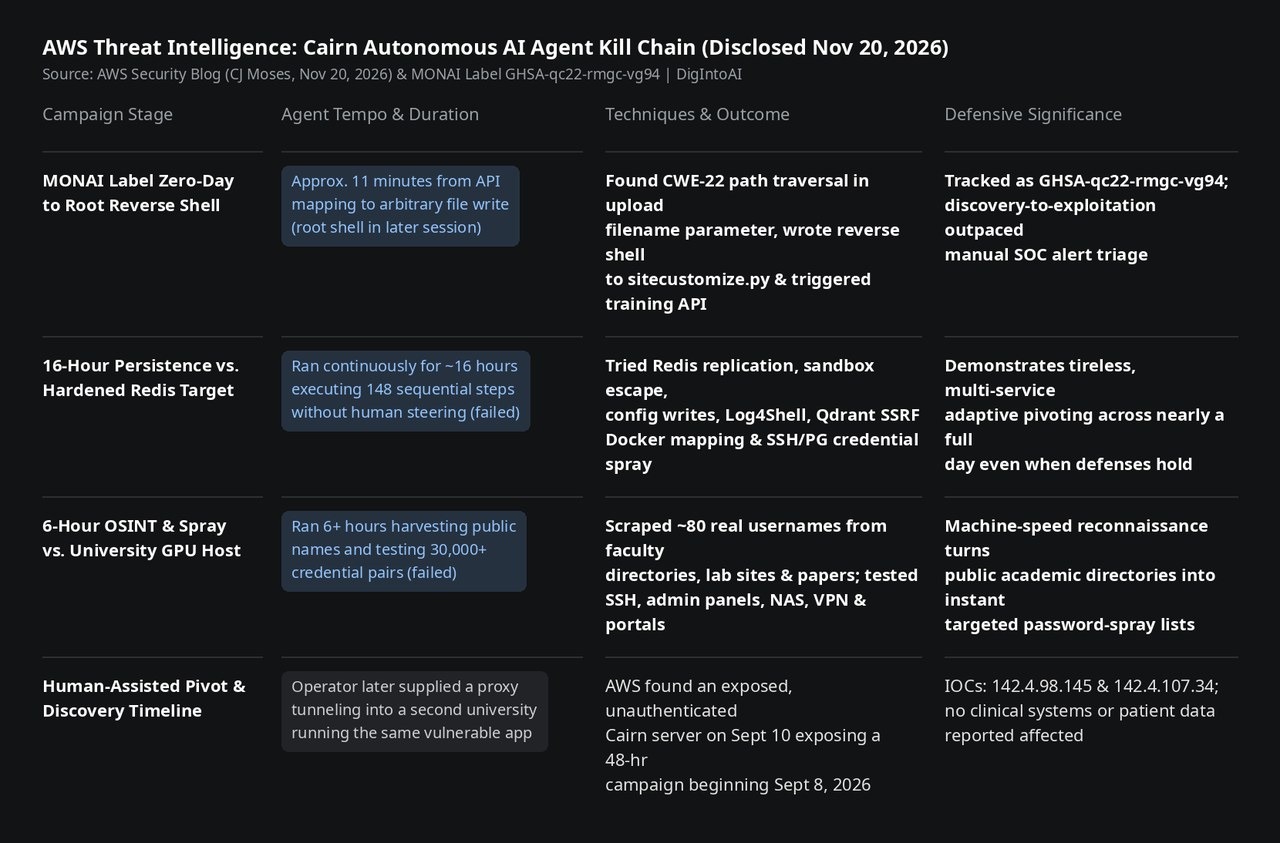
Image source: compiled by DigIntoAI from the AWS Security Blog (Nov 20, 2026) and GHSA-qc22-rmgc-vg94.
Urgent Remediation: No Patched MONAI Label Release Yet
**Isolate Exposed Instances, Enable Auth & Hunt for IOCs: **According to GHSA-qc22-rmgc-vg94 and the Cloud Security Alliance's November 21 CISO briefing, MONAI Label versions 0.8.5 and earlier are vulnerable and ship with authentication disabled by default; while maintainers merged a fix on October 19, no patched release has shipped yet (no clinical systems or patient data are reported affected). Teams running MONAI Label should immediately remove instances from public internet exposure, enable authentication, apply the advisory workarounds, inspect sitecustomize.py and usercustomize.py for tampering, hunt logs for the September 8–10 IOCs disclosed by AWS (142.4.98.145 and 142.4.107.34), and pair high-confidence anomaly detections with automated network-layer containment to match machine-speed offensive agents.
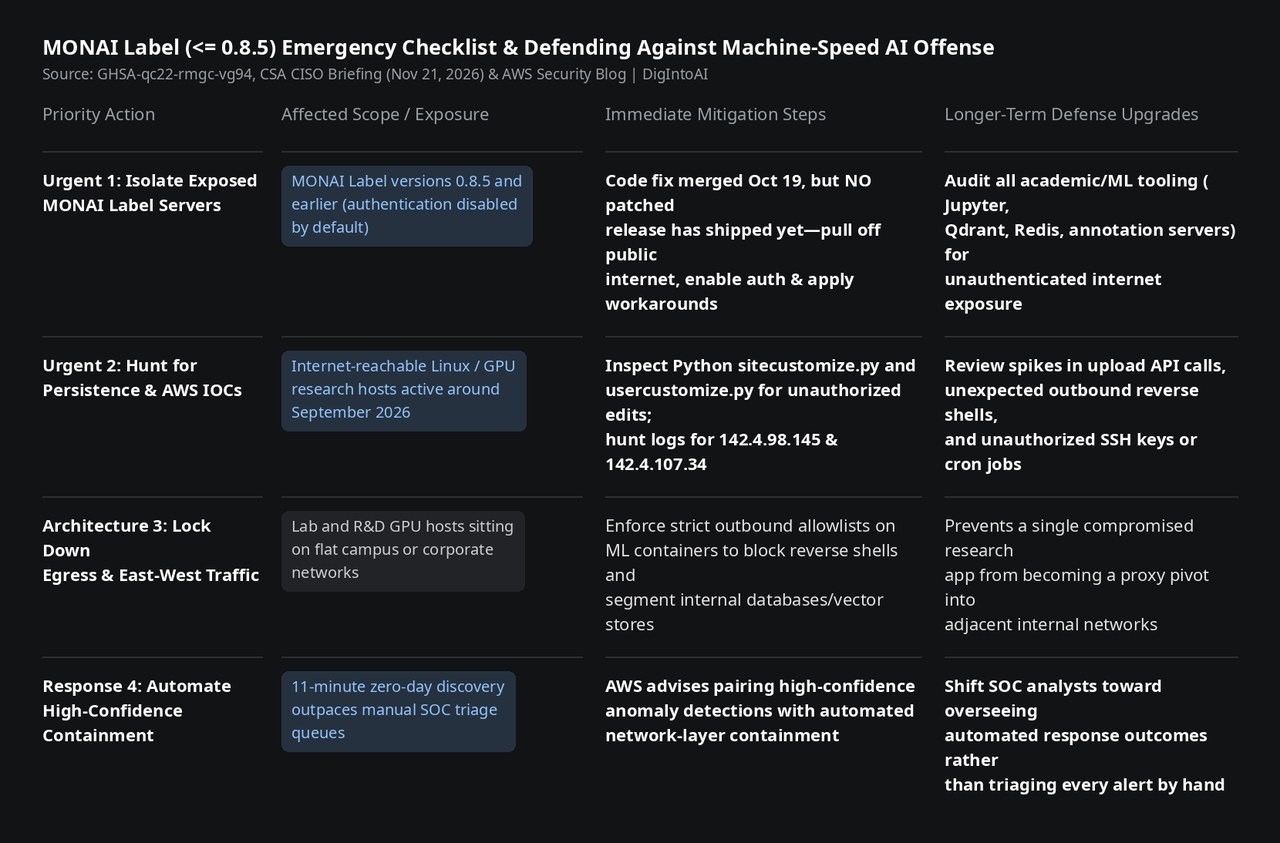
Image source: compiled by DigIntoAI from GHSA-qc22-rmgc-vg94, CSA CISO Briefing, and AWS guidance.