
On November 25, 2026 PT (November 26, 2026 Beijing time), ByteDance's Seed team launched Seed-TTS 3.0 on OpenRouter under the model ID bytedance-seed/seed-tts-3-0. While the integration makes ByteDance's latest speech synthesis easy to call via OpenRouter's unified endpoint, a key billing rule on the model card directly impacts budgeting for Chinese workloads.
The Billing Catch: $20 Headline Rate, $40 Effective Rate for Chinese
OpenRouter lists Seed-TTS 3.0 at $20 per million input characters. However, the pricing note explicitly specifies that each Chinese character (Hanzi) is counted as 2 characters for billing purposes.
Exact Double Cost on Chinese Audio Pipelines: **English workloads billed at 1 character per unit cost the advertised **$20 per 1M characters. By contrast, processing 1 million Chinese characters for podcasts, audiobooks, or voice agents bills as 2 million character units—bringing the real effective rate to $40 per 1M Chinese characters. Teams forecasting spend directly off the $20 headline figure will underestimate Chinese TTS bills by 100%.
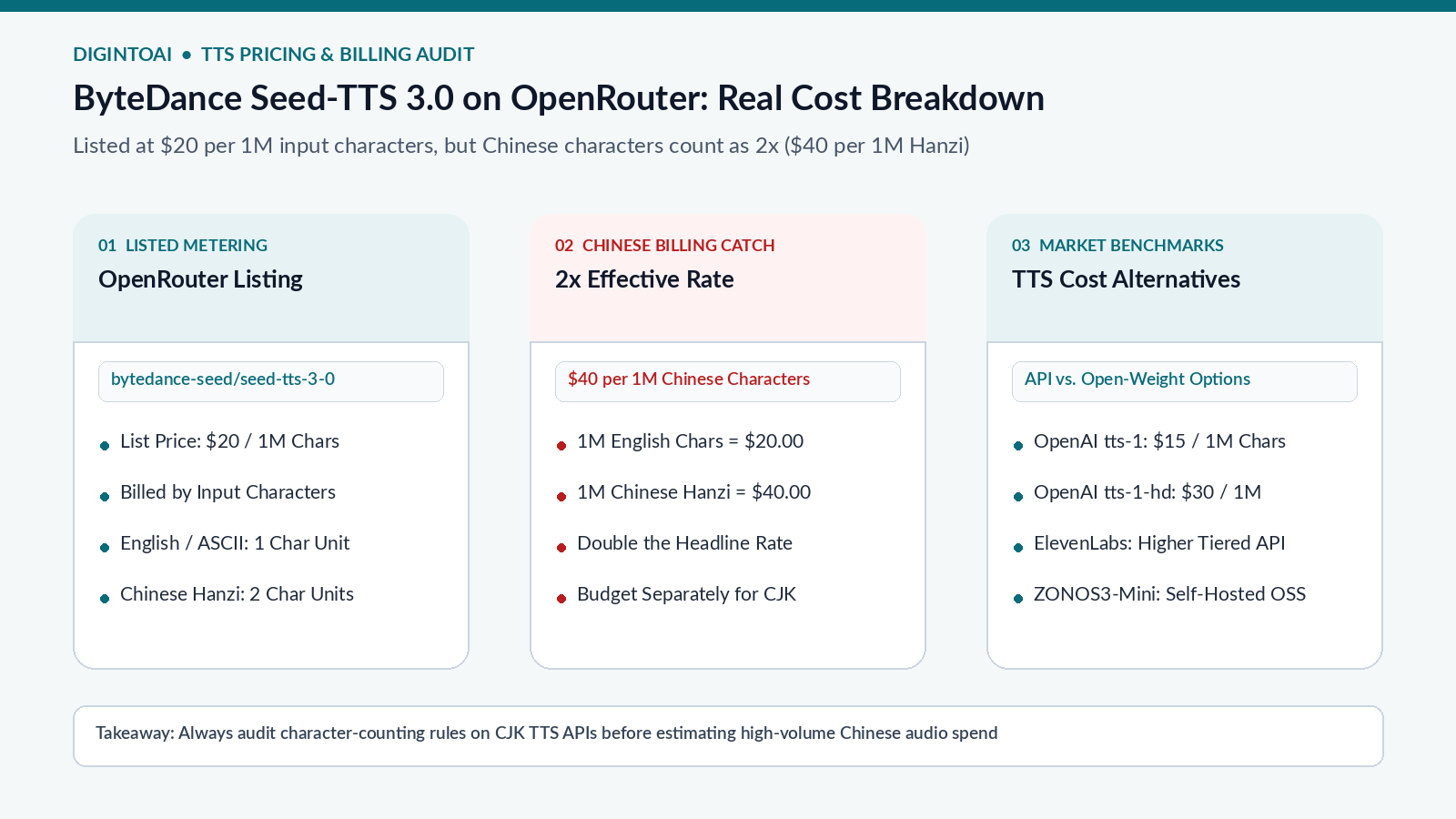
Image source: Compiled by DigIntoAI from the OpenRouter model listing and public TTS pricing schedules.
How Seed-TTS 3.0 Compares Against OpenAI TTS, ElevenLabs, and ZONOS3-Mini
Evaluating the true $20 (English) / $40 (Chinese) per-million-character rates clarifies where Seed-TTS 3.0 fits:
**Versus OpenAI TTS (tts-1 and tts-1-hd): **OpenAI's character-metered endpoints sit at $15 per 1M characters for tts-1 and $30 per 1M characters for tts-1-hd. For English synthesis, Seed-TTS 3.0 ($20) falls cleanly between the two; for Chinese synthesis ($40 effective), it costs more than tts-1-hd, meaning adoption makes sense primarily when natural prosody and expressiveness justify the premium.
**Versus ElevenLabs: **ElevenLabs bills via character/credit tiers that generally translate to substantially higher effective per-million-character costs on commercial plans. Calling Seed-TTS 3.0 pay-as-you-go on OpenRouter avoids upfront subscription commitments for small-to-medium multilingual workloads.
Versus Open-Weight ZONOS3-Mini: **For high-volume Chinese audio generation where per-character 2x metering compounds rapidly, self-hosting open-weight models such as **ZONOS3-Mini eliminates API character charges altogether in favor of predictable GPU compute costs.