
By November 2026, open-weight video generation models have progressed far beyond silent 5-second clips into native 4K resolution, synchronized audio-video synthesis, and multi-reference directorial control. For engineering teams deploying self-hosted pipelines, selecting the right foundation model requires balancing VRAM requirements, native audio capabilities, LoRA ecosystem maturity, and commercial license thresholds. Four model families anchor the current open-weight landscape: LTX-2.5 from LTX (Lightricks), Wan 2.2 from Alibaba, HunyuanVideo 1.5 from Tencent, and MAGI-2 from Sand.ai.
Architectural and Specification Breakdown of the Top Four Families
LTX-2.5 (Native Audio-Video and 4K Production Workhorse): **Released by Lightricks' LTX unit in August 2026 and actively maintained on Hugging Face (~22B DiT architecture), LTX-2.5's defining advantage is **jointly generating synchronized 24 kHz stereo audio and video in a single forward pass. It supports native resolutions up to 4K (including 1080x1920 portrait), 24/25/48/50 FPS, clips up to 20 seconds, multi-shot continuity, and IC-LoRA conditioning (depth, pose, edge maps, and camera motion tracks). Official documentation lists a 32GB VRAM floor (RTX 5090 class; 80GB A100/H100 recommended for full BF16 precision). Its LTX-2.x Community License allows free commercial and production use for entities under $10M in annual revenue, requiring a paid commercial agreement above that threshold.
Wan 2.2 (Unrestricted Apache 2.0 Licensing and Largest LoRA Ecosystem): **Alibaba's Wan 2.2 open-weight family—spanning the dense **Wan2.2-TI2V-5B and Mixture-of-Experts Wan2.2-T2V-A14B / I2V-A14B (14B active parameters per token; newer Wan 2.6 remains closed-source via APIs)—excels at dynamic subject motion and commands the largest library of community LoRAs and ComfyUI workflows. It does not generate native audio. Documented VRAM floors sit at 24GB for TI2V-5B with offload flags (8GB–12GB via community GGUF builds) and 80GB for single-GPU A14B inference. Crucially, all Wan 2.2 checkpoints ship under the Apache 2.0 license with zero revenue or user-count caps.
HunyuanVideo 1.5 (Lowest Hardware Floor for Cinematic Realism): **Tencent's HunyuanVideo 1.5 distills cinematic motion and strong prompt adherence into a compact **8.3B DiT architecture, generating native 480p and 720p video with built-in super-resolution upscaling to 1080p (video-only, no native audio). With model offloading enabled, its documented VRAM floor drops to 14GB, making it the most accessible high-fidelity option for 16GB–24GB consumer GPUs such as the RTX 4090. It uses the Tencent Hunyuan Community License, which permits free commercial deployment up to 100 million monthly active users subject to territory and acceptable-use restrictions.
MAGI-2 and MAGI-2 Preview (Frontier-Scale Omnimodal Reference): **Built on a single-stream Transformer with Multi-Head Latent MoE, Sand.ai's August 2026 **MAGI-2 Preview (~114B total / ~6B active parameters; Apache 2.0 inference code) is already open on Hugging Face, while the full 480B MAGI-2 (~28B active parameters, trained on 4T tokens; see our was unveiled on November 24, 2026 PT with open weights slated to follow. MAGI-2 delivers up to 30-second 1080p 25fps native audio-video and accepts up to 20 media references (images, videos, and audio clips), targeting multi-GPU server clusters.
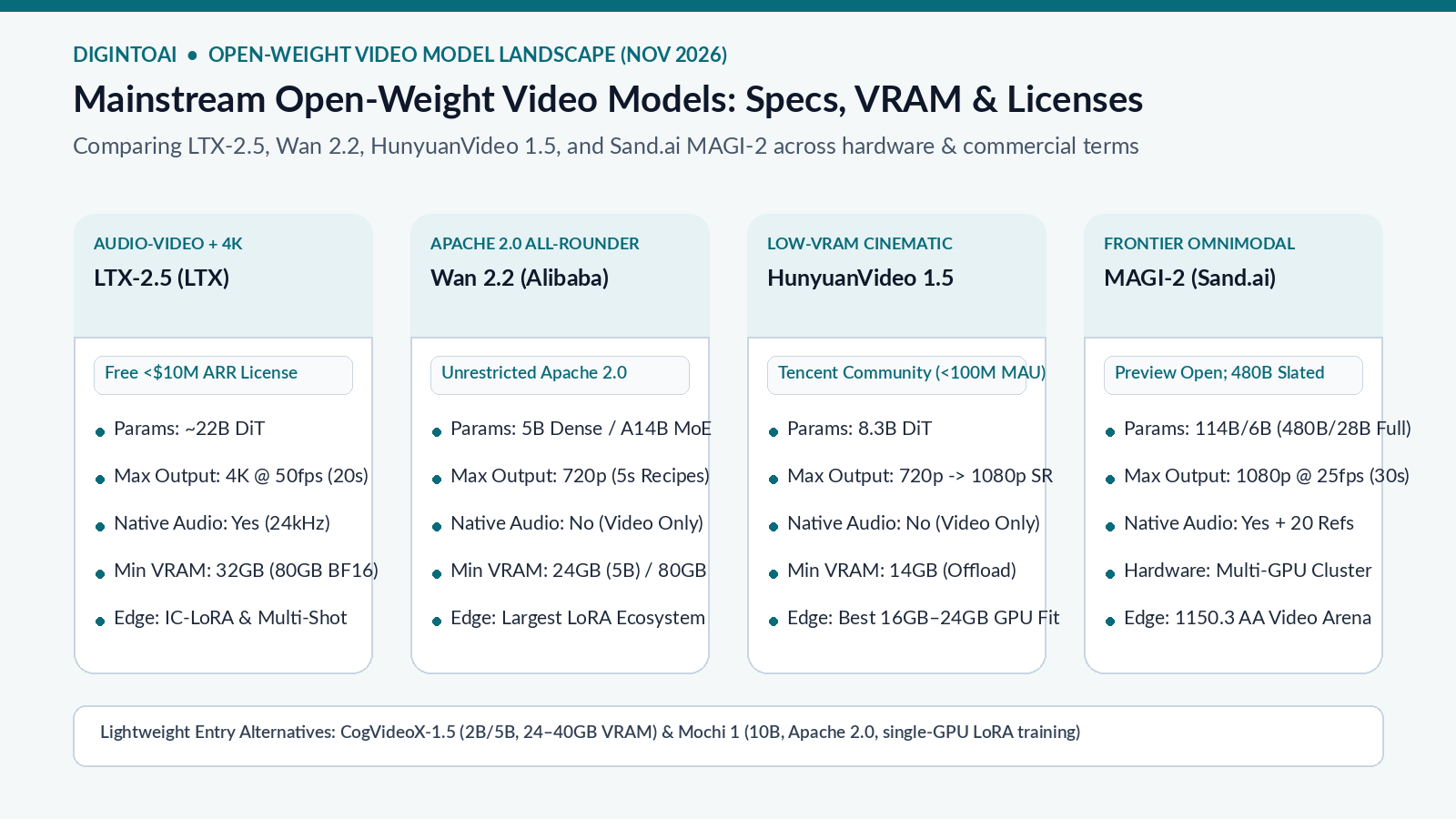
Image source: Compiled by DigIntoAI from official Lightricks, Wan-AI, Tencent Hunyuan, and Sand.ai model cards and documentation.
Lightweight Alternatives and Practical Selection Matrix
Lightweight Fine-Tuning Bases (CogVideoX-1.5 and Mochi 1): **For teams prioritizing rapid prototyping or single-GPU LoRA training pipelines, Zhipu AI's **CogVideoX-1.5 (2B / 5B, 24GB–40GB VRAM, native Hugging Face diffusers and CogKit support) and Genmo's Mochi 1 (10B AsymmDiT, Apache 2.0, official single-GPU LoRA training script, ~20GB VRAM in FP8) remain solid entry points, though they trail the newer generation in maximum resolution and multi-shot coherence.
How to Choose for Production: **Choose **Wan 2.2 for unrestricted Apache 2.0 commercial deployment and deep LoRA customization; choose LTX-2.5 for native synchronized audio, 4K output, and structural conditioning (when under $10M ARR or licensed); choose HunyuanVideo 1.5 for photorealistic rendering on 16GB–24GB consumer GPUs; and track MAGI-2 for multi-GPU enterprise clusters requiring 30-second omnimodal consistency.