
On this page
On November 13, 2026, DeepSeek opened the full suite of application-layer capabilities powering its official web and mobile apps to third-party developers. Centered on deepseek-flash (served by DeepSeek-V4.1-Flash-1017 with a 1M context window and up to 384K output tokens), the release lets builders toggle server-managed web search, deep thinking search, document parsing, URL reading, and content safety checks directly inside standard chat requests—or call Search, Fetch, OCR, Speech-to-Text (ASR), and Text-to-Speech (TTS) as standalone endpoints.
To demonstrate a full reference implementation, DeepSeek also published and open-sourced chat-demo (hosted at cdn.deepseek.com/chat-demo with source code at github.com/deepseek-ai/chat-demo). The browser-only client stores API keys and uploaded images locally, supports importing exported DeepSeek Chat history files to resume threads, and showcases deep thinking search, document uploads, Mermaid diagram rendering, and voice input/read-aloud.
What Runs Server-Side vs. How to Chain Standalone Endpoints
DeepSeek splits the release into two integration layers—in-chat server orchestration across the Anthropic-compatible Messages API (/anthropic/v1/messages), OpenAI Responses API (/responses), and Chat Completions API (/chat/completions), plus five standalone tool endpoints under /v1/tools/:
**Server-Handled Web Search, Deep Thinking Search & URL Reading: **Declaring the deepseek_web_search tool with thinking disabled lets the server trigger web or image searches automatically and return inline citations. Enabling thinking turns the same tool into Deep Thinking Search, allowing the model to execute up to roughly 20 autonomous search and page-inspection calls across multi-step reasoning. Declaring deepseek_read_url instructs the server to scan the latest user message for up to 10 unique URLs, fetch them, and inject encrypted page payloads (carried in a signature field) into context. Your client never runs crawlers—it simply renders returned content blocks and echoes them back unchanged on subsequent turns.
**Two-Step File Parsing (Files API + Chat Reference): **For PDF, Word (DOC/DOCX), PowerPoint (PPT/PPTX), and image files, upload first via POST /files using purpose set to text_recognition (Word and PowerPoint files without images have text extracted directly without OCR) or rich_layout_recognition (page-by-page layout and chart parsing). Reference the returned file_id in subsequent chat turns so the server injects parsed text into context. Plain-text and code files (txt, md, csv, json), spreadsheets (xlsx, xls), and non-DRM ebooks (epub, mobi) uploaded with purpose set to user_data are converted to Markdown free of charge.
**Chaining Standalone Tool APIs (/v1/tools/): **For custom agent pipelines outside standard chat, developers can call five standalone endpoints: Search (POST /v1/tools/search, supporting site: and -site: operators but not image search yet), Fetch (POST /v1/tools/fetch, returning single-page Markdown), OCR (POST /v1/tools/ocr, page-by-page recognition without storing in Files API), ASR (POST /v1/tools/asr, auto-detecting 21 languages including Chinese, Cantonese, English, Japanese, and Korean), and TTS (streaming HTTP POST /v1/tools/tts or incremental WebSocket wss://api.deepseek.com/v1/tools/tts with stella female and tide male voices across 10 auto-detected languages). A voice assistant can chain browser audio recording into ASR, pass the transcript to deepseek-flash, and stream tokens into WebSocket TTS.
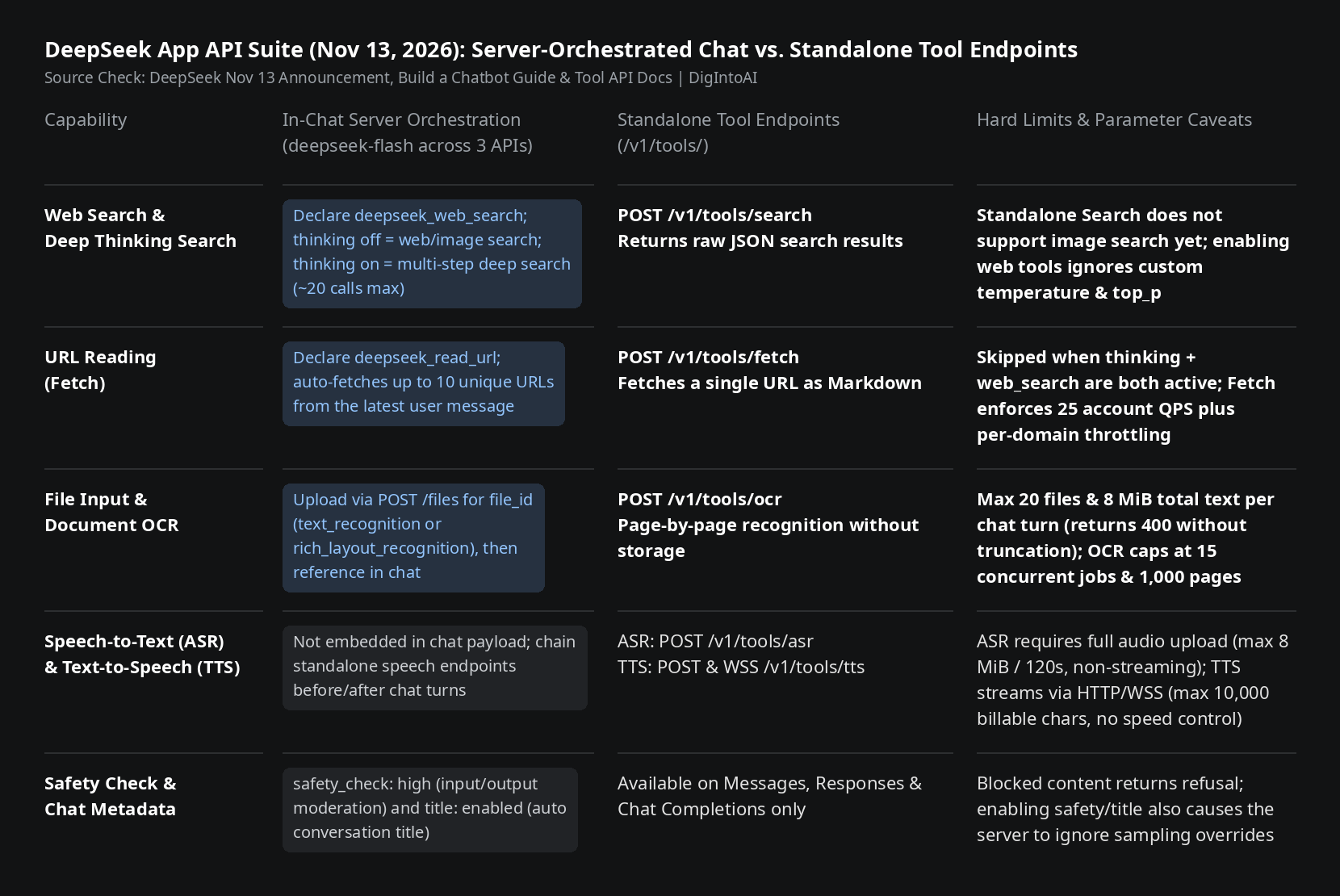
Image source: compiled by DigIntoAI from DeepSeek's November 13 announcement and official API documentation.
Per-Call Cost Breakdown: Model Tokens Plus Tool Fees
Using these application capabilities incurs both base model token charges and per-use or per-unit extension tool fees, deducted from granted balances first when available:
**deepseek-flash Token Pricing (Peak vs. Off-Peak): **DeepSeek applies a 50% off-peak discount outside 01:00–04:00 and 06:00–10:00 UTC Monday through Friday (excluding Chinese public holidays). Off-peak rates are $0.003 per 1M input tokens on cache hit (RMB 0.02), $0.15 on cache miss (RMB 1), and $0.60 per 1M output tokens (RMB 4), doubling to $0.006, $0.30, and $1.20 (RMB 0.04, 2, and 8) during peak hours. In Deep Thinking Search, multi-step reasoning chains count toward output tokens.
**Search & Fetch Per-Request Fees: **Both standalone /v1/tools/ calls and model-triggered web tools cost $0.75 per 1,000 successful requests (RMB 5 per 1,000). Requests are billed only on HTTP 200 responses with non-empty results; errors, timeouts, and empty search results are not billed.
**File Parsing & OCR Per-Page Fees: **Document parsing and standalone OCR cost $0.225 per 1,000 pages (RMB 1.5 per 1,000 pages), billed once when upload parsing succeeds. Referencing an already-parsed file_id across multiple chat turns incurs no repeat parsing fee—only standard input token charges.
**Speech APIs (50% Limited-Time Discount): **TTS lists at $0.45 per 10,000 characters (RMB 3) and is currently discounted 50% to $0.225 (RMB 1.5), counting each Chinese character as 2 billable characters and ASCII characters as 1. ASR lists at $0.116 per audio hour (RMB 0.78) and is discounted 50% to $0.058 (RMB 0.39), metered per second rounded up to 1 second.
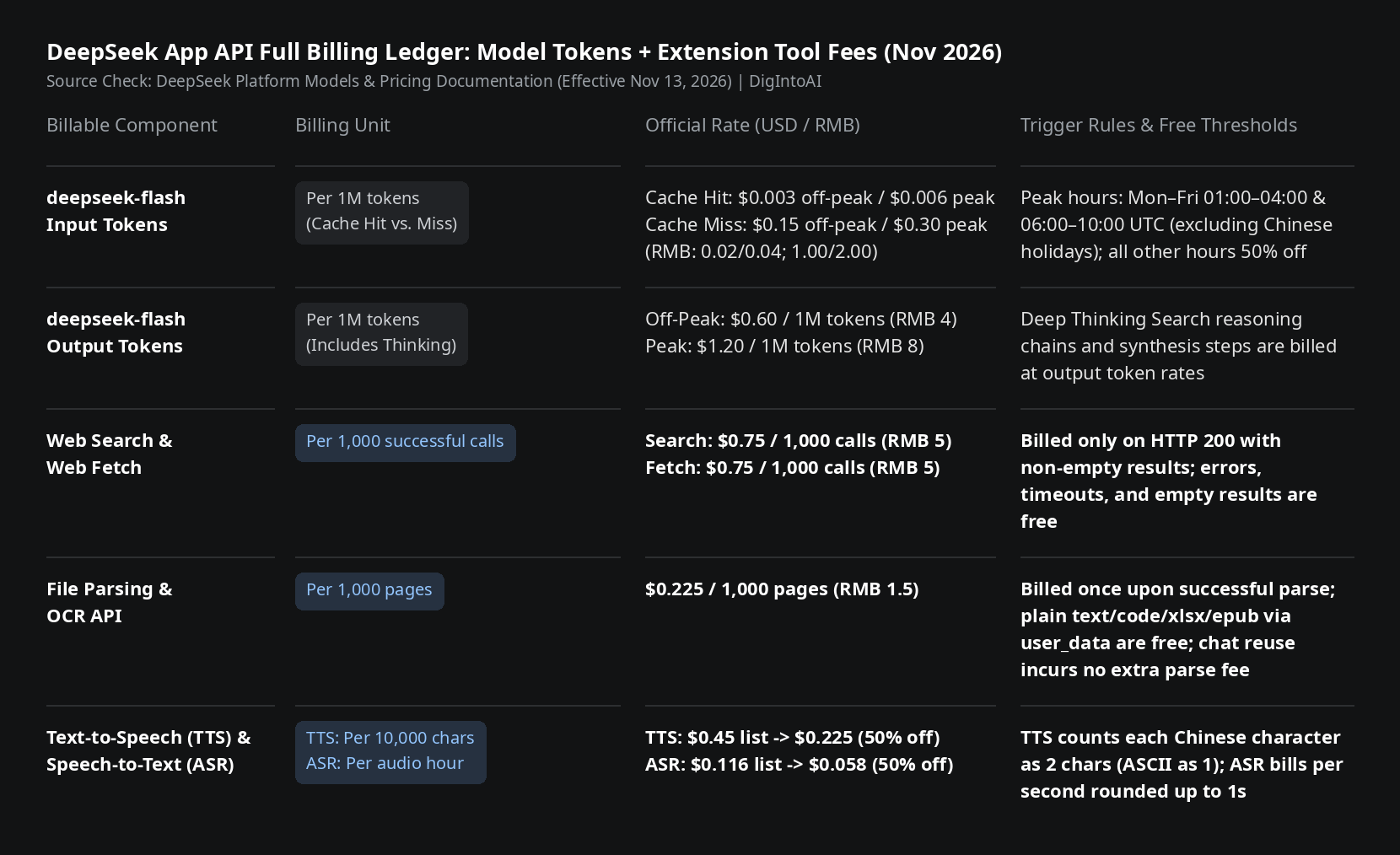
Image source: compiled by DigIntoAI from DeepSeek's Models & Pricing documentation.
Compatibility Caveats & Operational Limits to Check Before Launch
**Model Availability: **In-chat app tools currently require deepseek-flash (2,500 concurrency limit); deepseek-v4-pro does not support vision or this app suite.
**Silently Ignored Sampling Parameters: **Whenever a request declares deepseek_web_search or deepseek_read_url, sets safety_check to high, or enables title generation, the server overrides and silently ignores custom temperature, top_p, top_k (Messages), frequency_penalty / presence_penalty (Chat Completions), and preserve_thinking values. Also, max_tokens (or max_output_tokens) caps each individual inference step within a turn rather than the cumulative output across all search steps.
**Tool Precedence & Document Ceilings: **deepseek_read_url checks only the first 10 unique URLs in the latest user message, and is bypassed when thinking is enabled alongside deepseek_web_search. Chat requests can reference at most 20 documents totaling no more than 8 MiB of extracted text; documents are never truncated silently and return HTTP 400 if context limits are exceeded.
**Speech Endpoint Constraints & Compliance: **Standalone ASR does not support streaming and requires complete 16-bit PCM WAV or Ogg Opus files (max 8 MiB, max 120 seconds, left channel only for stereo). TTS caps at 10,000 billable characters (30 minutes max audio) with no speech-rate adjustment or resume support. Public-facing services must enable safety_check and fulfill local content moderation, model registration, and AI-labeling obligations.