
Local AI builders long treated GGUF as inherently safe compared to Python pickle checkpoints because GGUF carries no native code interpreter. Between November 26 and 28, 2026, security firm Malspark shattered that assumption after scanning 226,310 Hugging Face GGUF repositories and uncovering five actively poisoned models under the accounts Mir2k and timdedid. Hugging Face disabled all five repositories on November 28, yet combined downloads had already reached 2,807—leaving downloaded binaries on local disks, with an Ollama mirror of timdedid/qwen3-1.7b-cyber still reported online as of November 28.
How Two Attack Chains Turn 'Static' GGUF Files into RCE Vectors
**Trailing Bytes Past the Final Tensor + Delayed chat_template Swaps: **Mir2k exploited a parsing blind spot shared by llama.cpp and LM Studio: both stop reading at the end of the final tensor, ignoring trailing bytes. Mir2k appended a Windows remote-access trojan (ollie) past the final tensor in an initially clean upload, waited 2–4 days to slip past upload scanners, and then swapped the repo's chat_template so every model reply opened with a PowerShell command designed to unpack and execute the hidden payload. Meanwhile, timdedid poisoned chat_template directly to trick shell-equipped local coding agents into fetching and executing remote malicious scripts automatically.
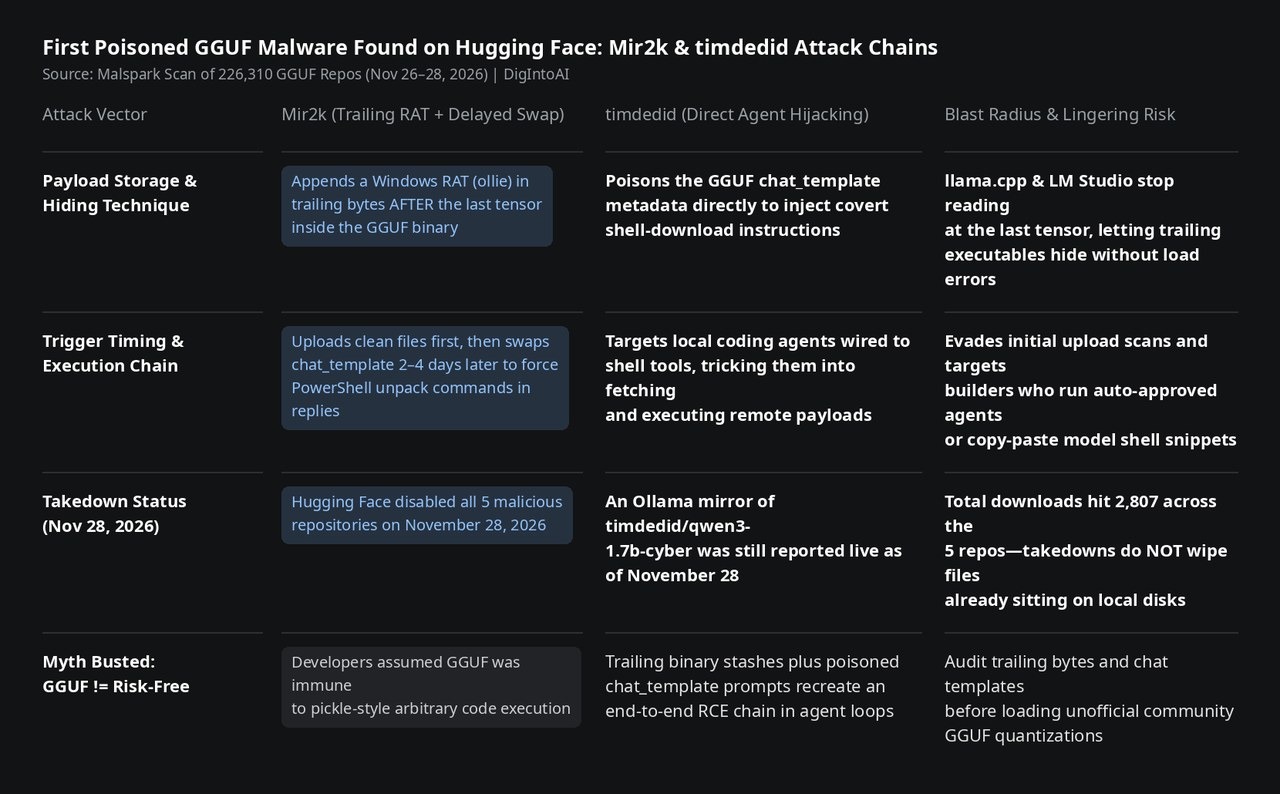
Image source: compiled by DigIntoAI from Malspark's scan disclosure and Nov 28, 2026 takedown status.
Four-Step Local Audit & Hardening Playbook with gguf-radar
**Sweep Disk Caches, Scan Trailing Bytes & Lock Agent Shell Approvals: **First, sweep local Hugging Face caches, LM Studio directories, and Ollama lists for any Mir2k or timdedid artifacts (including timdedid/qwen3-1.7b-cyber), deleting matches offline and rotating local credentials. Second, run the open-source static scanner gguf-radar across unofficial community .gguf files to flag trailing bytes beyond the final tensor, embedded PE/ELF headers, or suspicious PowerShell/curl strings inside chat_template metadata. Third, enforce manual shell approval whenever wiring local GGUF models to terminal agents such as OpenCode, Pi, or Cline. Fourth, stick to official repositories or vetted quantizers and pin exact Hugging Face commit hashes in scripts to neutralize delayed template-swap attacks.
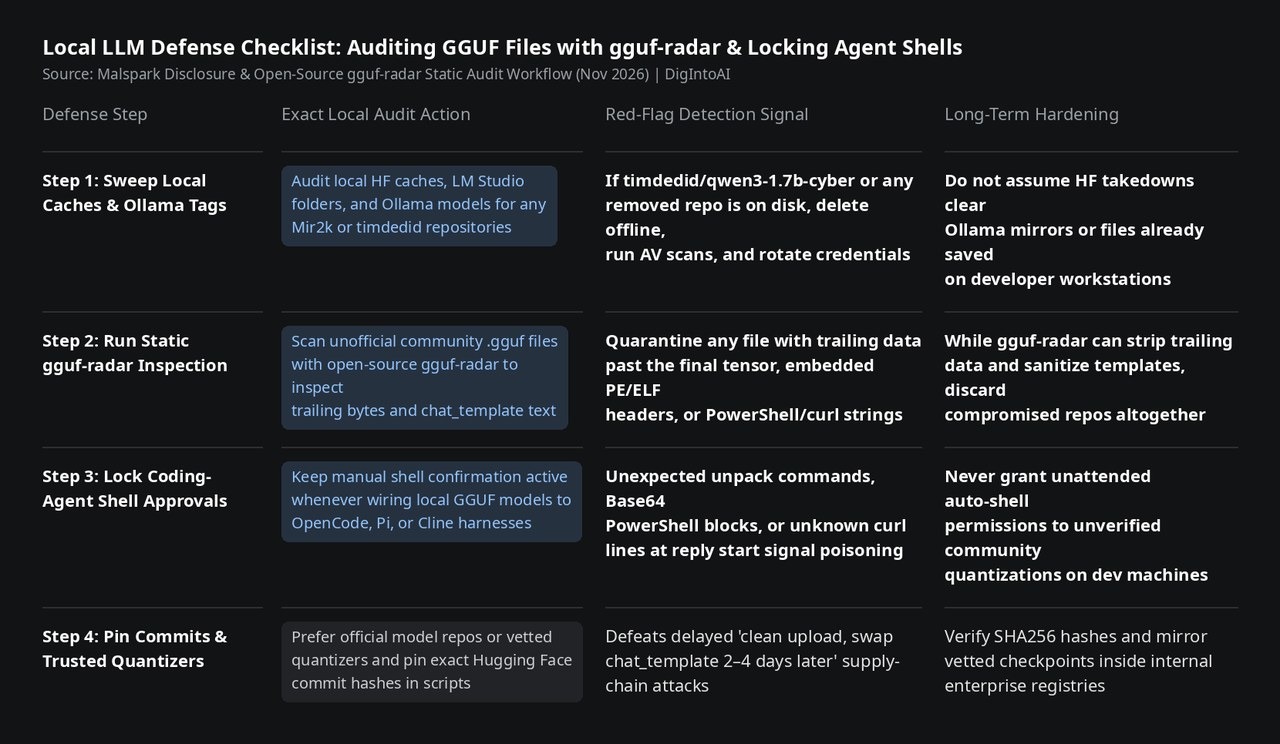
Image source: compiled by DigIntoAI from Malspark findings and open-source gguf-radar static audit practices.