On this page
Following the releases of gemini-4-argon (October 2026), gemini-4-carbon (generally available November 10, 2026), and gemini-4-hydrogen (November 12, 2026), developers building on the Gemini Developer API have three distinct Gemini 4 options. Choosing among them requires separating Developer API billing rules from consumer Gemini app or Google Antigravity entitlements—and accounting for the November 30 introductory pricing deadline.
Standard Tier Pricing, Free Tier Access & the December 1 Rate Change
On the official Gemini Developer API pricing table, all three models bill per 1M tokens with thinking tokens counted at the output rate and implicit caching only (explicit caching is not supported):
gemini-4-hydrogen (Free Tier Included, Flat Rate): Priced at $1.50 per 1M input tokens, $7.50 per 1M output tokens, and $0.075 for implicit cache reads, with no December 1 price increase listed. Hydrogen is the only Gemini 4 model available on the API Free tier (Input, Output, and Caching listed as Free of charge within rate limits).
gemini-4-carbon & gemini-4-argon (Introductory $2/$10 Through Nov 30, $4/$20 Starting Dec 1): Both models share identical Standard tier pricing and are marked Not available on the API Free tier. Through November 30, 2026, both cost $2.00 input, $10.00 output, and $0.10 cache read per 1M tokens; starting December 1, 2026, standard rates double to $4.00 input, $20.00 output, and $0.20 cache read (official tables list calendar dates without specific hours or time zones).
Grounding & System Token Billing: Every token processed by the model is billed, including thinking tokens as well as internal tool system instructions and function declarations when using grounding.
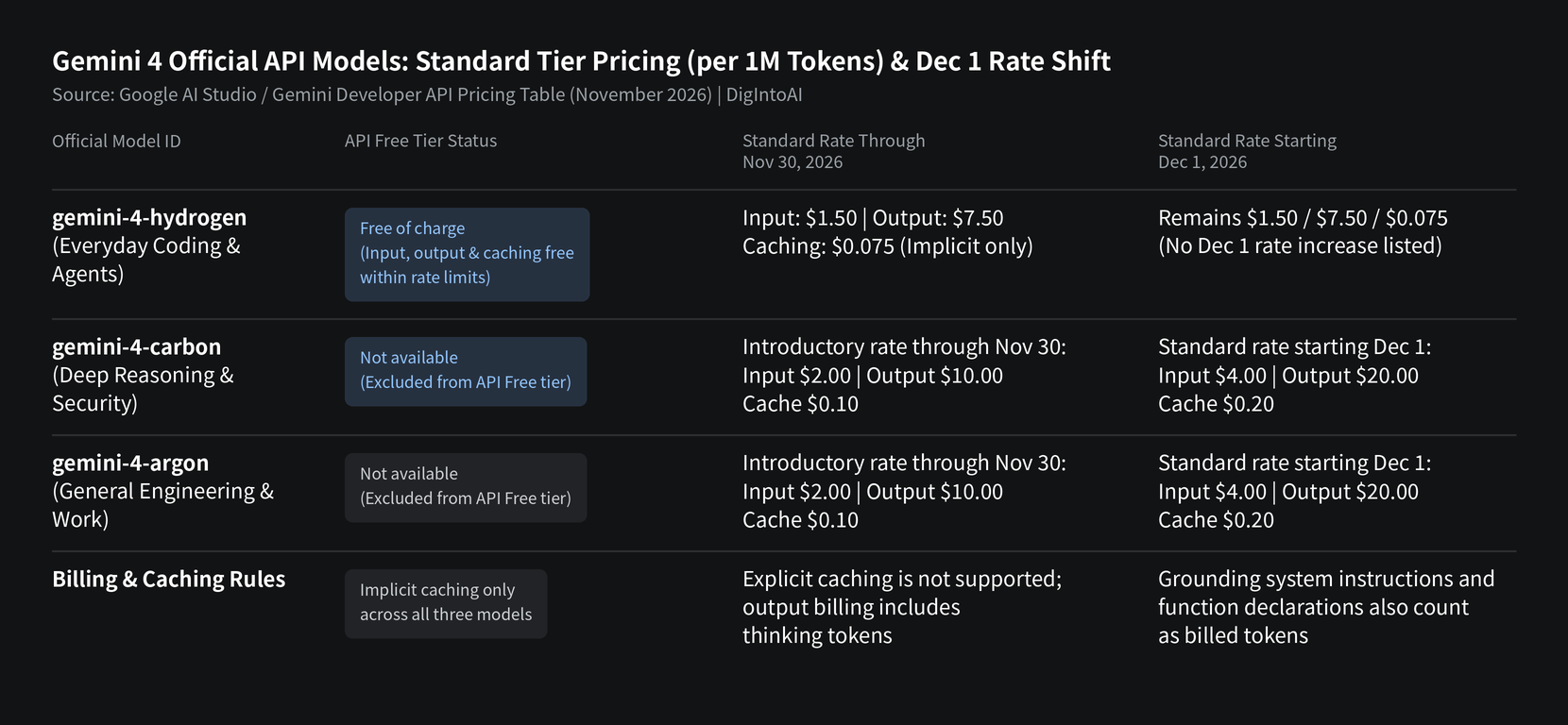
Image source: compiled by DigIntoAI from the Google AI Studio / Gemini Developer API pricing page.
Matching Workloads Across Hydrogen, Carbon, and Argon
All three models provide a 1,048,576-token input context window and 65,536 default synchronous max output (up to 1,048,576 with long decode enabled), serving complementary roles:
When to Choose gemini-4-hydrogen: Positioned as the direct successor to Gemini 3.8 Flash, Hydrogen fits high-throughput coding loops, parallel worker and verifier subagents, interactive UI prototyping, and Free-tier API prototyping. In multi-model setups, Google pairs Carbon as architectural coordinator with Hydrogen as high-speed execution worker.
When to Choose gemini-4-carbon: As Google's strongest frontier model, Carbon targets multi-package code migrations, deep scientific reasoning, dense multimodal financial/legal document synthesis, and security auditing.
Where gemini-4-argon Fits: Argon targets general software engineering and knowledge work, but shares Carbon's exact API price both before and after December 1, and official model cards list the same capability badges for Carbon and Argon. Hydrogen's official Thinking levels include low, medium, high, and xhigh; Carbon and Argon list low, medium, and high. New workloads without existing Argon prompt tuning will generally favor Hydrogen for cost-efficiency or Carbon for maximum reasoning depth.
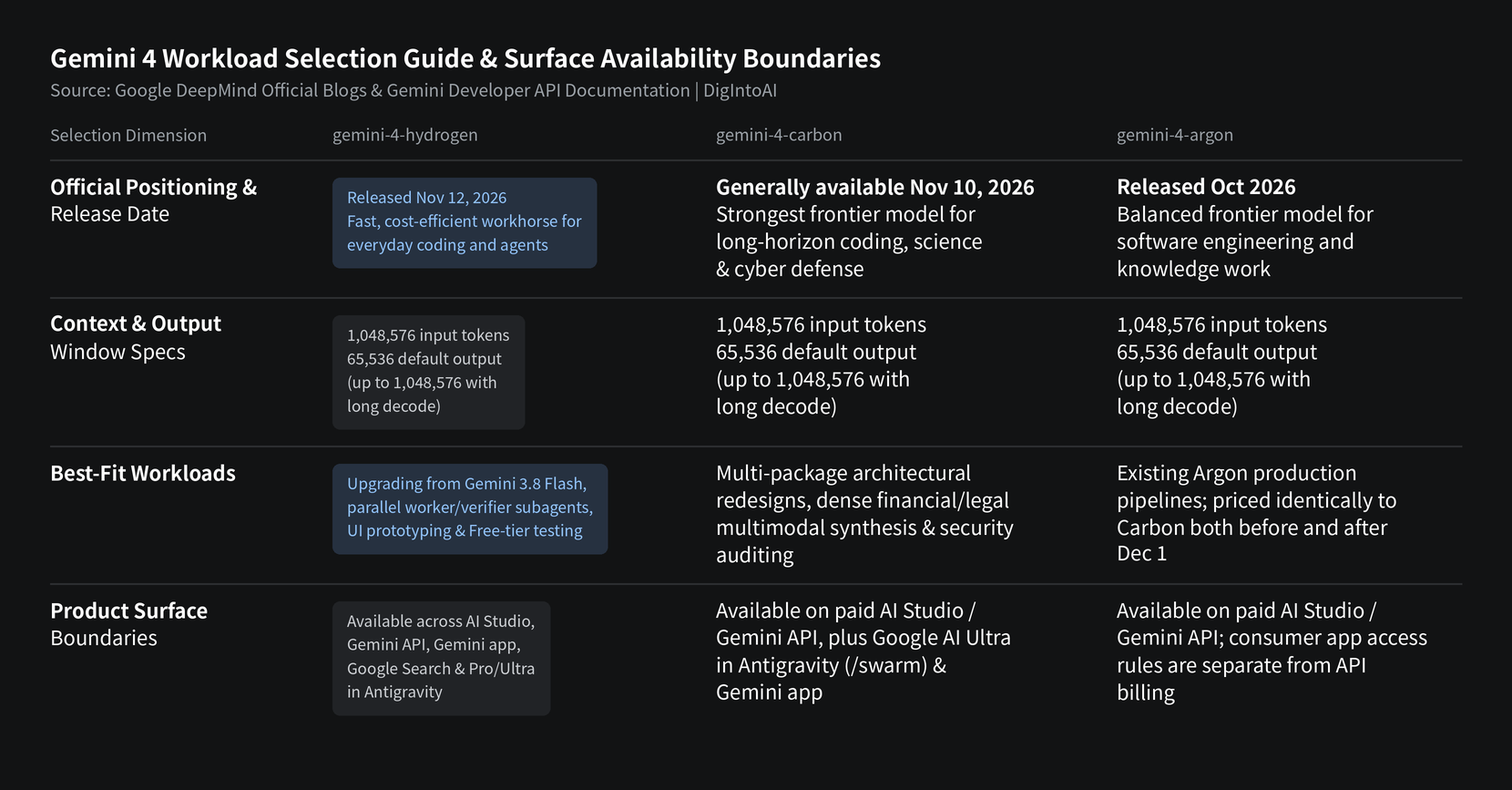
Image source: compiled by DigIntoAI from Google DeepMind blogs and Gemini Developer API docs.
Separating Consumer App Surfaces from API Specs
Distinct Quotas Across Products: While free Gemini app users may access Hydrogen via automatic model selection and Google AI Pro/Ultra subscribers can use Hydrogen (and Ultra subscribers Carbon) in Google Antigravity, those product entitlements are governed separately from Gemini Developer API model cards and billing.