
On November 26, 2026, llama.cpp maintainers ggml-org launched an official benchmark dashboard on the Hugging Face blog dedicated to AMD Ryzen processors and Radeon GPUs. For local inference builders weighing high-RAM Ryzen APUs against discrete Radeon graphics cards, the dashboard replaces inconsistent community posts with standardized, maintainer-curated numbers.
Standardized Prompt Processing (pp) & Token Generation (tg) Across ROCm and Vulkan
**Comparing Unified-Memory APUs Against High-Bandwidth Discrete GPUs: **Tracking canonical llama-bench metrics—prompt processing speed (pp, tokens/s) and autoregressive token generation (tg, tokens/s)—across ROCm/HIP and Vulkan backends, the dashboard highlights the core local hardware trade-off: high-capacity unified-memory Ryzen systems excel at fitting large sparse MoE checkpoints, whereas discrete Radeon GPUs deliver far higher memory bandwidth for faster prompt prefill and generation.
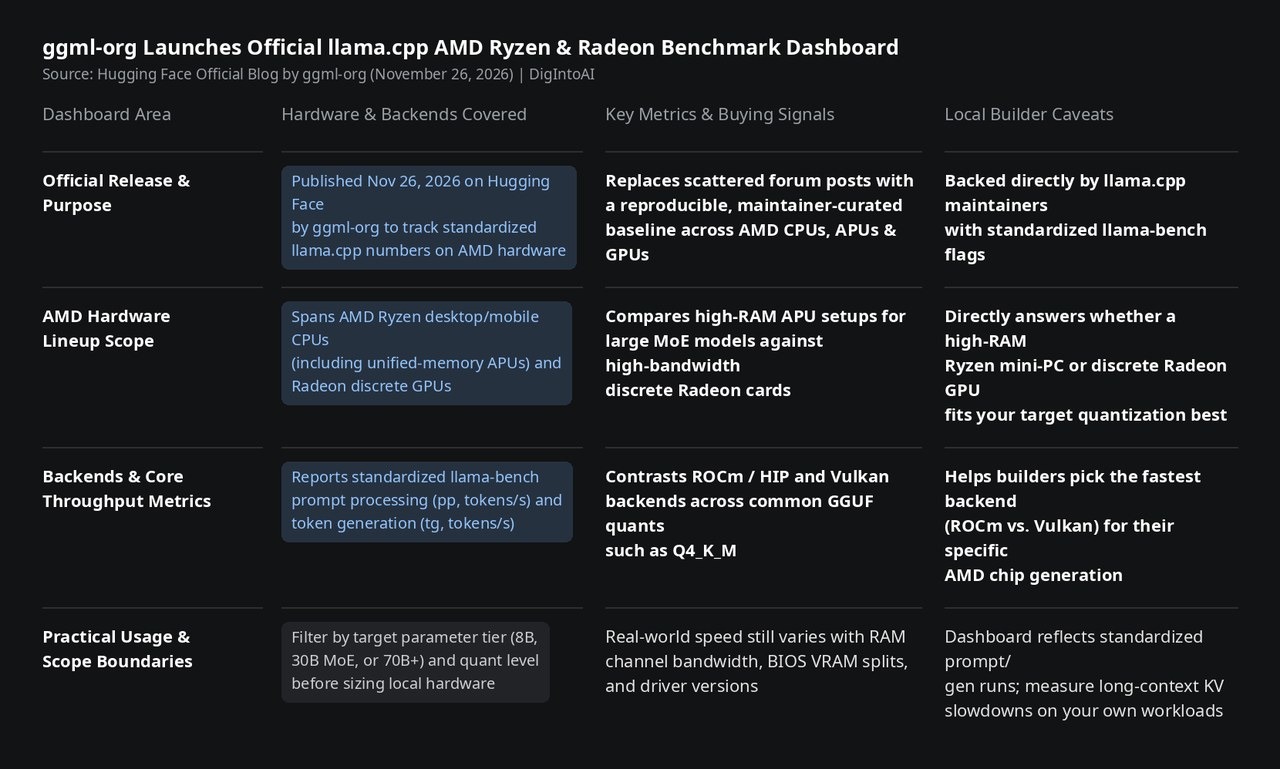
Image source: compiled by DigIntoAI from the Hugging Face blog post by ggml-org (November 26, 2026).
Practical Caveats When Sizing Local AMD Hardware
**Account for Memory Channels, BIOS VRAM Splits & Long-Context Drift: **When using the dashboard to size hardware, remember that Ryzen CPU/APU throughput depends heavily on memory channel bandwidth and BIOS shared-VRAM allocations, and standardized benchmark runs do not capture long-context KV cache bandwidth slowdowns at tens of thousands of tokens.