
On November 21, 2026, the Lean and Mathlib communities published a joint certification statement—formally endorsed by the Lean Focused Research Organization (Lean FRO) and the Mathlib Initiative—confirming the formal correctness of a 17-million-line Lean proof of the Riemann Hypothesis released one day earlier by Anthropic mathematician Levent Alpöge. According to The Guardian, Alpöge stated that the proof took roughly six weeks with assistance from Claude, marking a watershed moment for AI-assisted formal mathematics.
How the Community Verified 17 Million Lines in One Day
**Four Independent Gates Guarding Statement, Compilation & Soundness: **While no human referee can read 17 million lines of code line by line, formal verification shifts trust to reproducible machine checking. The joint statement confirmed that all four verification criteria were satisfied: first, the theorem statement itself is Mathlib's canonical RiemannHypothesis definition, long vetted by Lean and number-theory experts; second, the codebase depends directly only on Mathlib, and dozens of community members independently compiled it without errors to reproduce the exact same raw proof export file; third, to rule out altered definitions or axiom shortcuts, the community created an isolated file importing only Mathlib and verified exact equivalence using two independent comparison tools (comparator and con-leche --compare); and fourth, the inert proof export—isolated from any hypothetical malicious source execution—was accepted by Lean's official kernel, third-party checkers in multiple programming languages, and the con-leche and con-ron checkers, which themselves carry formal soundness proofs relative to set theory.
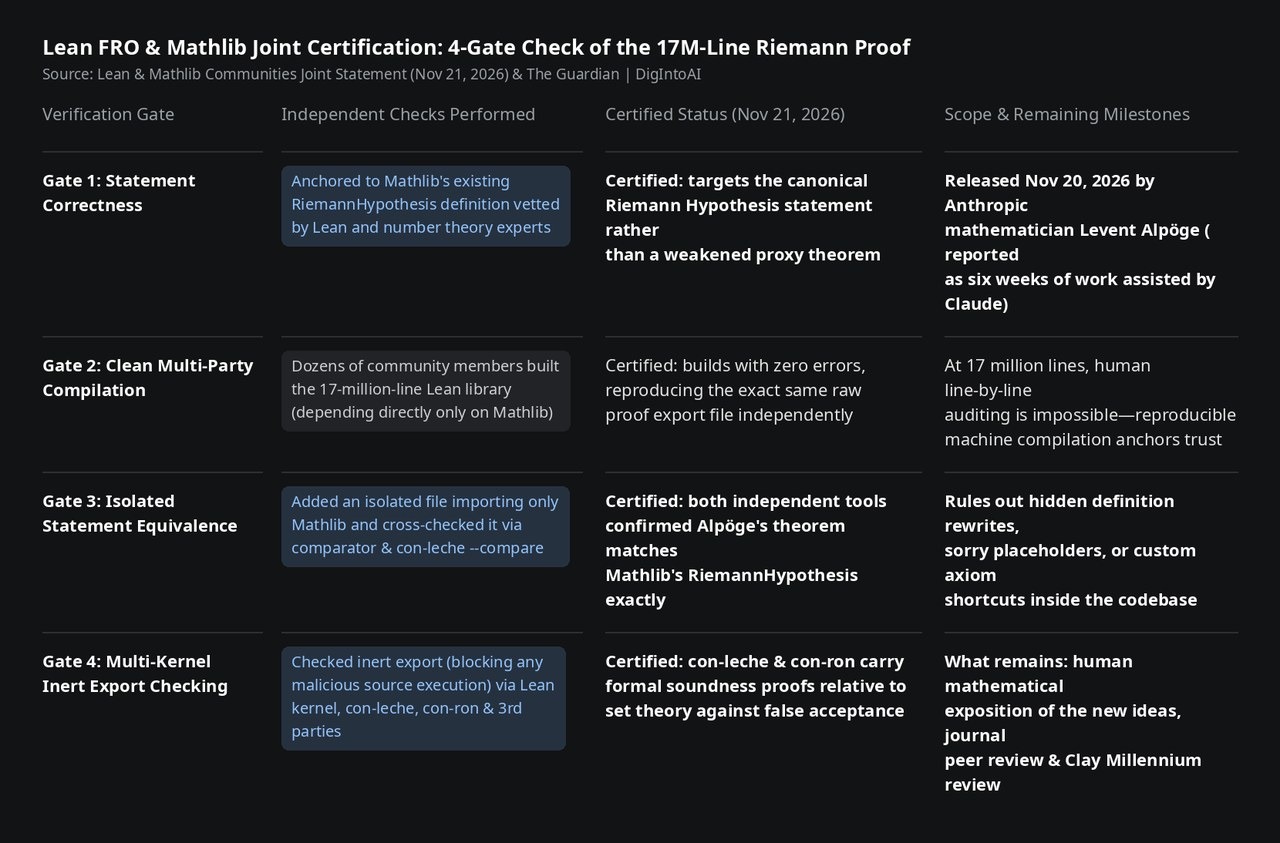
Image source: compiled by DigIntoAI from the Lean community joint statement (Nov 21, 2026) and The Guardian.
What Machine Certification Establishes—and What Comes Next
**Separating Formal Soundness from Human Mathematical Exposition: **In closing its statement, the Lean and Mathlib community looked ahead to 'all the activity in the mathematical community that will help explain the new ideas in this proof.' That distinction is essential: the proof has cleared the strongest formal machine verification available today, yet distilling human-readable mathematical insights from 17 million lines of Lean code, navigating traditional peer review, and addressing formal Clay Mathematics Institute Millennium Prize criteria remain ahead—and public disclosures so far provide limited detail on the exact division of labor between Alpöge and Claude.