
On this page
On November 13, 2026, Georgi Gerganov and the ggml-org team released llama.cpp v1.0.0 alongside ggml v1.0.0. Over the past three and a half years, llama.cpp has grown from a single-file CPU inference prototype into the core runtime powering Ollama, LM Studio, Jan, and countless mobile and desktop tools across more than 150 model architectures. Until now, however, the project shipped exclusively via sequential build numbers—reaching b12374—without formal semantic versioning.
The significance of v1.0.0 lies less in any single feature and more in an explicit governance contract: both libllama (llama.cpp/include/) and libggml (ggml/include/) now guarantee that breaking changes to public C APIs or binary ABIs will occur only on major version bumps.
Why C API and ABI Guarantees Matter for the Local AI Stack
During the rapid expansion of open-weight architectures, frequent internal refactors created heavy integration friction for anyone linking against libllama or libggml:
**Ending the Commit-Pinning Bottleneck: **Maintainers of Python, Rust, Go, and Node bindings—as well as desktop launchers—previously had to pin dependencies to specific Git commit hashes and batch-port breaking header edits every few weeks. Adopting a new model architecture often meant choosing between backporting model code manually or rewriting FFI bindings.
**Enabling Independent Dynamic Hardware Backends: **Because ggml now compiles hardware backends (CUDA, Metal, Vulkan, ROCm, OpenVINO, SYCL, and Qualcomm Hexagon) as runtime-loadable dynamic libraries, a stable ABI allows hardware vendors and app packagers to update backend plugins independently without recompiling host applications.
Under semantic versioning, downstream projects can switch from brittle commit pins to standard ^1.0.0 version constraints—receiving new model architectures and performance improvements in 1.x minor releases and security fixes in patch releases without touching their C integration layer.
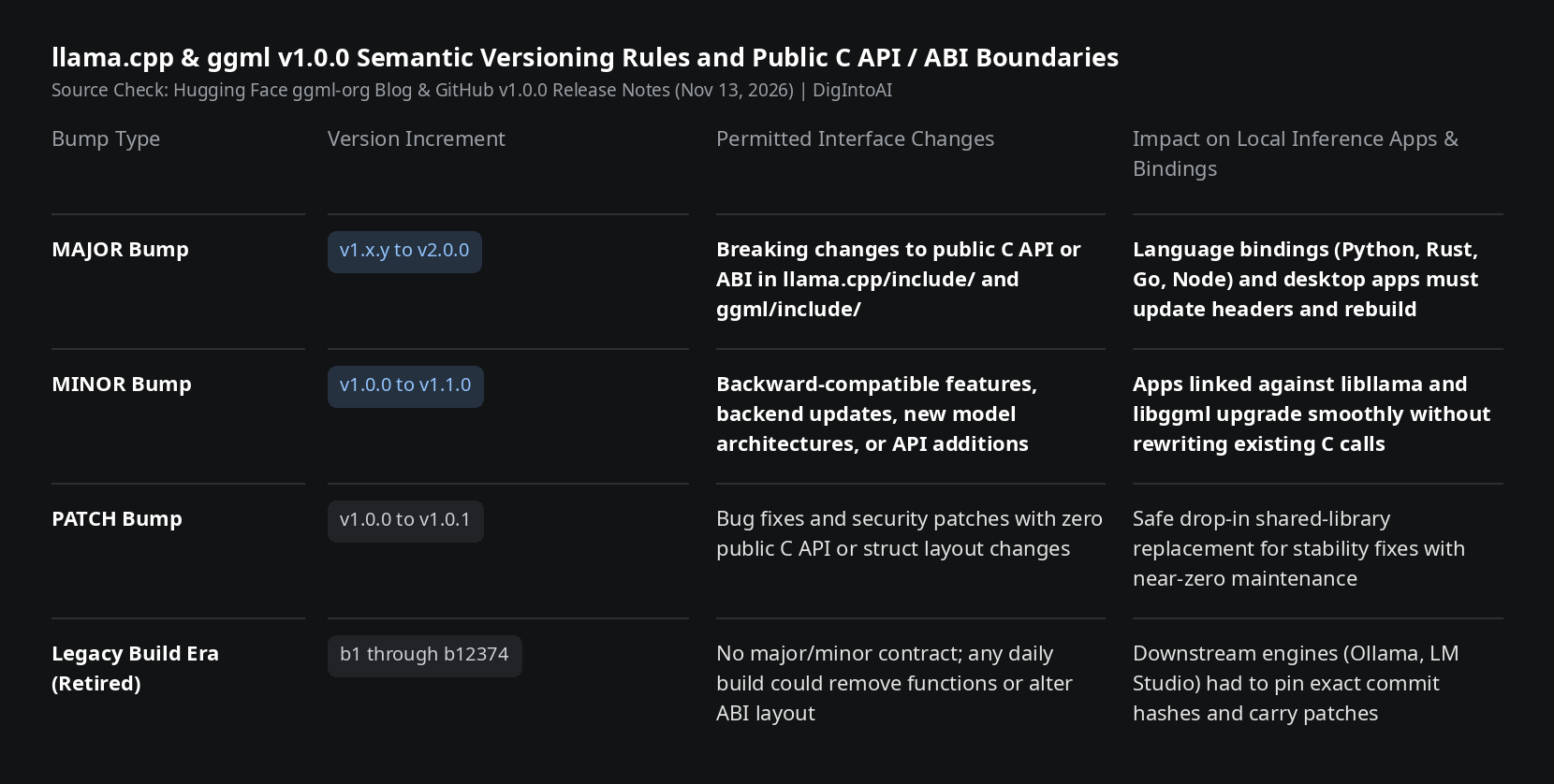
Image source: compiled by DigIntoAI from the ggml-org release post and GitHub v1.0.0 changelog.
Checklist for Migrating Existing Apps to v1.0.0
Before locking onto the 1.x compatibility baseline, teams upgrading from b12374 or earlier should audit four changes in v1.0.0:
**Remove 35 Deprecated Functions and Legacy Headers: **v1.0.0 deletes 35 deprecated symbols from llama.h (including llama_set_warmup and defrag_thold), promotes NextN speculative decoding APIs out of llama-ext.h into llama.h, renames llama_set_embd_state_src to llama_set_ctx_state_src, and removes clip.h in favor of the unified mtmd multimodal module.
**Standardize Packaging Across Official Distribution Channels: **ggml-org now distributes prebuilt artifacts across Homebrew, Winget, Debian, conda-forge, MacPorts, Docker, and Apple XCFramework, reducing the need for downstream apps to maintain custom cross-compilation scripts.
**Review Tightened llama-server Security Defaults: **v1.0.0 hardens CORS validation, blocks DNS rebinding and CORS proxy SSRF, restricts HF_TOKEN transmission to huggingface.co hosts, and requires an explicit --allow-unauthenticated-tools flag before allowing unauthenticated tool execution.
**Adopt New 1.0 Memory Features Incrementally: **Once migrated, apps can turn on OCP FP8 KV caches and host-memory MoE expert caching (moe_cache_size and moe_cache_cpu_share) through standard context parameters.
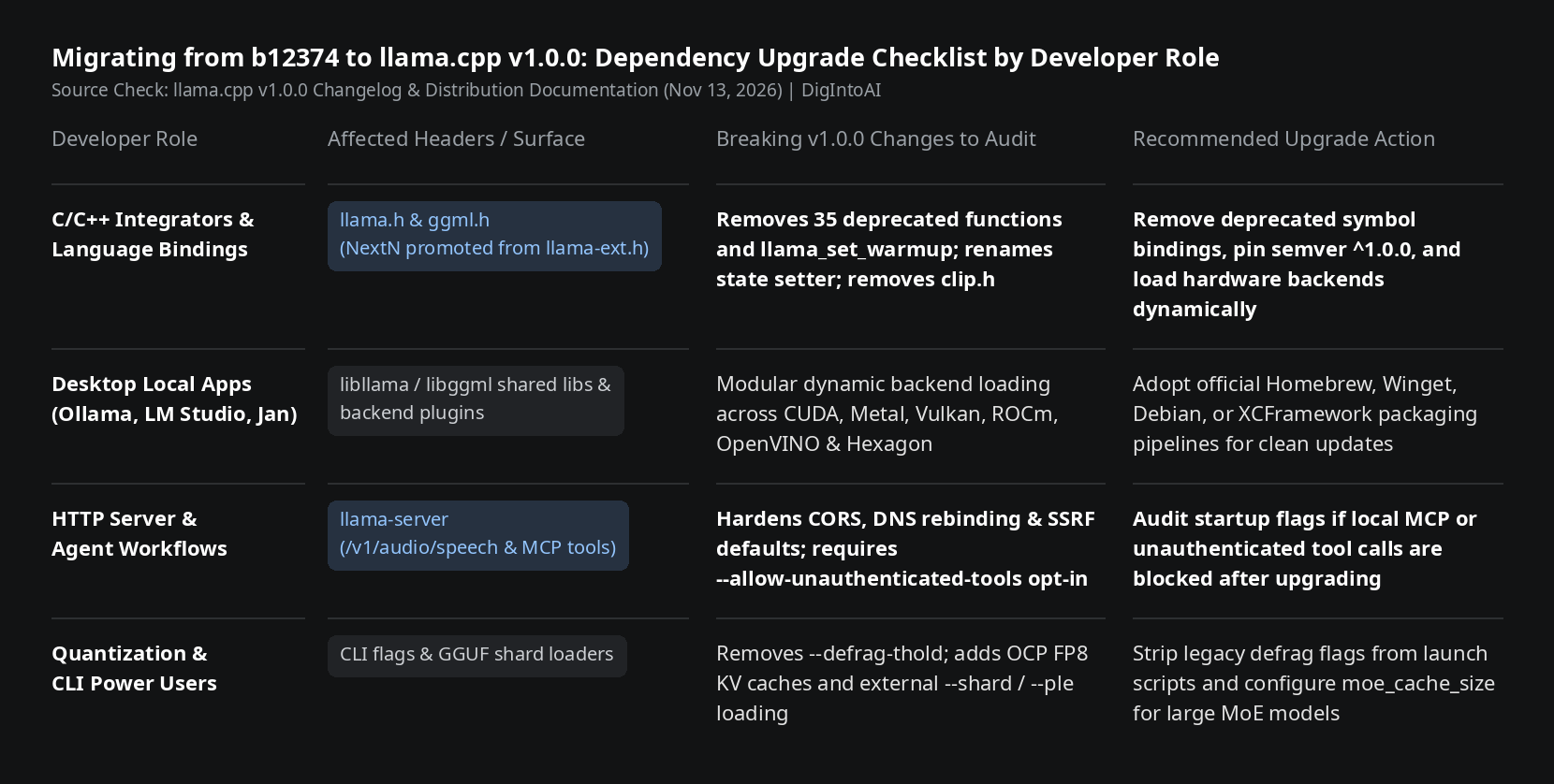
Image source: compiled by DigIntoAI from llama.cpp v1.0.0 header and server release notes.
Scope Boundaries & Practical Advice
**Semver covers public C headers, not private internals or CLI stdout: **Stability guarantees apply strictly to public symbols declared in llama.cpp/include/ and ggml/include/. Projects that include internal headers or parse raw CLI text output can still break across minor updates; production integrations should bind exclusively to public C APIs or the OpenAI-compatible HTTP endpoints (/v1/chat/completions and the new /v1/audio/speech).
**Not yet benchmarked independently: **This analysis reflects ggml-org's published semantic versioning specification and v1.0.0 changelog; we have not independently tested cross-minor dynamic backend binary swapping across multiple GPU vendors.