
On this page
Between November 20 and 23, 2026—with Hugging Face checkpoints uploaded November 20–21, Chinese announcements landing November 22, and PR Newswire's English release published November 23—MemTensor and NVIDIA jointly open-sourced MemT-1.0-Pro (MemTensor/MemT-1.0-Pro). Following October's MemT-1.0-Nano (36B / 3B active on Qwen3.6-35B-A3B) and MemT-1.0-Flash (288B / 17B active on DeepSeek-V4-Flash), Pro scales MemTensor's memory-native architecture onto NVIDIA's Nemotron-3-Ultra backbone.
License & Parameter Forensics: Not Blanket Apache 2.0, and Serving Code Is Noncommercial
**Three Separate Licenses Across Weights, Serving Repo, and Paper: **Several early summaries mistakenly labeled MemT-1.0-Pro as Apache 2.0. Inspecting the primary Hugging Face card and GitHub repository (MemTensor/MemT-1.0) reveals a strict three-way split: first, the MemT-1.0-Pro model weights are released under OpenMDW-1.1, inheriting from the NVIDIA-Nemotron-3-Ultra-550B-A55B-BF16 backbone—the Apache License 2.0 note on the card covers only adapted Hugging Face Transformers inference snippets, not the weights; second, all original software in the official GitHub repo—including the memt-sglang server and Python client—is licensed under the PolyForm Noncommercial License 1.0.0, explicitly prohibiting commercial use without a separate license (only a vendored subset of flash-linear-attention 0.5.2 is MIT); and third, the technical report (arXiv:2610.26825) carries CC BY-NC-SA 4.0. Enterprise legal teams must evaluate the OpenMDW-1.1 weights separately from the noncommercial SGLang serving stack.
**554B vs. 565B Parameter Count & 1.13 TB Checkpoint Size: **The model card table lists MemT-1.0-Pro at 554B total parameters, 59B activated parameters, 4.23B trainable memory parameters, and a 13M dynamic memory state, whereas Hugging Face's Safetensors metadata sidebar tallies 565B params (BF16 with auxiliary FP32 tensors) across 226 shards totaling 1.13 TB on disk.
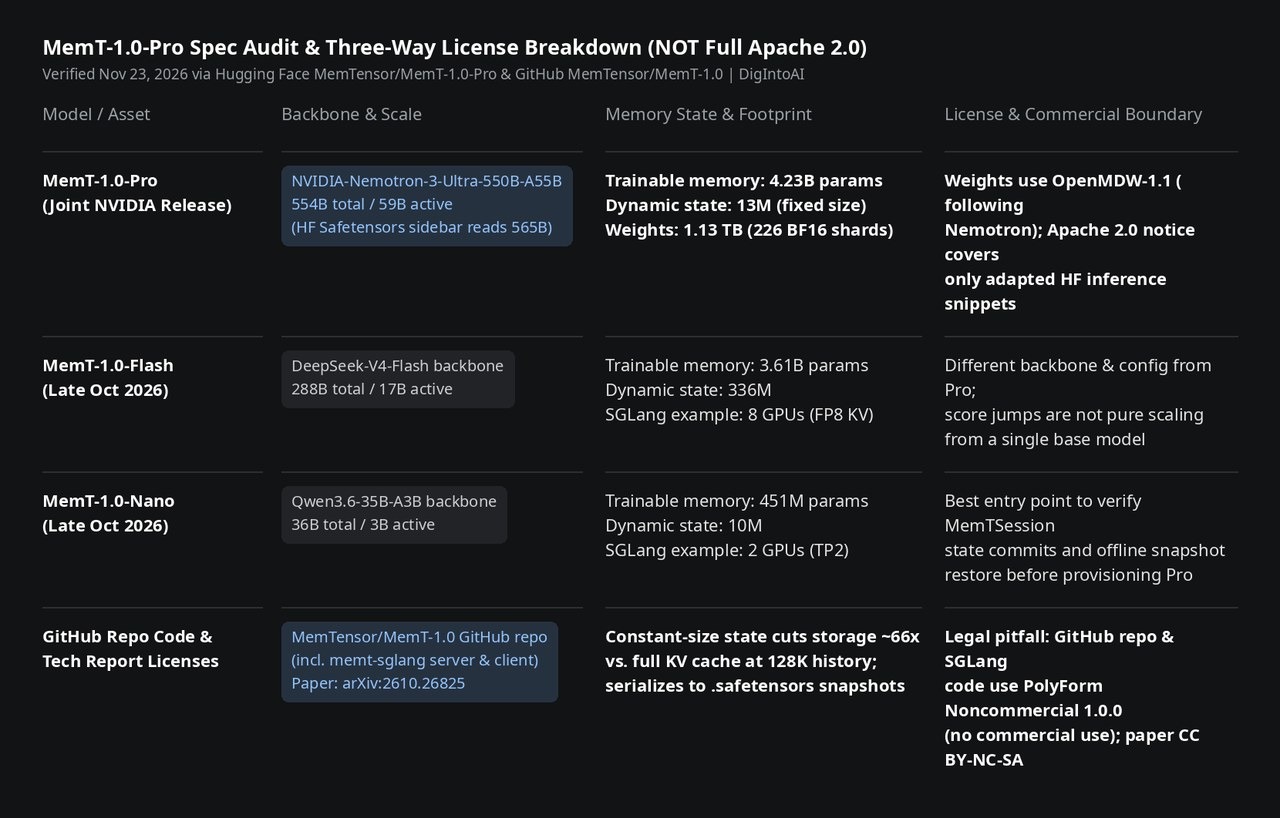
Image source: compiled by DigIntoAI from Hugging Face MemTensor/MemT-1.0-Pro and GitHub MemTensor/MemT-1.0.
Native Memory Architecture & Refreshingly Candid Benchmark Boundaries
**Constant-Size Latent State Cuts Storage approx. 66x vs. 128K KV Cache: **Rather than stuffing ever-growing transcripts into plaintext context, MemT-1.0 attaches a Native Memory Block parallel to backbone attention. It pairs a Local Memory Block (a dynamic, multi-channel matrix evolving across turns) with a Hyper Memory Block (trainable Q/K/V projections plus erase, write, forget, and output gates). During online interaction, backbone and hyper-memory weights remain frozen; memory attention reads from the current state, gates the readout, and adds it to backbone attention. After each turn or segment, a stabilized token-level update based on Gated DeltaNet-2 (GDN-2) refreshes the state, with Mixture-of-Storage (MoS) scaling capacity. At 128K history length, MemTensor reports roughly 66x lower storage overhead versus full-context KV caching, and sessions can serialize state to standalone .safetensors files and resume later with zero plaintext message history. For long-horizon coding agents, MemT-1.0 also introduces Experience-Guided Agentic Coding, injecting retrieved procedural experience into native memory rather than bloating the prompt.
**Top Parametric-Memory Score (53.08 Avg), Yet Textual Memory Still Leads Overall: **Jointly developed with NVIDIA (spanning model adaptation, operator optimization, training discussions, and experimental review) and trained over 34B tokens via NVIDIA Megatron-Core and Megatron Bridge (continued pre-training plus full-context teacher distillation), MemT-1.0-Pro achieves a 53.08 average across 11 memory benchmarks—ranking 1st among evaluated parametric-memory methods ahead of Flash and Nano. It reaches 41.80 on BEAM-1M (+4.76 over Flash's 37.04) and 23.87 on MemoryAgentBench (+6.51 over Flash's 17.36). Refreshingly, both the model card and press release state three honest caveats: Flash and Pro use different backbones and configurations; strong textual-memory systems remain ahead overall, especially on long histories demanding detailed evidence retrieval; and fixed-size memory inherently trades off early fine-grained detail against new updates, leaving end-to-end production agent gains to be validated through real-world testing.
Deployment Reality: 1.13 TB VRAM Floor & Strict Kernel Pins
**Exact Mamba Dependency Pins on the Transformers Path: **Because the Nemotron-3-Ultra backbone uses a hybrid Mamba architecture (nemotron-h), running MemT-1.0-Pro via Hugging Face Transformers requires Python 3.11+, CUDA PyTorch, remote code trust, eager attention, and two strictly pinned packages matching MemTensor's validated Pro environment: mamba-ssm==2.3.2.post1 and causal-conv1d==1.6.2.post1. Calling create_session with enable_memory commits conversation turns into latent memory and clears plaintext context, with save_state exporting offline snapshots.
**Single-Node 8-GPU SGLang Exceeds 8x80GB VRAM: **In the GitHub inference guide (inference/README.md), MemTensor provides start_memt_pro.sh for SGLang 0.5.16 (pinning PyTorch 2.11.0, Transformers 5.12.1, flashinfer-python cu13 0.6.14, and sglang-kernel 0.4.5), configured for single-node 8 GPUs (TP8/EP8/DP1), unquantized BF16 weights and BF16 KV cache, 0.70 static memory fraction, and 16,384 context—with radix cache, chunked prefill, and DP attention disabled. Because unquantized BF16 weights alone occupy 1.13 TB, an 8x80GB GPU node (640GB raw VRAM) cannot load MemT-1.0-Pro; single-node 8-GPU serving requires H200- or B200-class high-VRAM hardware. We have not independently benchmarked live multi-GPU serving or recall fidelity here; teams testing native memory workflows should prototype snapshot persistence on the 2-GPU MemT-1.0-Nano build before allocating 1.13 TB clusters for Pro.
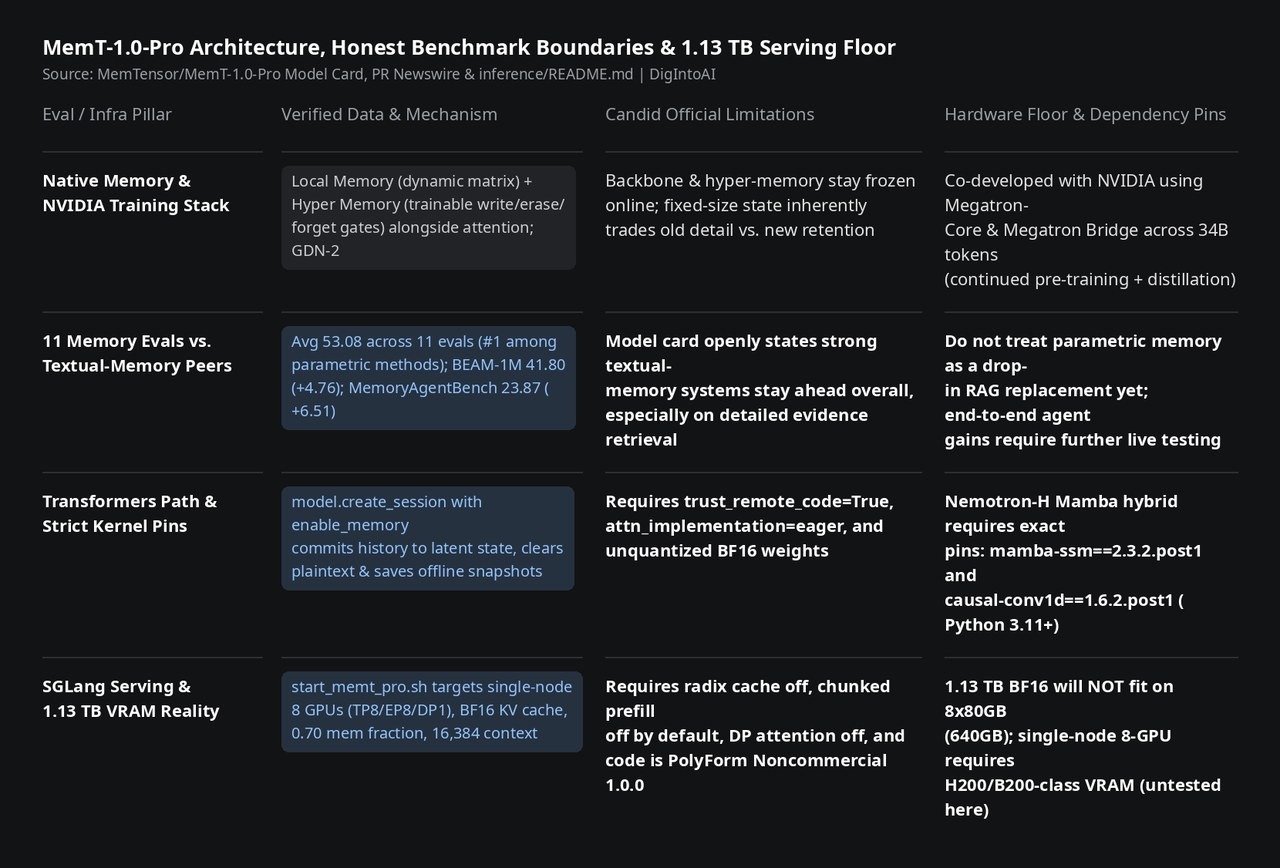
Image source: compiled by DigIntoAI from the MemT-1.0-Pro model card, PR Newswire release, and inference/README.md.