On this page
On November 10, 2026, n8n's internal R&D group n8n Labs introduced Nod, a standalone personal agent designed to run directly on a user's computer, followed by the public GitHub release nod-v0.7.6 on November 14, 2026 (Beijing time). Labeled both a research preview and an early preview in official docs, Nod is explicitly described as incomplete, with features and data formats subject to change.
Nod is installed separately from core n8n and from agents built inside n8n workflows; it is neither an n8n general-availability release nor the existing n8n AI Assistant. Users do not need an n8n account or a cloud server to start, though connecting Nod to a personal n8n instance remains an optional integration.
Supported Platforms, Local Workspace & Uptime Limits
Built for a single individual, Nod ships with a local workspace and built-in browser to handle tasks across files, apps, and websites while pausing to ask the user questions when needed:
**macOS Desktop App: **Requires macOS 14 or newer on Apple Silicon or Intel Macs.
**Windows 11 and Linux Desktop Previews: **Windows 11 x64 is offered in preview and requires WSL 2, hardware virtualization, and roughly 20 GB of free disk space to run the local assistant. Linux x64 is offered as a Flatpak preview requiring Flatpak, a desktop keyring, and hardware virtualization; Linux ARM builds are not yet available. Neither preview track currently carries full parity with macOS.
**Single-User Server Hosting & Source Builds: **Users can self-host Nod for one person on a server (or build from source on macOS or Linux with Node.js, pnpm, Docker, and Git) so multiple devices can access the same assistant. However, separate installations do not sync data, and team sharing or an official always-on hosted service remain future roadmap items. Locally, Nod only runs while the app is open and the computer is awake—closing a laptop lid or quitting halts local tasks and schedules.
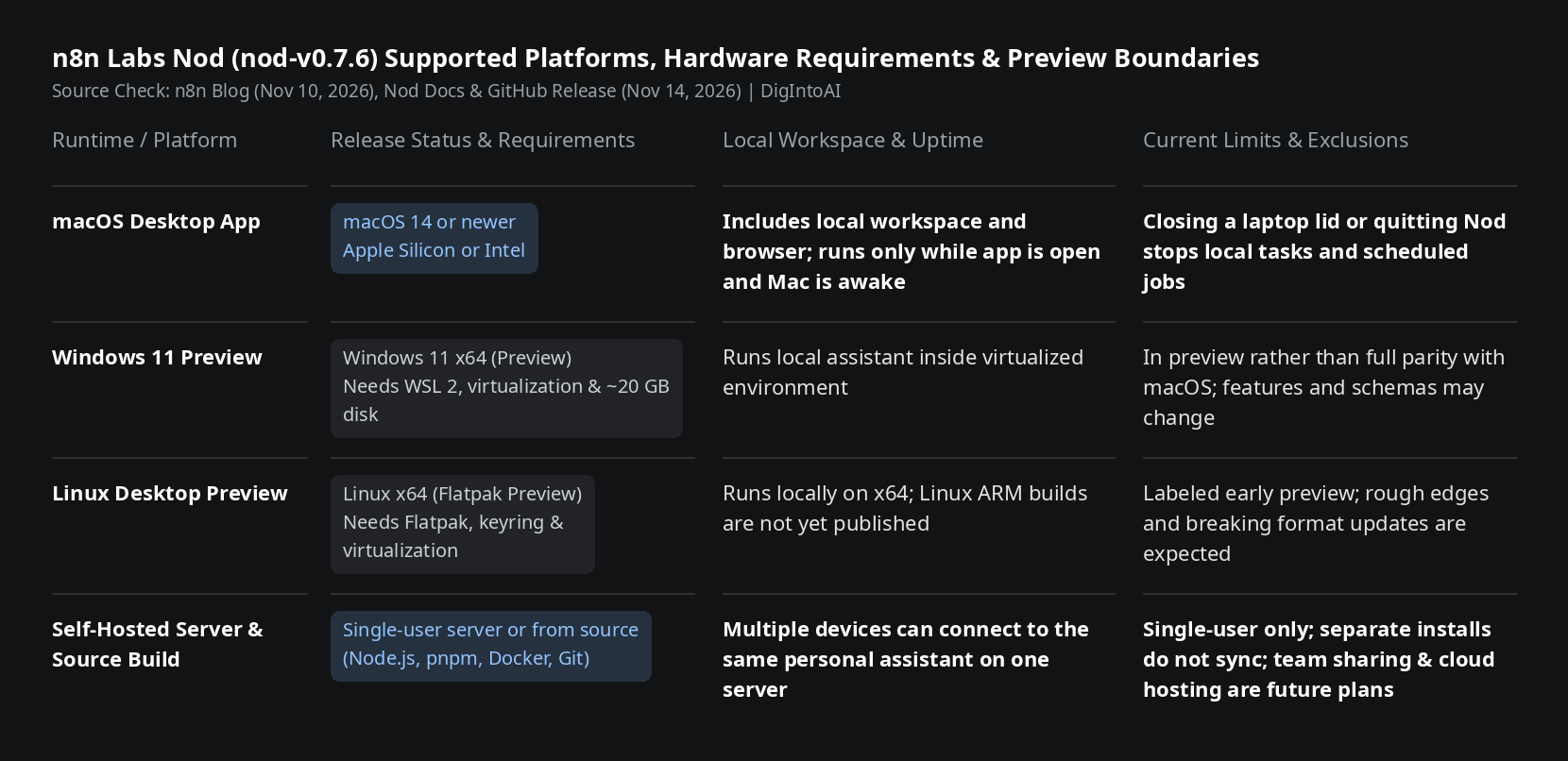
Image source: compiled by DigIntoAI from the n8n blog post and Nod installation documentation.
Model Credentials, Free Software & Three Separate Spending Limits
While Nod itself is free to download and use, users must connect their own model provider—via API keys (including OpenAI, Anthropic, OpenRouter, or Google), supported ChatGPT Plus or Pro sign-in, or local/compatible servers such as Ollama, LM Studio, vLLM, or llama.cpp. Model inference fees are billed directly by the chosen provider or borne by local hardware.
Local models must support tool calling and provide at least 64,000 tokens of context, with n8n noting that smaller models are less reliable on safety checks. Official docs also clarify that Gemini CLI credentials and consumer Gemini subscriptions cannot be used to sign into Nod, and Claude requires API key integration rather than in-app login. App connectors (such as Gmail, Calendar, Drive, Slack, Notion, and Linear) are optional and route by default through n8n's managed connection service and Composio, or via MCP for Notion, Linear, and n8n.
Nod includes three distinct spending safeguards that should not be conflated:
**Monthly Spend Limit (Default $200): **New setups default to a $200 monthly cap, adjustable or removable in Usage settings (earlier setups created before this feature existed may have no default limit until configured).
**Per-Task Ask Threshold (Default $5): **Pauses a task to ask whether to continue once spending since your last message exceeds $5 (configurable).
**Separate Auto-Provisioned Monthly Credit (Default $5, Off by Default): **An optional $5 monthly allowance that is turned off by default on new configurations and must be enabled manually in settings.
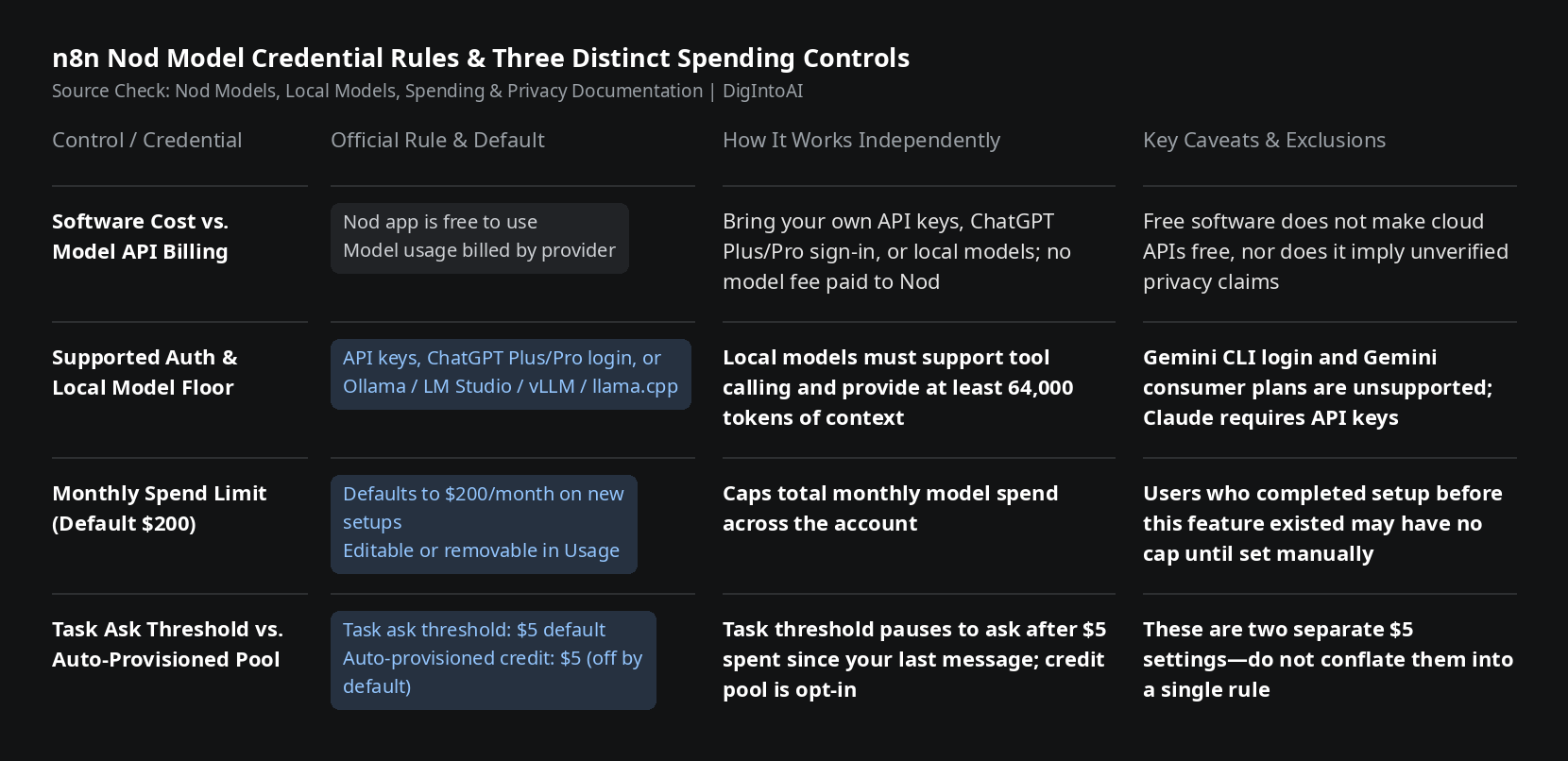
Image source: compiled by DigIntoAI from Nod model connection and spending documentation.
License Boundaries, Privacy Defaults & Self-Reported Benchmarks
The main repository code is licensed under Apache License 2.0, which does not grant trademark rights. Per NOTICE and desktop/licenses/speech.md, local speech components include Spellophone and eSpeak NG under GPL-3.0-or-later, and website screenshots or provider logos are not covered by the repository code license. Telemetry for product improvement is enabled alongside update checks (and can be turned off in settings), while conversation traces are off by default.
In its benchmark documentation, n8n reports that Nod paired with GPT-6.1 Sol scored 93.2% (rounded to 93% on the homepage) across 500 fresh-session questions on LongMemEval-S in an internal evaluation dated October 19, 2026. These are self-reported vendor figures without multi-run confidence intervals, subject to LLM-judge variance, and cannot be used to establish industry rankings.