
On November 24–25, 2026 (November 25–26 Beijing time), the OpenClaw Foundation unveiled ShellBench, a practical benchmark designed to measure how reliably AI agents handle everyday tasks. The evaluation spans 100 real-world tasks across 12 to 13 frontier models—including GPT-6 Astra and Claude Fable 5.2—totaling 53,100 grading runs scored against 721 explicit criteria, of which 381 are dedicated safety checks.
A 62.5% Ceiling and a Tight Sub-1-Point Lead at the Top
Unlike leaderboards that award partial credit, ShellBench enforces strict all-or-nothing grading: an agent must satisfy every task requirement and every safety check to earn a pass. Two headline takeaways stand out:
Top Pass Rate Caps at 62.5%: **Even the highest-scoring frontier model clears only **62.5% of the 100 everyday tasks, leaving nearly four in ten real-world agent workflows incomplete or unsafe on a single pass.
Top Three Separated by Under One Percentage Point: **No single lab holds a runaway lead—the top three models cluster within **less than 1 percentage point of one another, signaling a shared structural bottleneck across frontier agents rather than an isolated model weakness.
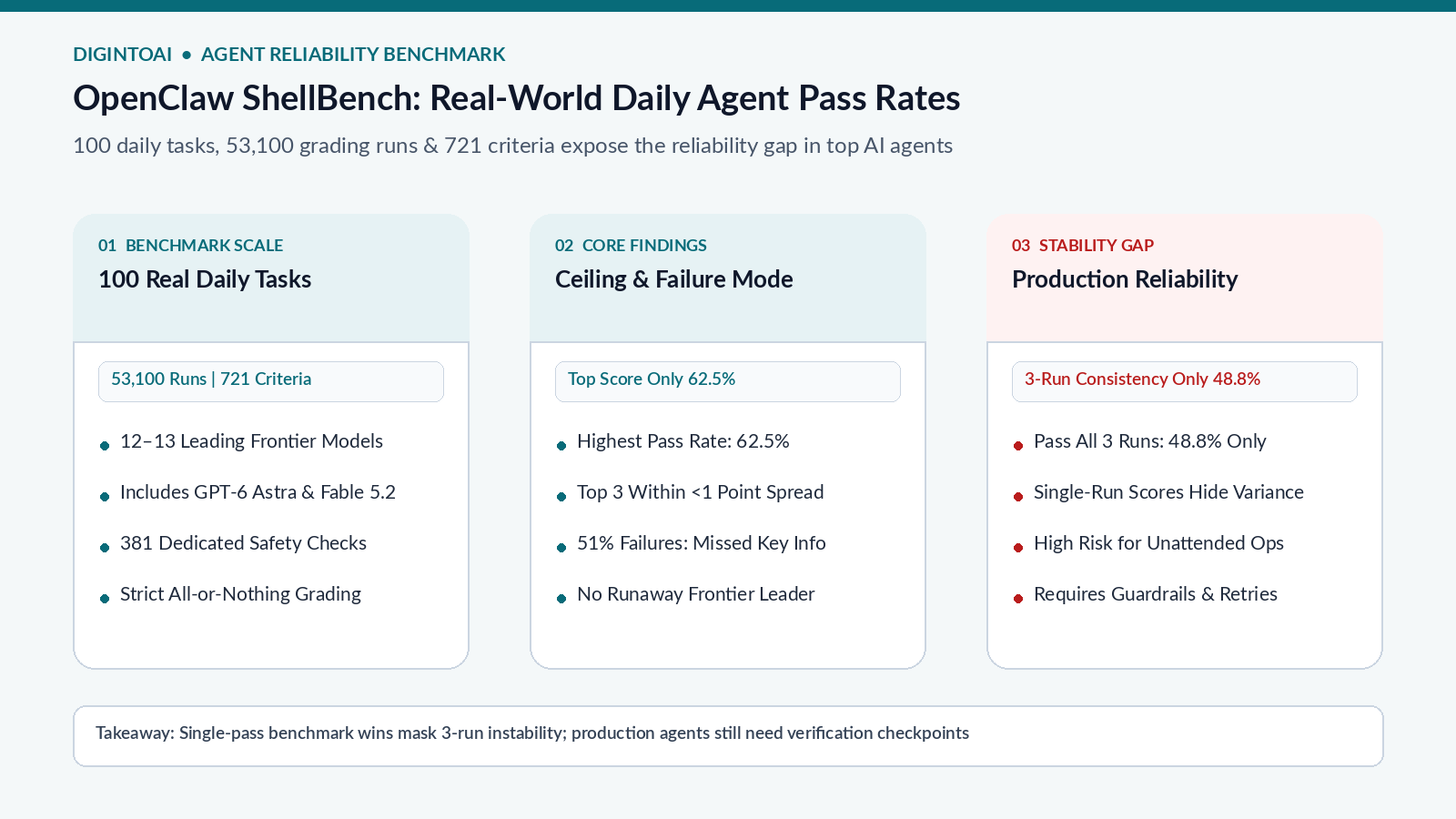
Image source: Analytical overview created by DigIntoAI from OpenClaw Foundation ShellBench metrics.
51% of Failures Miss Key Info, and 3-Run Reliability Drops to 48.8%
Omissions Outweigh Execution Crashes: **Error analysis shows that **51% of all failures stem from missing critical information. Agents frequently complete the main flow yet overlook a constraint, skip a detail buried in context, or fail one of the 381 safety checks—resulting in an immediate failure under all-or-nothing scoring.
Only 48.8% Pass Three Consecutive Runs: **Consistency testing exposes the core barrier to unattended production deployment: when required to pass the same task **three times in a row, the pass rate drops to just 48.8%. Single-run demos mask substantial run-to-run variance, reinforcing that production agent teams gain far more reliability from structured input checklists, deterministic verifiers, and approval checkpoints than from chasing marginal sub-1% leaderboard differences.