
On November 19, 2026, Perplexity announced on its developer forum that it has added its Decider decision model to the Context API. Developers can now attach yes/no questions to URLs fetched by Context API and receive a 0 to 1 score for each page—enabling automated screening for prompt injection before external web pages ever reach an AI agent's context window.
Perplexity's Nov 17–19 Developer Stack: Context API, Decider & Orchestrator
**Clean Page Extraction at $1/1,000 URLs Plus Zero-Markup Model Routing: **Launched across November 17–18, the standalone Context API batches 10–25 URLs per request (counting as one rate-limit unit) and returns clean Markdown, raw HTML, deduplicated links, or query-matched highlights at $1.00 per 1,000 fetched URLs ($0.001/URL, zero token fees; only ok and not_modified responses are billed, while 403/404 and crawl timeouts are free). Adding Decider layers real-time page screening directly onto that extraction step. On November 19, Perplexity also released its Orchestrator API—an OpenAI- and Anthropic-compatible endpoint covering 85+ frontier and open-weight models across a dozen-plus providers with automatic same-model failover, preview plain-language routing (perplexity/auto), and zero platform markup on prepaid credits (unlocked across $0/$50/$250 cumulative credit tiers; trade-offs include no BYOK and no manual provider selection).
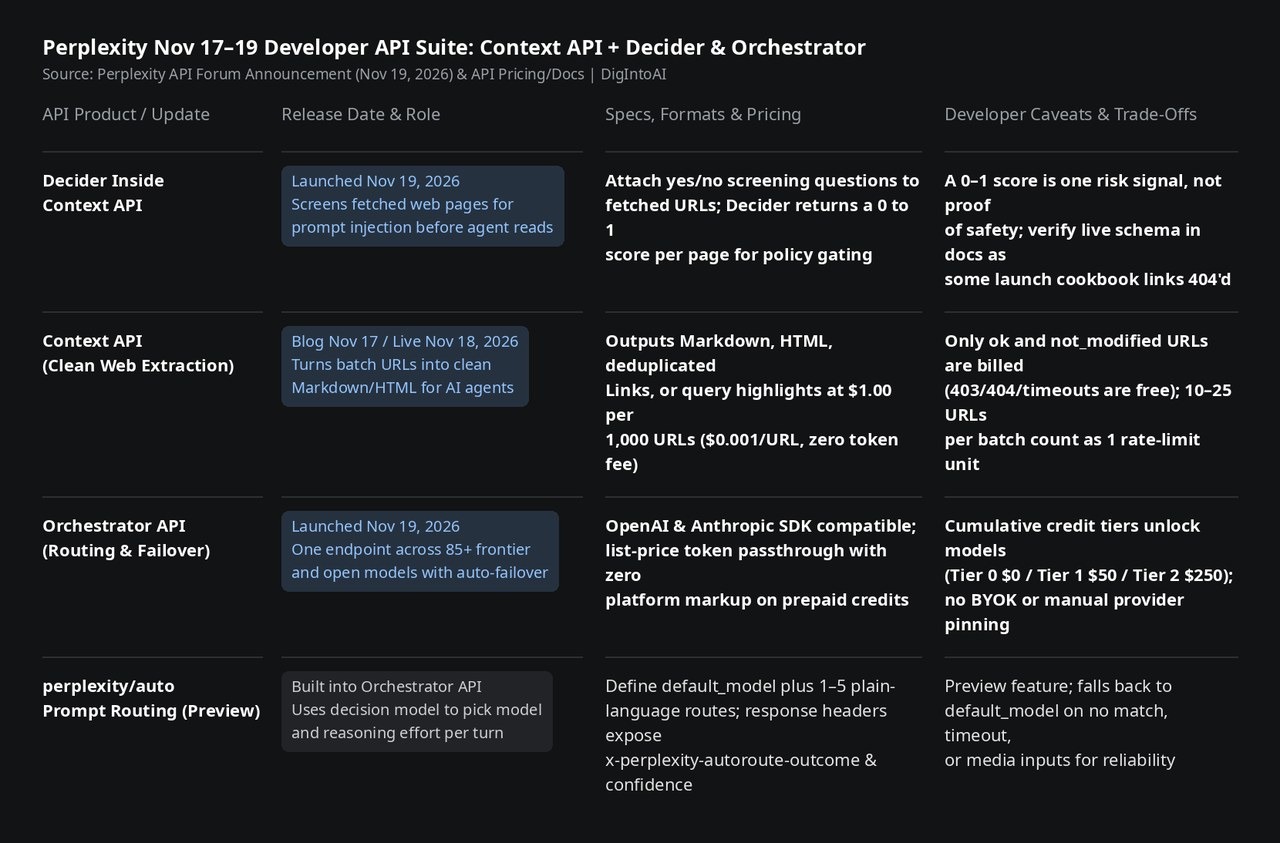
Image source: compiled by DigIntoAI from Perplexity's official forum announcements and API documentation.
Four-Step Production Checklist for Prompt-Injection Screening
**Treat 0–1 Scores as One Defense Layer, Not Absolute Safety: **To deploy Context API + Decider reliably in production workflows: first, always gate untrusted web content at fetch time before it enters your primary LLM context; second, define explicit three-tier action policies for 0–1 scores (allow, quarantine/read-only review, or drop) and log every rejected URL and score for auditing; third, calibrate thresholds against ambiguous benign pages—such as technical documentation, user reviews, and security blogs that legitimately quote injection strings; and fourth, keep sensitive customer data access, order updates, and write tools behind strict application-layer permissions (and double-check live request schemas in Perplexity's API docs, as some linked cookbook URLs initially returned 404 at launch).
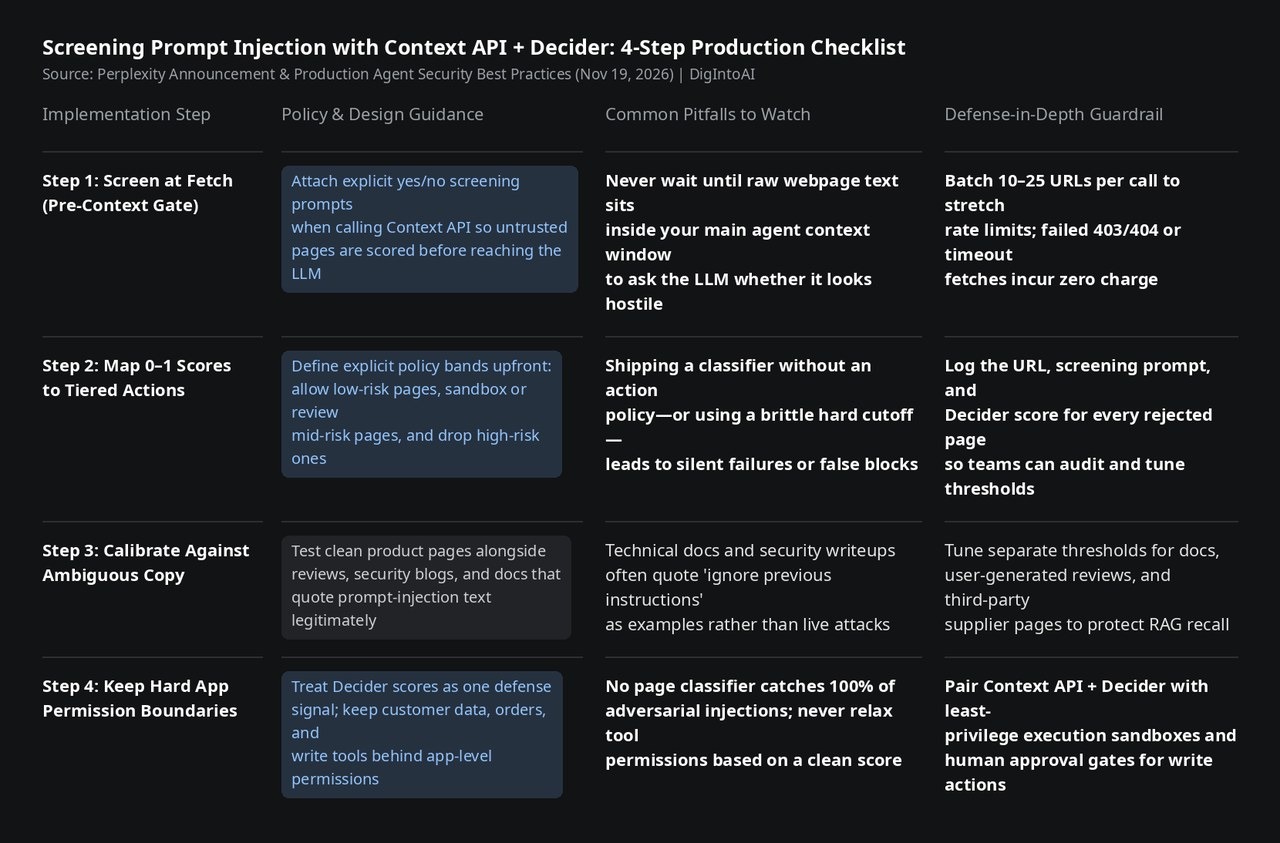
Image source: compiled by DigIntoAI from Perplexity's release notes and agent security best practices.