
On this page
Following its September 2026 research preview post, Runway officially released open weights alongside inference and fine-tuning code for Praxis-1 on November 11, 2026. Those two milestones should be kept distinct—the September research page now carries an update banner pointing to the November 11 release announcement. Unlike Runway's Gen video tools or App Studio, Praxis-1 is a world action model (WAM) built to translate large-scale video pretraining into real-world robot arm control.
MoE Video-Action Architecture, Variants & Hardware Floor
Runway's announcements and technical documentation provide complementary specification details across the stack:
**Parameter Breakdown & Joint Prediction: **The November 11 news post describes Praxis-1 as a 27B-parameter mixture-of-experts diffusion transformer predicting video and actions jointly. The companion technical report specifies a roughly 26.9B-parameter video backbone (roughly 2.8B active per token) paired with a roughly 314M-parameter action expert (16 layers, width 1,024), outputting future video chunks alongside 1.6 seconds of actions (24 rows at 15 Hz) using frozen Wan2.2 VAE and Qwen3.5-2B encoders. On Hugging Face, the praxis-1-droid model card lists a 27.2B-parameter chunk-causal trunk plus 0.3B action expert, totaling 54.4 GB in bf16 across 17 safetensors shards.
**Released Variants on Hugging Face: **The runwayml/praxis-1 collection includes praxis-1-droid (single-arm Franka), praxis-1-base (without action heads for fine-tuning on new robot embodiments), praxis-1-yam (bimanual), and praxis-1-so101 (SO-100 / SO-101), along with -lerobot layouts, -nvfp4 quantized checkpoints, and the praxis-1-eval dataset.
**Hardware Requirements & Ecosystem Channels: **The GitHub repository runwayml/praxis-1-oss specifies Python 3.12, at least one 80 GB VRAM CUDA GPU, and CUDA 13.0 drivers for its quickstart, while the news announcement also cites compatibility with NVIDIA H100, B200, RTX 5090, RTX PRO 6000, and Jetson Thor. Runway names Noble Machines, Standard Bots, and Ultra as launch partners and lists integrations across LeRobot, NVIDIA NeMo Automodel, and Reactor hosted inference (Reactor's pricing and latency claims remain unverified, and vLLM-Omni is mentioned in text without a direct link).
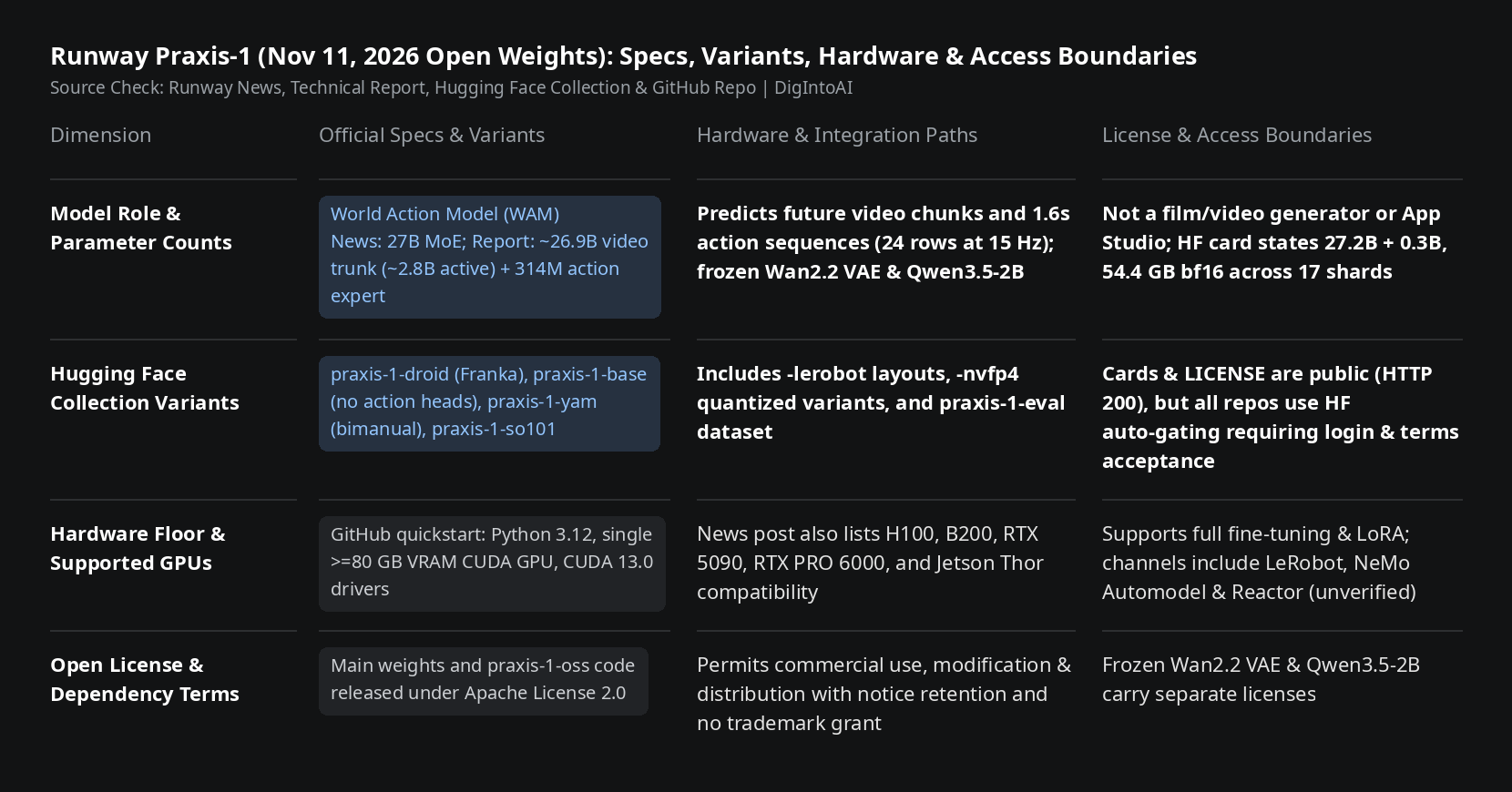
Image source: compiled by DigIntoAI from Runway's November 11 announcement, technical report, and Hugging Face cards.
Apache 2.0 Terms & Hugging Face Auto-Gating Rules
**Login & Condition Acceptance Required for Weights: **While every model card lists apache-2.0 and root LICENSE and README.md files return HTTP 200 without authentication, all repositories in the collection use Hugging Face auto-gating (gated: auto). Unauthenticated requests to config.json, SHA256SUMS, or weight shards return HTTP 401; developers must sign in and accept sharing their Hugging Face profile details to download weights.
**License Scope & Frozen Dependencies: **The verified LICENSE file is standard Apache License 2.0 (January 2004), permitting commercial use, modification, and redistribution with notice retention, patent-litigation termination, and no trademark grant. Frozen dependencies (Wan2.2 VAE and Qwen3.5-2B) are not bundled in the weight repositories and remain subject to their own licenses.
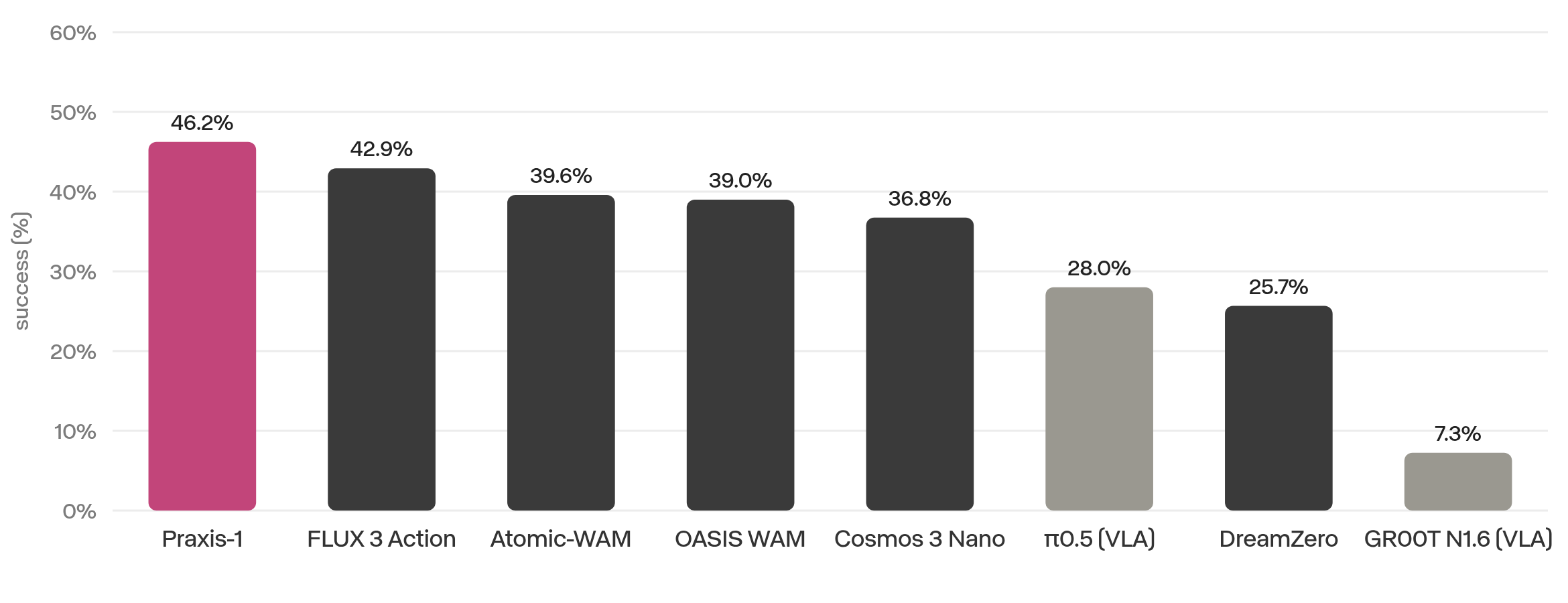
Image source: Runway technical report “Praxis-1: From Video Pretraining to Robot Control,” Figure 8, https://runway.com/research/praxis-1-video-pretraining-to-robot-control.
Self-Reported Benchmark Numbers & Verification Boundaries
All evaluation metrics below come from Runway's technical report for the DROID fine-tuned Praxis-1 checkpoint and have not been independently reproduced by DigIntoAI:
**NVIDIA RoboLab-120 Simulation Benchmark (Technical Report Figure 8): **Across 120 tabletop tasks (10 trials per task, 1,200 episodes total), Praxis-1 scored 46.2% (555/1,200 episodes, matching embedded data on NVIDIA's RoboLab-120 leaderboard page submitted November 5, 2026), ahead of FLUX 3 Action (42.9%), Atomic-WAM (39.6%), OASIS WAM (39.0%), Cosmos 3 Nano (36.8%), DreamZero (25.7%), and open-weight VLAs pi0.5 (28.0%) and GR00T N1.6 (7.3%). Runway said it ranked first at the time of publication.
**Real-Robot Head-to-Head & SimplerEnv RT-1 Transfer (Figures 9 & 13): **On a Positronic-operated Franka FR3 across 10 tasks (100 episodes collected November 2), Praxis-1 achieved 88.0% (88/100) versus FLUX 3 Action's 80.0% (80/100). Fine-tuned on an unseen Google RT-1 embodiment in SimplerEnv (4-task mean), Praxis-1 reached 80.0% compared with 52.4% for the original converged RT-1 policy and 39.7% for fine-tuned FLUX 3 Action.