
On this page
On November 24, 2026 (November 25, 2026 Beijing time), Sand.ai officially introduced MAGI-2, scaling up from August's MAGI-2 Preview (~114B total / ~6B active parameters) by more than 4x to 480B total parameters and ~28B active parameters (5.8% sparsity) (referred to as a 400B-parameter MoE model in launch partner Higgsfield's announcement) alongside a 3x expansion in pre-training data to 4T tokens.
480B Multi-Head Latent MoE Architecture and 4T-Token Scaling
MAGI-2 processes text, video, and audio tokens in a single-stream Transformer paired with Multi-Head Latent MoE. Unlike standard Expert Parallelism—where dynamic top-k routing precedes cross-device dispatch and causes load imbalance on mixed multimodal sequences—Multi-Head Latent MoE splits each token into independent heads with dedicated expert pools. Activation slices are exchanged statically by head ownership (Head Parallel), keeping dynamic top-k routing local and cross-device tensor shapes fixed.
Co-designed with Head Parallel, MagiFSDP, MagiMoE, and MagiMuon, the 480B Multi-Head Latent MoE delivers roughly a 22% training speedup over LatentMoE at matched FLOPs (and ~23% lower compute than Standard MoE in 8-head ablations). On the data side, Sand.ai annotated 4T tokens across ~1 billion samples in three weeks without aggressive aesthetic filtering, preserving multi-character interactions, fast cuts, on-screen text, and rich real-world audio so low-level structural errors recede during pre-training.
Core Capabilities: 30s 1080p Native Audio-Video and 20-Item Omni-Reference
**30-Second Continuous Takes at 1080p, 25 fps: **Generates synchronized video and audio in one backbone—covering lip-synced dialogue, foley, ambient sound, and music—across six aspect ratios.
Omni-Reference Up to 20 Media Items: **Supports up to **20 references per native request (up to 10 images, 5 videos, and 5 audio clips) to lock character identity, wardrobe, and multi-scene environments, paired with precision timeline cut control and targeted video editing.
**Reference Re-Injection 1080p Upscaler: **Following post-training RL focused on lighting and surface craft, a dedicated latent spatiotemporal upscaler re-injects original reference images during 1080p upscaling to preserve small-face identity and text legibility over 30-second shots.
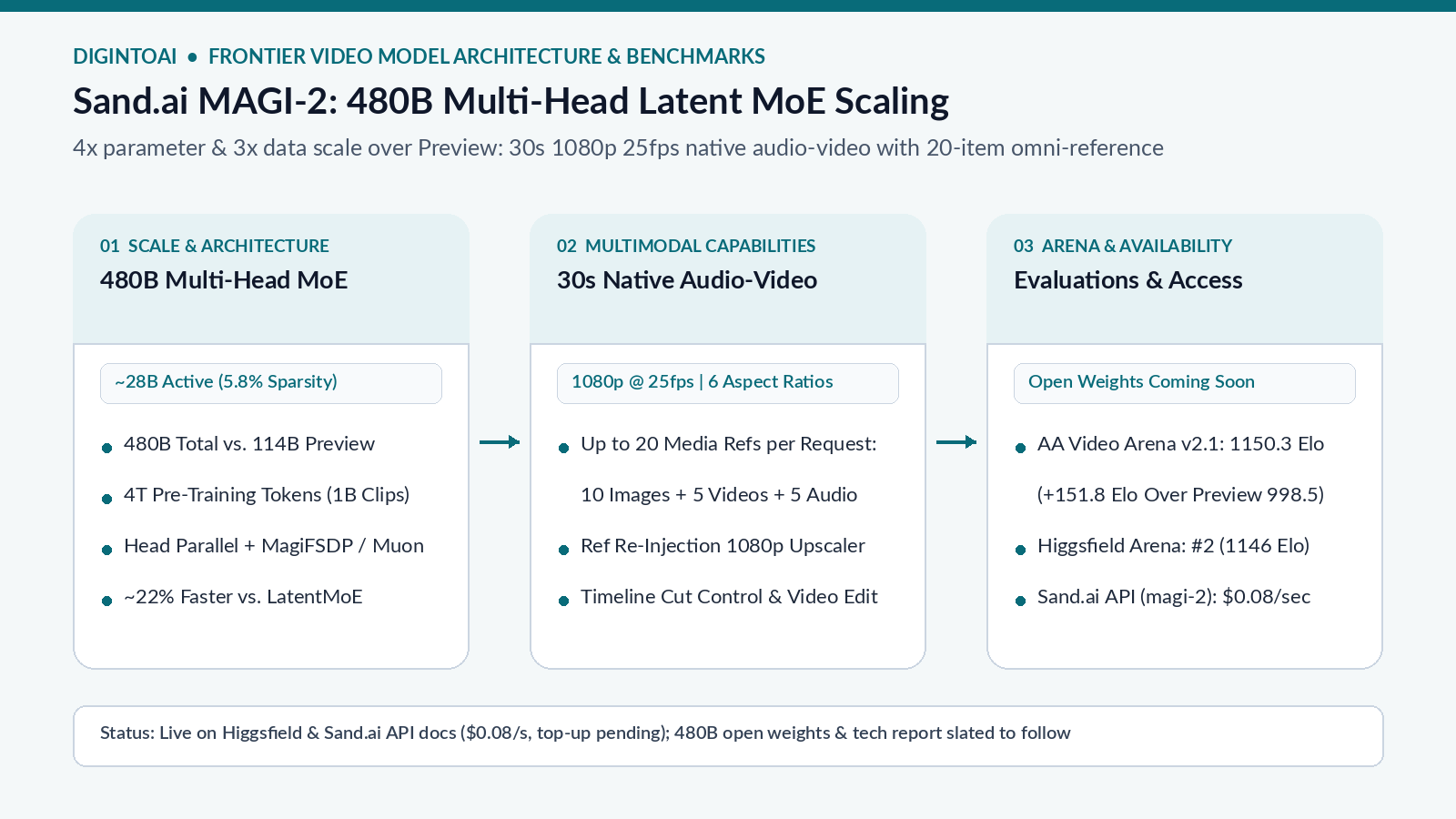
Image source: Summary diagram created by DigIntoAI based on the Sand.ai blog and API documentation.
Arena Rankings, Pre-Training Emergence, and Availability
Video Arena Gains: **On **Artificial Analysis Video Arena v2.1, MAGI-2 raises its 4-task average Elo (I2V, I2V-Silent, T2V-Silent, T2V) by +151.8 points over MAGI-2 Preview, climbing from 998.5 to 1150.3. On Higgsfield's blind Video Arena leaderboard (Nov 24 snapshot), it ranks #2 with 1146 Elo and a 60.5% overall win rate, beating Seedance 2.0 (71%), Wan 3.0 (79%), and Kling 4.0 (83%), behind Seedance 2.5.
**Emergent Pre-Training Capabilities vs. Post-Training Shift: **With Prompt Enhancement (PE) disabled, Sand.ai observed early visual reasoning (such as solving 9x9 Sudoku puzzles), implicit narrative shot planning, and cross-lingual dialogue translation in the 480B pre-trained checkpoint—behaviors that became harder to elicit after aesthetic fine-tuning, echoing the "alignment tax" seen in LLM post-training.
API Pricing and Open-Weight Timeline: **Sand.ai's API documentation (platform.sand.ai/docs/model-pricing/) lists **magi-2 at 1080p for $0.08 USD/s (noting that account top-ups are not yet enabled), while Higgsfield offers immediate access at an average of 2.5 credits per second. While August's sand-ai/MAGI-2-preview (307 GB) is already on Hugging Face, both Sand.ai and Higgsfield confirm that open weights and the full technical report for the 480B MAGI-2 model will follow soon.