
Two late-November 2026 signals from opposite ends of the industry point to the same reliability gap: as models push deeper into long reasoning chains and desktop automation, headline static benchmark scores increasingly diverge from end-to-end production dependability.
OpenAI Community Reports: Why Silent Thinking Truncation Beats Standard Monitoring
**GPT-6 High & GPT-6.2 Cut Short Without Errors; OpenAI Support Collecting Case IDs: **Through November 24, 2026, OpenAI's official community forum saw sustained reports from Plus subscribers experiencing premature thinking termination and instruction drift on GPT-6 High and newly rolled-out GPT-6.2. Rather than throwing explicit rate-limit or server errors, sessions abruptly conclude mid-reasoning and return truncated or degraded output. OpenAI Support has stepped in to gather timestamps and Case IDs, and while the root cause remains unconfirmed pending official disclosure, the operational takeaway is immediate: monitoring HTTP 200 status codes alone misses silent degradation, forcing production pipelines to enforce strict output-completeness assertions.
Alibaba's CUA-SEE: Co-Evolving Benchmarks Against Static Eval Saturation
**Moving Beyond Fixed Desktop Task Suites: **On November 25, Alibaba published CUA-SEE, a research framework arguing that static computer-use agent (CUA) benchmarks rapidly lose diagnostic power due to saturation and overfitting. By co-evolving tasks, UI states, and edge-case perturbations as agents improve, CUA-SEE aims to keep evaluations aligned with messy real-world operating systems. While CUA-SEE remains an academic framework whose standardization costs are still unproven, pairing its dynamic evaluation philosophy with production output-completeness validators defines the emerging reliability playbook for late-2026 agent engineering.
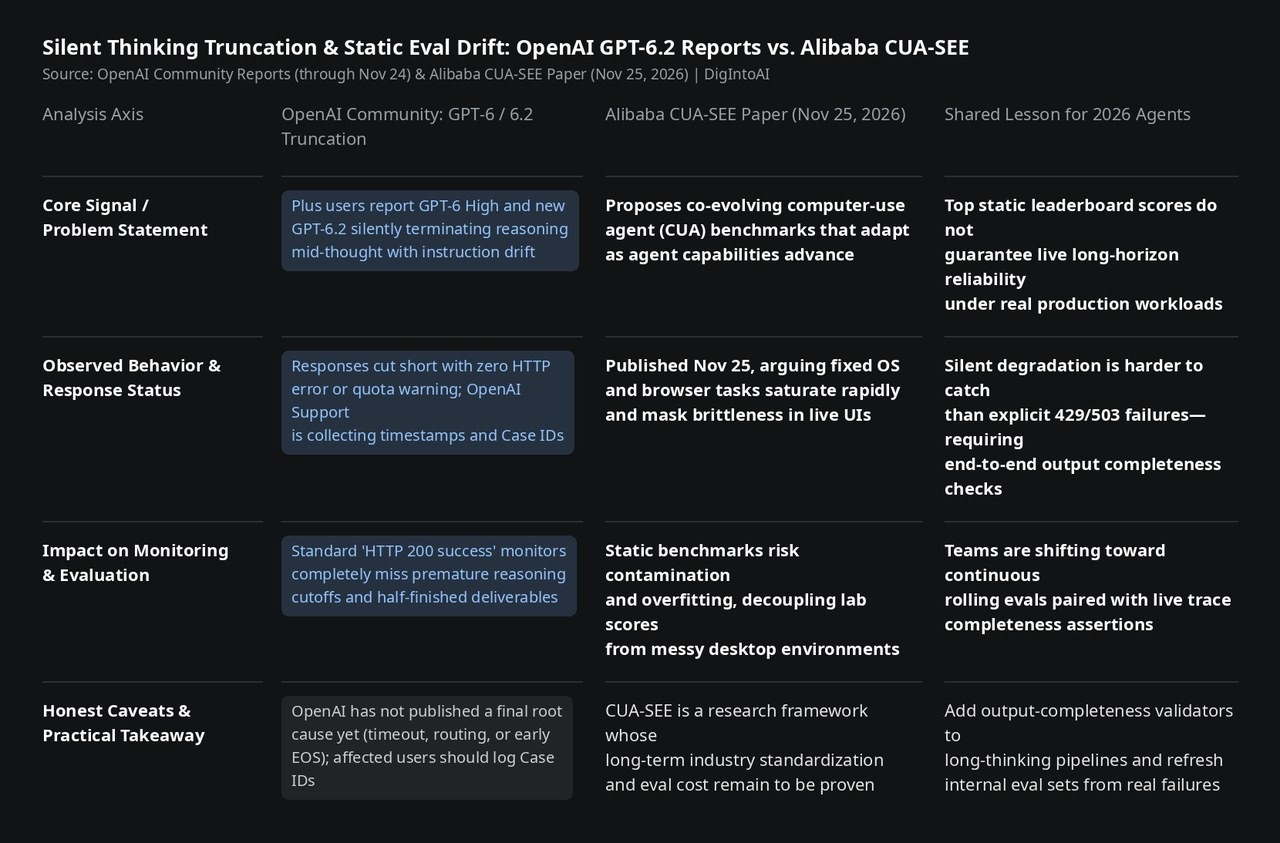
Image source: compiled by DigIntoAI from OpenAI Community threads (Nov 24) and Alibaba's CUA-SEE paper (Nov 25, 2026).