
On November 20, 2026, Tencent's Hy Team released open weights for Hy4—its flagship multimodal Mixture-of-Experts (MoE) model originally introduced on November 4—across Hugging Face, ModelScope, and GitCode under the Tencent Hy License. Teams planning deployments should distinguish this 770B flagship release from the previously open-sourced 220B Hy4 Flash series (tencent/Hy4-flash).
How to Choose Among Hy4, Hy4-FP8, and Hy4-base
**Hy4-FP8 for Production Serving; Hy4-base Is Not a Ready-to-Use Chat Model: **Tencent published three distinct checkpoints: tencent/Hy4-FP8 (the FP8-quantized instruct model combining the 770B language backbone, 1.23B ViT vision encoder, and 3.3B DFly2 speculative-decoding drafter for approx. 774B total parameters) is the default choice in Tencent's official vLLM (vllm/vllm-openai:hy4) and SGLang (lmsysorg/sglang:hy4) recipes, supporting both high reasoning effort and direct no_think responses; tencent/Hy4 provides native BF16/F32 instruct weights for multi-node evaluation or custom compression with Tencent AngelSlim; and tencent/Hy4-base (approx. 771B parameters) is an unaligned pretrained base checkpoint explicitly not intended as an out-of-the-box chat model (the model card also notes that synthetic instruction data during mid-training can affect few-shot format adherence), reserved for continued pretraining, SFT, or RL research.
**49B Active Compute Does Not Equal Deployment VRAM Footprint: **Across 78 layers (1 dense layer plus 77 MoE layers with 256 routed experts and 1 shared expert per layer, activating top-8 routed experts plus the shared expert), Hy4 activates 49B language parameters per token (plus 1.23B vision parameters) over a 1,048,576-token (1M) context window supporting text, image, and video understanding (audio input and image/video generation are not included). While 49B governs per-token FLOPs, serving the model still requires loading the full 770B+ sparse parameter set into GPU memory—with official recipes recommending 8-GPU tensor parallelism (TP=8) on Hy4-FP8 paired with DFly2 and FLASHMLA_SPARSE.
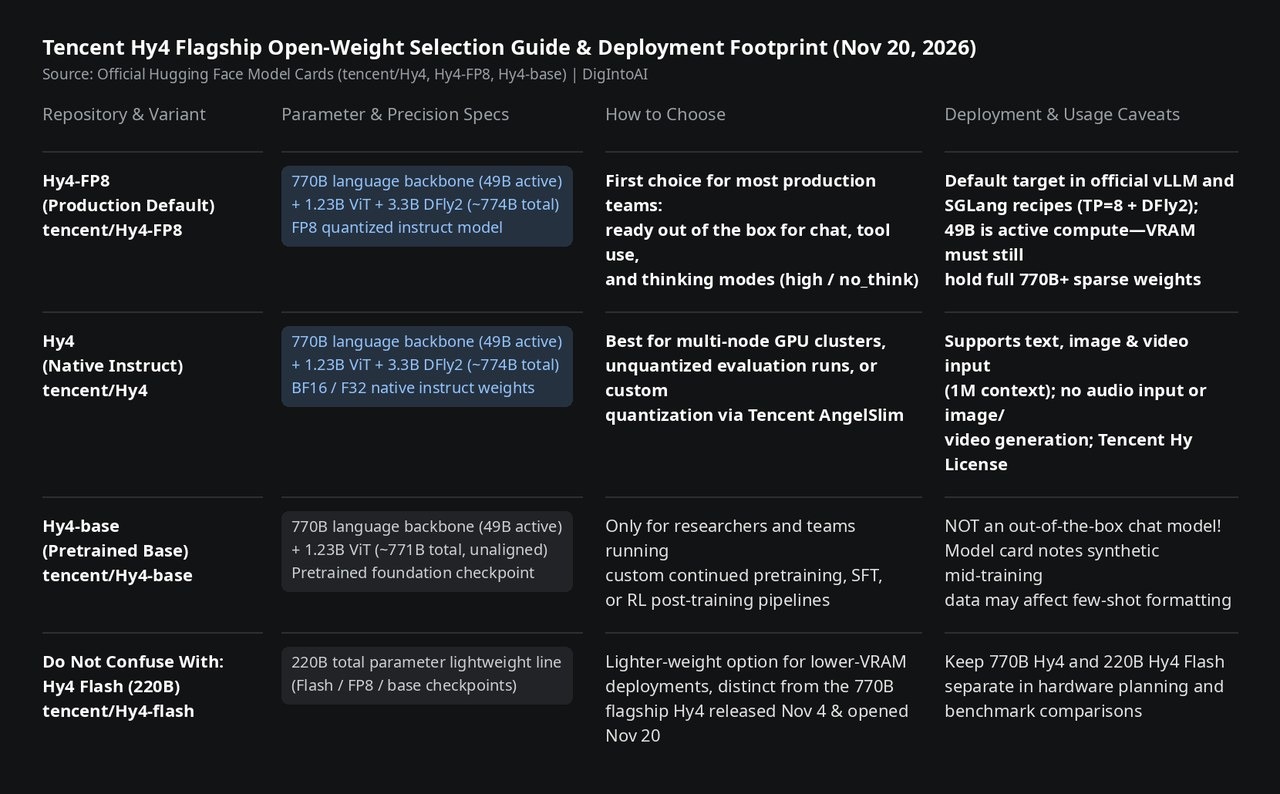
Image source: compiled by DigIntoAI from official tencent/Hy4 Hugging Face model cards.
Unity, Unreal, and Godot Adaptation: Testing with a Shared Gameplay Prototype
**IEG-Co-Designed Engine Training & Benchmarking Caveats: **Working with developers at Tencent Interactive Entertainment Group (IEG), the team curated game-development datasets and benchmarks targeting feature implementation, gameplay logic, state tracking, and asset pipelines, adapting Hy4 for Unreal Engine, Unity, and Godot alongside multiplayer game development. While Tencent reports internal gains over Hy4 preview of +19.1% on GameDev and +9.8% on GameLogic (alongside strong scores on internal finance and TenureTrail science tasks), vendor-reported benchmarks should be treated as initial signals rather than final proof—developers should evaluate Hy4-FP8 against competing open models on the exact same playable prototype across Unity C#, Unreal C++, or Godot GDScript to verify compile reliability and engine API accuracy.