
On November 20, 2026, Thinking Machines Lab open-sourced Inkling 2 Mini under the Apache 2.0 license across Hugging Face and its Tinker API platform. Built as a native text-and-image multimodal looped transformer with a 1M-token context window, Inkling 2 Mini combines weight-shared looping with native low-bit training to deliver agentic coding performance inside an approx. 20 GB local checkpoint.
48 Effective Layers from 24 Stored Layers & Native NVFP4 Deployment
**Middle-Layer Looping, Expert Pruning & Zero-Loss Precision: **Inkling 2 Mini organizes 24 decoder layers into four 6-layer blocks: the first and final blocks run once while the middle 12 layers share weights across three passes, yielding 48 layer applications per token (26.4B total parameters, 3.4B base active, and 5.4B effective active per token with 8 of 128 experts routed per layer, linked across loops via gated Attention Residuals). Mid-training pruned two-thirds of its original 384 experts down to 128 before healing on 1T distilled tokens, followed by SFT and 2.2T tokens of RL. Twenty expert layers were trained and deployed natively in 4-bit NVFP4 with the final four layers in 8-bit MXFP8—avoiding post-training quantization loss and fitting on a single NVIDIA DGX Spark or 32 GB+ Apple Silicon Mac via Ollama, Exo Labs, SGLang, vLLM, or GGUF. In early Stanford Hazy Research Lab testing on a 128 GB DGX Spark (MXFP8, low reasoning effort), it scored 0.703 on Intelligence per Watt versus 0.430 for Qwen3.6-35B-A3B and 0.159 for Gemma-4-26B-A4B.
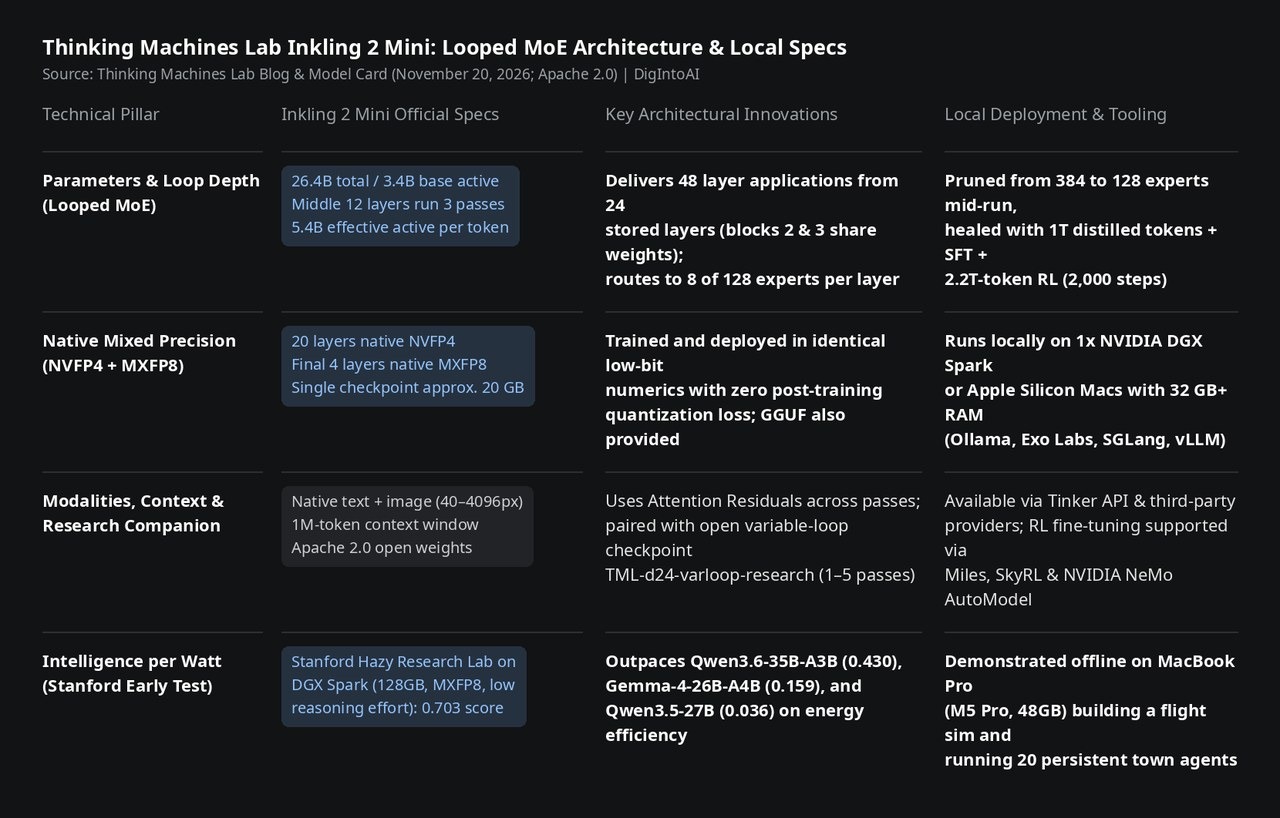
Image source: compiled by DigIntoAI from Thinking Machines Lab's announcement and model card.
Sub-100B Coding Lead, Loop Monitorability & Known Trade-Offs
**Strong Tool-Use Coding, Companion Research Weights & Limitations: **In reported sub-100B open-weight evaluations, Inkling 2 Mini leads on DeepSWE v1.1 (48.2%), Vals Index v2.2 (46.5%), SWE-bench Pro v2 Hard (77.9%), BrowseComp (79.0%), DeepSearchQA (85.3%), and MCP Atlas (82.7%). Alongside it, the lab open-sourced a variable-loop research model (TML-d24-varloop-research, trained for 1–5 passes): its no-CoT 50% task horizon grew from 16 seconds at one pass to 37 seconds at three, and N-Hop Lookup improved out to 10 passes while chain-of-thought traces remained legible without increased agentic sabotage. Thinking Machines Lab also notes clear limitations: looping boosts reasoning and long-context retrieval rather than static factual memory (AA-Omniscience score -8.6), and Inkling 2 Mini trails Qwen3.8-27B on MultiChallenge (50.0%) and ComplexConstraints v1.1 (33.4%) as well as larger models on HLE-Diamond (15.2%) and CritPt v2.
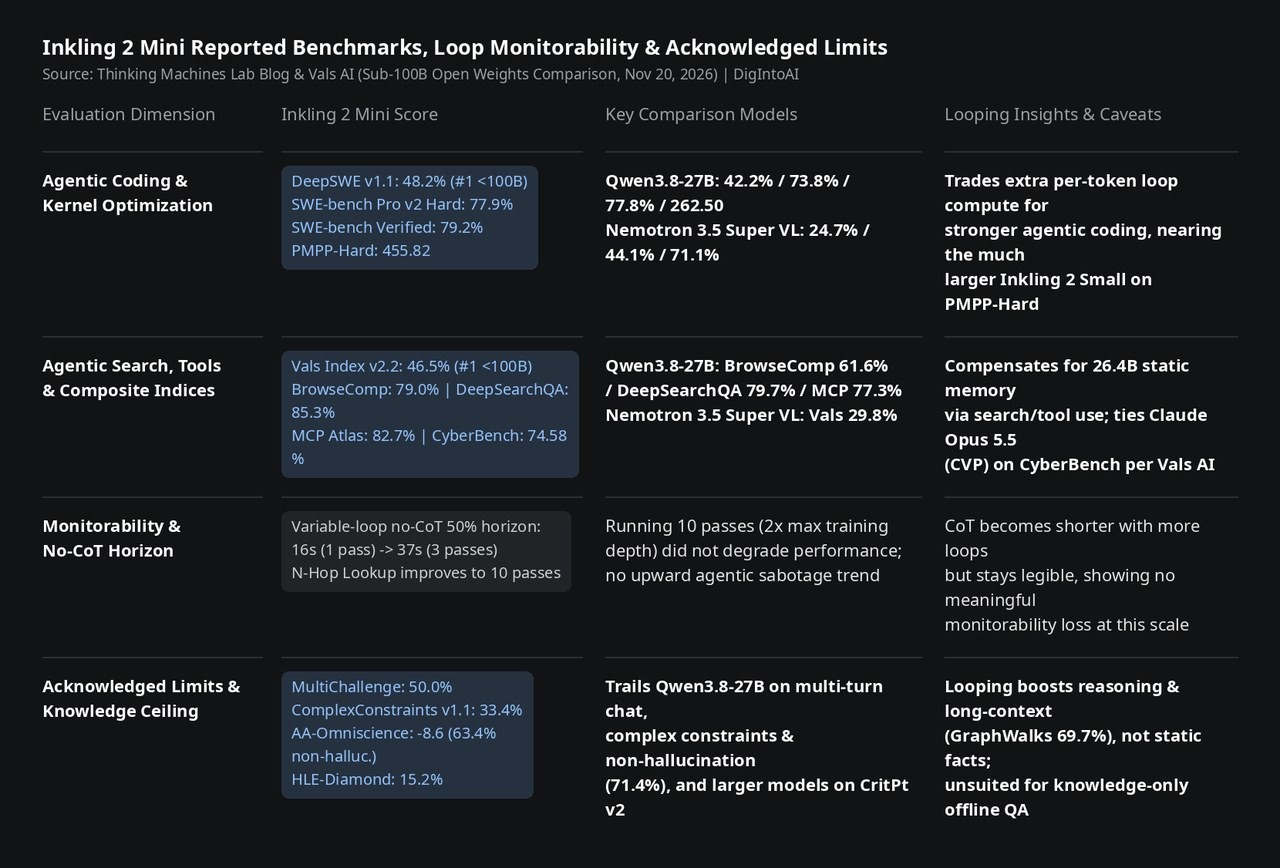
Image source: compiled by DigIntoAI from Thinking Machines Lab's release post and Vals AI.