
On November 21, 2026, Together AI disclosed that an unauthorized party downloaded stored samples from a subset of customer prompts submitted to its serverless inference service. The exposure stemmed from an AI coding agent committing a private Hugging Face repository credential while Together AI was developing its public xorl GitHub repository.
Why Reverting the Commit Could Not Stop Secondary Secret Harvesting
**Affected Models, Exposure Window & Dragos Canaries: **The stored samples—authorized by customers for routine software testing—involved serverless requests to MiniMax M3, GLM-5.2, and Kimi K2.6 primarily on June 24, July 4, July 8, and July 14, 2026. Although Together AI's automated scanners detected the exposed credential and reverted the commit, an unauthorized actor captured the token during the exposure window and downloaded the private repository's samples. Crucially, the intruder searched the downloaded prompts for credentials to other services and tested their validity—five of which were canary tokens planted by Dragos's November 19 supply-chain study. Together AI engaged external forensics and law enforcement, stated it has found no evidence of wider leakage and understands the data has been deleted, and is reviewing sample contents to notify affected customers directly (inquiries: security@together.ai).
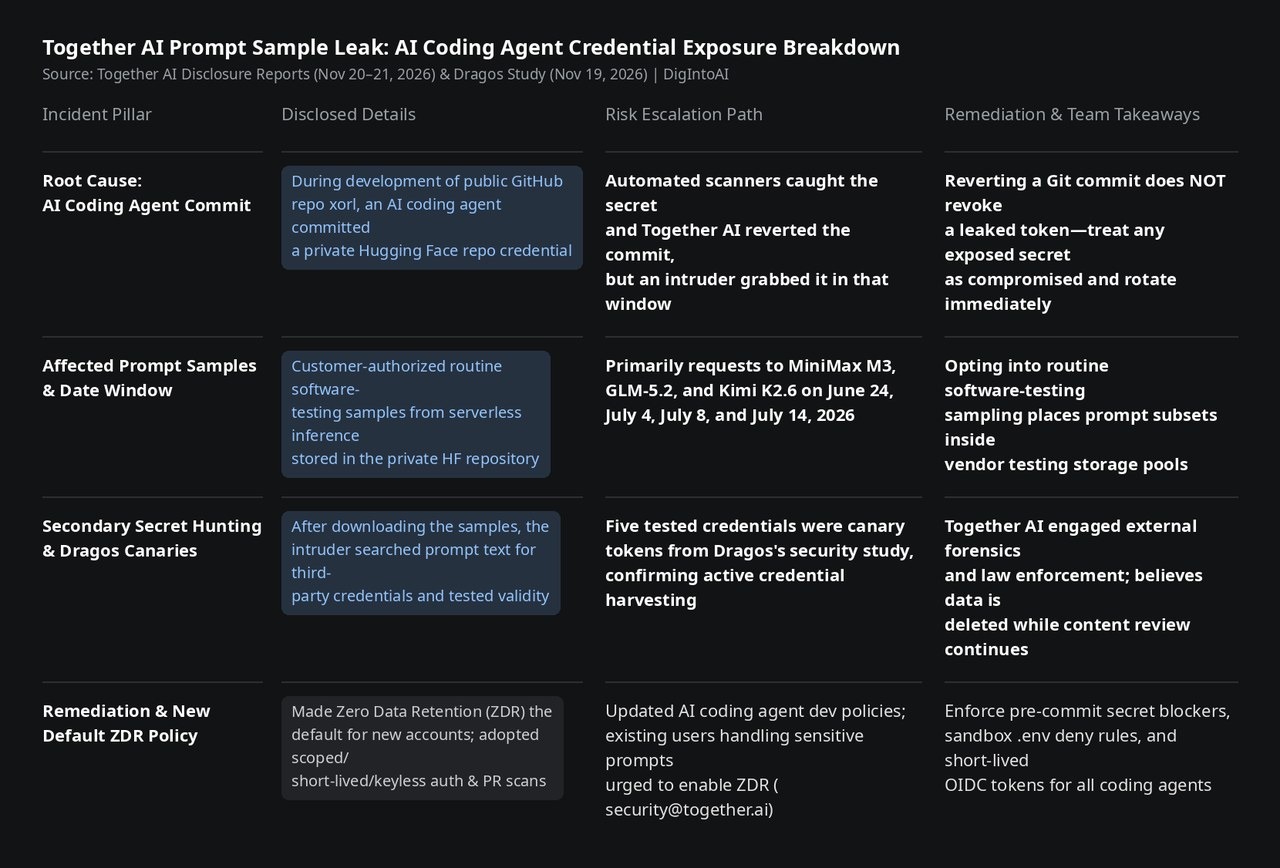
Image source: compiled by DigIntoAI from Together AI disclosure coverage and Dragos's November 19 study.
Default ZDR & Coding-Agent Security Lessons for Engineering Teams
**Short-Lived Credentials, PR Checks & Agent Governance: **In response, Together AI made Zero Data Retention (ZDR) the default for new accounts, advised existing customers handling sensitive prompts to enable ZDR, adopted scoped, short-lived, or keyless authentication where supported, mandated credential checks on all pull requests, and updated its internal AI coding-agent development rules. For engineering teams adopting autonomous coding agents, the takeaway is clear: reverting a public Git commit never revokes a leaked secret, coding agents should be blocked from reading long-lived cross-repo credentials via sandbox deny rules and short-lived OIDC tokens, and buyers should audit vendor testing-sample retention toggles before sending production traffic.