
ByteDance's AI coding environment TRAE recently consolidated its separate TraeCode and TraeWork apps into a unified TRAE client. Comparing the official changelogs for the China edition (docs.trae.cn) and the International edition (docs.trae.ai) as of November 12, 2026 reveals two distinct version numbering tracks and release cadences.
Side-by-Side Release Breakdown
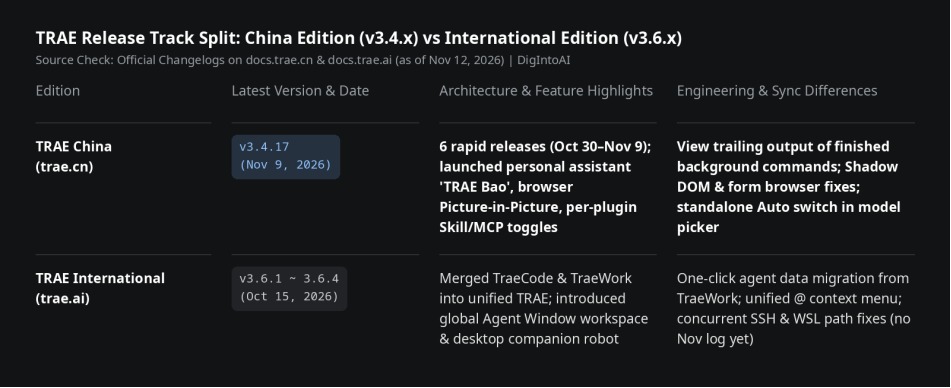
TRAE China Edition (docs.trae.cn) — Six updates in ten days up to v3.4.17: Between October 30 and November 9, 2026, the China client shipped six consecutive releases from v3.4.12 through v3.4.17. Version 3.4.12 (Oct 30) introduced the personal assistant 'TRAE Bao' for global and project-level tasks, a floating desktop widget shortcut (Alt+Shift+Space), Picture-in-Picture mode for the live browser preview, and per-plugin toggles for individual Skills and MCP servers. Version 3.4.15 (Nov 3) added a standalone Auto switch in the model picker; v3.4.16 (Nov 8) added inline trailing output inspection for finished background commands plus form and Shadow DOM browser fixes; and v3.4.17 (Nov 9) refined model picker scrolling and empty-project cleanup.
TRAE International Edition (docs.trae.ai) — Unified architecture at v3.6.1 ~ 3.6.4: The International build shipped v3.6.0 on October 8 with the cross-project Agent Window workspace, a desktop companion robot, and multi-path workspace mounting, followed by v3.6.1 ~ 3.6.4 on October 15 adding one-click data migration from TraeWork, a unified @ context mention menu, social preview cards for HTML artifacts, and concurrent SSH and WSL attachment fixes.
What This Is Not & Version Numbering Notes
v3.4.x and v3.6.x are parallel regional tracks, not sequential versions: Despite the lower minor number, China's v3.4.17 (Nov 9, 2026) is nearly a month newer than the latest logged International release (v3.6.4 on Oct 15, 2026). Features like TRAE Bao, browser Picture-in-Picture, and background command tail logs have landed first on the China track.
Client and agent workspace updates only: These releases cover IDE workflows, MCP/Skill controls, and multi-repo orchestration—not a new proprietary foundation model or API pricing change.