
On November 20, 2026, the U.S. House Committee on Homeland Security and the Select Committee on the CCP released the findings of a seven-month joint investigation—launched in April 2026—examining how American businesses adopt open-weight AI models originally trained by China-based developers, along with a tiered policy framework spanning federal systems, critical infrastructure, and open-weight ecosystem investments.
Three Corporate Case Studies: Why U.S. Firms Adopt PRC Open Weights
**Airbnb, Anysphere (Cursor) & DoorDash Usage Disclosures: **Drawing on document productions and staff briefings, the Committees highlighted three U.S. case studies: Airbnb runs customized versions of Alibaba's open-weight Qwen models on U.S.-based infrastructure in customer support, powering an AI assistant handling roughly 80,000 guest and host interactions per day alongside a fine-tuned ticket summarization model; Anysphere built Composer 2—the flagship proprietary coding model inside its Cursor platform—on a Moonshot AI base model, a lineage the report notes became public only after an independent developer identified it (media reports add Cursor is weighing a gradual move away with no decision or timeline); and DoorDash disclosed that engineers evaluated models from at least six PRC developers and authorized 25 PRC model families for non-trivial deployment (defined as at least $5,000 in compute and serving costs). Notably, the report's second major finding acknowledges that cost, customizability, and near-frontier performance drive adoption because the United States currently lacks competitive open-weight alternatives at the price and performance the market demands.
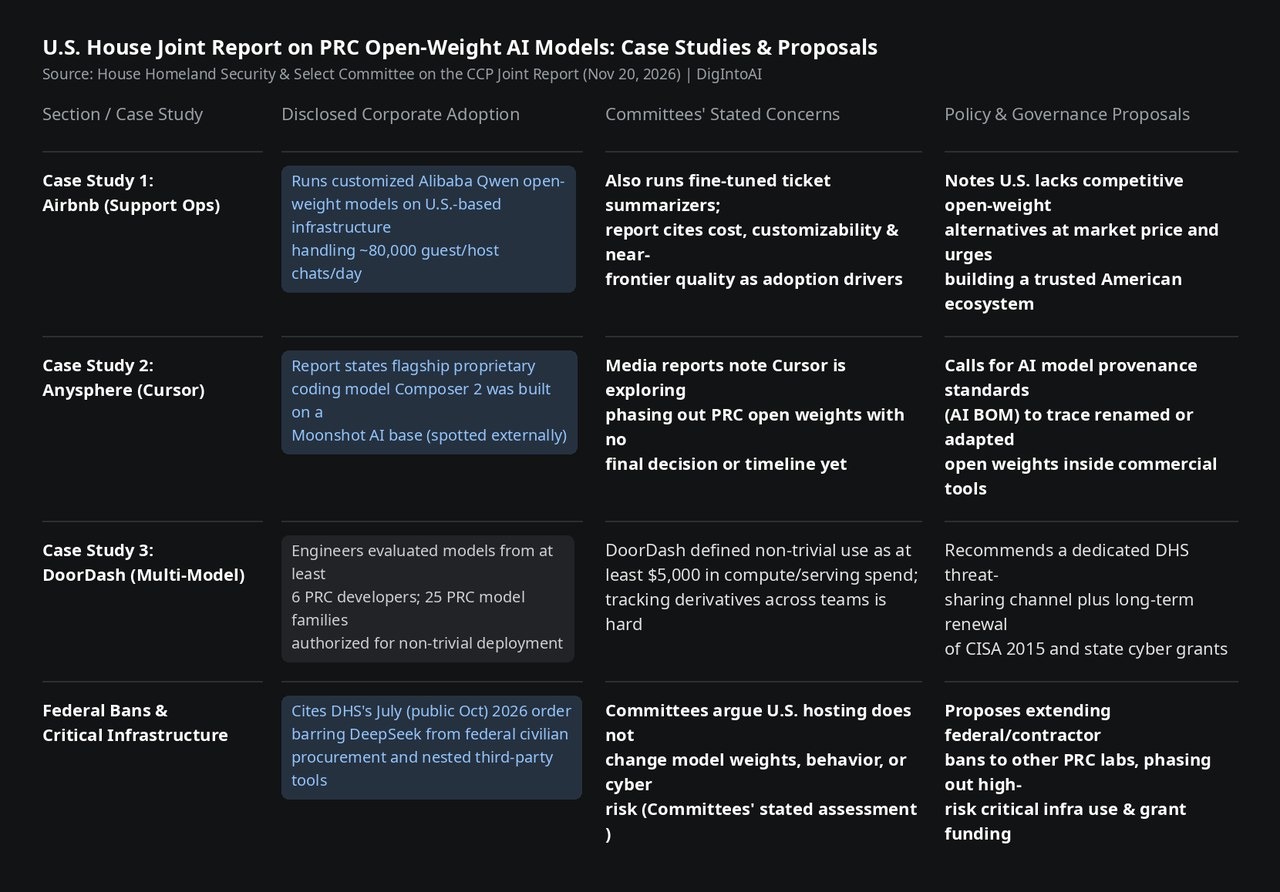
Image source: compiled by DigIntoAI from the U.S. House Committees' Joint Report on PRC AI Models (Nov 20, 2026).
Stated Risks & Tiered Recommendations: AI Provenance and Expanded Federal Bans
**Avoiding Economy-Wide Immediate Bans While Tightening Federal & Critical Infra Rules: **Reflecting the Committees' stated national security assessment, the report argues that running downloaded weights on U.S. servers keeps data domestic without changing model provenance or behavior, and notes that DHS's July 2026 order (made public in October) excluding DeepSeek and DeepSeek-derived third-party tools from federal civilian procurement reaches only one developer. Rather than imposing an immediate economy-wide ban before trusted open-weight alternatives exist—which the Committees warn would raise costs and concentrate the market in a few closed providers—the report recommends five tracks: building a competitive American and allied open-weight ecosystem; establishing AI model provenance standards (AI BOM) to trace embedded weights; creating a dedicated DHS threat-sharing channel alongside renewing CISA 2015 and state cybersecurity grants; imposing accountability costs on illicit model distillation; and extending federal system and contractor prohibitions to additional PRC developers while phasing them out of high-risk critical infrastructure functions and federal grant purchases.