
On this page
On November 25, 2026 (November 26 Beijing time), the Federal Communications Commission's Space Bureau issued a conditional authorization (order DA-26-1273A1, docket SAT-LOA-20260108-00016, call sign S00798) allowing SpaceX to deploy and operate up to one million Starmind orbital data center satellites in low Earth orbit. Rather than a blanket green light, the order narrowly defines backup radio spectrum rights, enforces an orbital-debris gate above 600 kilometers, and binds SpaceX to four rollout deadlines stretching through 2040.
How SpaceX Plans to Power and Route Orbital Compute Traffic
In its January 30, 2026 filing, SpaceX proposed using near-continuous orbital sunlight to power onboard compute hardware—aiming to lower computing costs—and routing routine data over optical inter-satellite links to Starlink for downlink through ground gateways. While the original application envisioned altitudes from 500 to 2,000 kilometers, the final FCC authorization schedule specifies six nominal operating altitudes between 500 and 1,002 kilometers.
Ka-Band Backup TT&C Conditions: **The FCC order allocates Ka-band radio frequencies strictly for backup and emergency telemetry, tracking, and command (TT&C): **18.8–19.3 GHz space-to-Earth and 28.6–29.1 GHz Earth-to-space. Under Condition 1, SpaceX must operate on a non-interference, unprotected basis and must immediately cease offending operations upon receiving a documented report of harmful interference until the issue is resolved.
The 600-Kilometer Debris Gate and Deferred Disposal Waivers
Modification Required Above 600 Kilometers: **The FCC found SpaceX's orbital debris mitigation plan compliant for satellites operating below 600 kilometers. Before deploying any satellite intended to operate **above 600 kilometers, however, SpaceX must file a license modification containing its final debris mitigation plan.
Non-Reentry Disposal Waivers Deferred: **SpaceX also requested authorization to move some end-of-life spacecraft into Earth-orbit disposal trajectories or heliocentric orbits rather than atmospheric reentry. In Paragraph 11 and Condition 4, the FCC **deferred action on that waiver, requiring SpaceX to file a separate modification justifying any non-reentry disposal method prior to deployment and operation.
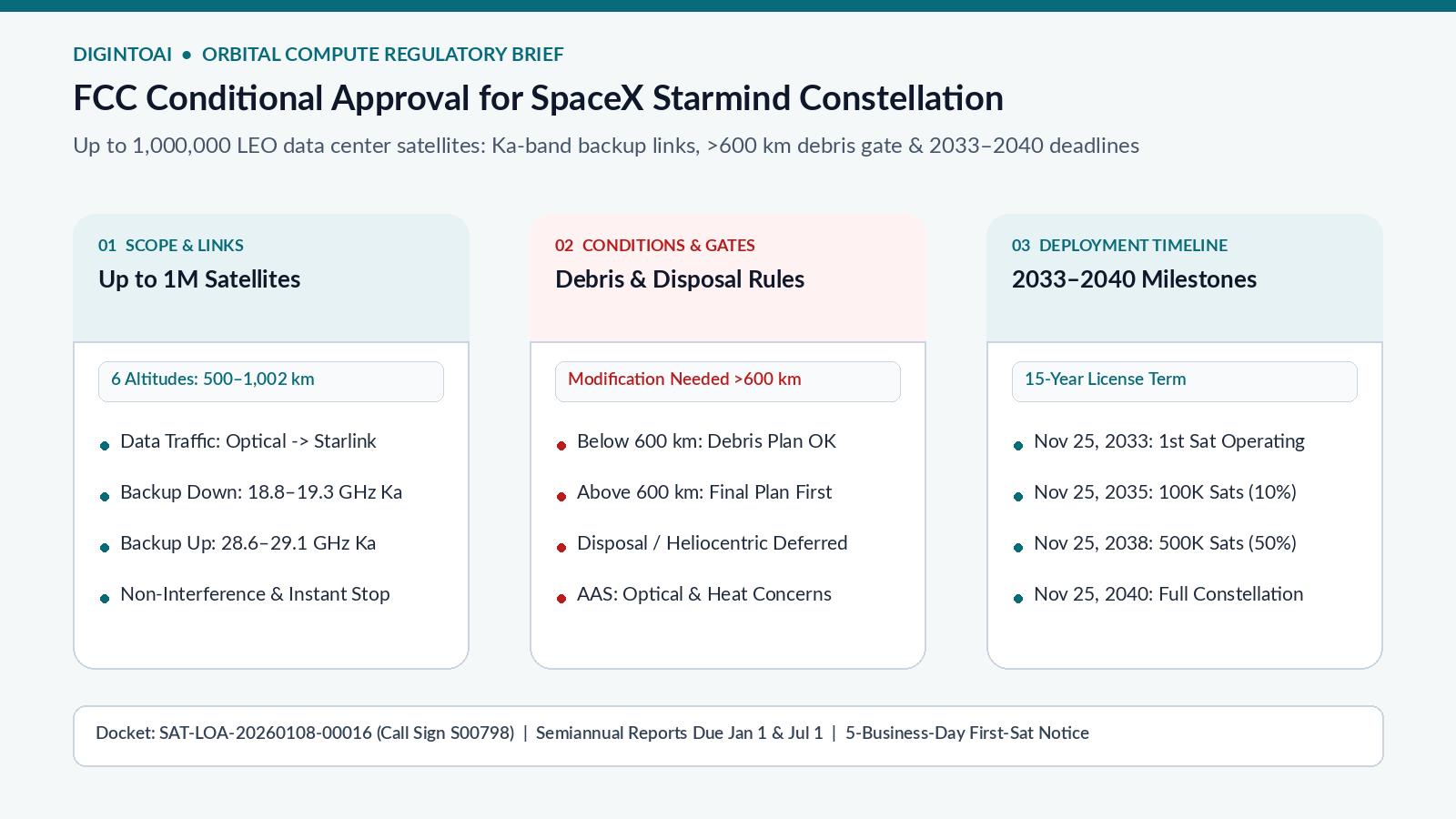
Image source: Compiled by DigIntoAI from FCC Order DA-26-1273A1, the SpaceX application, and the AAS press statement.
Deployment Deadlines Through 2040 and Semiannual Reporting
Under Conditions 10 and 11, the Starmind license runs for a 15-year term starting on the date SpaceX certifies to the FCC that its first satellite is operating in its assigned orbit in compliance with the order (certification is due within five business days of initial operation). To retain full authorization, SpaceX must meet four mandatory milestones:
**November 25, 2033 (1 satellite): **First satellite operating in its assigned orbit in compliance with the license.
**November 25, 2035 (100,000 satellites, 10%): **One-tenth of the authorized ceiling deployed and operating.
**November 25, 2038 (500,000 satellites, 50%): **Half of the authorized ceiling deployed and operating.
**November 25, 2040 (Full constellation): **Remaining authorized satellites deployed in assigned orbits and operating.
Next Public Verification Filings: **Under Conditions 5 and 6, SpaceX must submit semiannual reports due **January 1 and July 1 each year detailing cumulative deployments, orbital parameters of deployed spacecraft, and how many satellites actually used backup Ka-band links to communicate with ground stations. Observers can track docket SAT-LOA-20260108-00016 (call sign S00798) for the first-satellite certification and future modification filings.
Astronomy Objections and Unanswered Commercial Questions
AAS Optical and Infrared Concerns: **In its November 25 statement, the American Astronomical Society warned that sunlight reflected off the constellation could disrupt optical observations while waste heat from massive orbital computing clusters could elevate infrared backgrounds. In Paragraphs 16 and 17, the FCC concluded that SpaceX's commitment to coordinate with the National Science Foundation adequately addressed optical astronomy concerns in the record without extra conditions, and placed **infrared thermal radiation outside the scope of this radio-service licensing review.
**Open Commercial Benchmarks: **Key business and engineering figures remain undisclosed in the public filings—including which AI workloads the initial satellites will run, sustained power draw, deliverable compute per satellite, round-trip latency via Starlink relays, and side-by-side orbital versus terrestrial cost assumptions covering launch, thermal rejection, and hardware replacement.