
On November 20–21, 2026, OpenRouter emailed affected customers warning that prompts and outputs routed to MiniMax models between July and October 2026 (with some accounts citing windows extending into November) may have been read by a third party. Pending investigation, OpenRouter removed the Zero Data Retention (ZDR) label from the affected MiniMax endpoints. Rather than a platform outage, the notice highlights a structural reality of multi-hop AI routers: a ZDR toggle in a router UI cannot guarantee end-to-end non-retention across reseller chains.
What the Canary Study Caught Across Direct and Forwarded Routes
**Test URLs Opened 40–130 Hours Post-Inference: **The customer warning follows Dragos researcher HD Moore's November 19 study seeding roughly two million prompts with unique canary URLs and decoy keys. According to OpenRouter's email, unique test URLs placed inside MiniMax prompts were accessed by an external third party 40 to 130 hours after requests completed—whether MiniMax served the request directly or through three hosts that told OpenRouter they forward MiniMax listings to MiniMax: AtlasCloud, Novita, and StreamLake. Parallel tests on other models at those same hosts were mostly untouched, and planted AWS canary keys were not used, though OpenRouter noted it had not yet received an explanation from MiniMax and stripped ZDR labels while investigating. As Dragos summarized, 'a privacy flag only binds the first hop.'
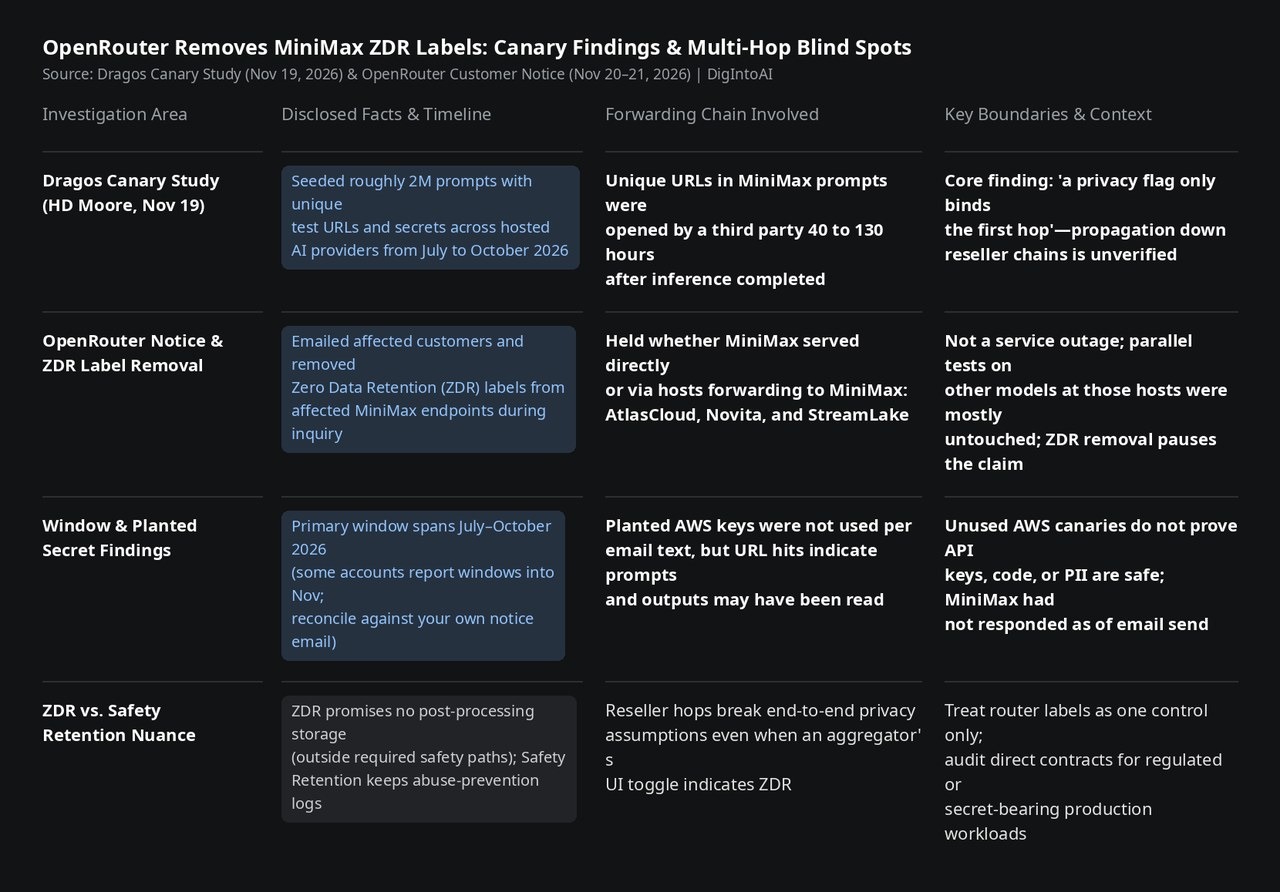
Image source: compiled by DigIntoAI from Dragos's canary study and OpenRouter customer notice coverage.
4-Step Developer Action Plan: Audit, Rotate, Pin Routes, and Probe
**Reconcile Logs, Rotate Exposed Secrets & Pin Upstream Providers: **First, compare the per-account request counts, dates, and host names in OpenRouter's email against your internal gateway logs (including background coding agents that silently fell back to low-cost MiniMax routes). Second, rotate any API keys, database URLs, or tokens that may have entered prompts—unused AWS canaries do not rule out source code or PII exposure. Third, pin explicit hosts on OpenRouter with provider.only or provider.ignore and set allow_fallbacks: false so rate limits cannot redirect traffic to unvetted resellers, or move regulated workloads to direct ZDR contracts or self-hosted weights. Fourth, add pre-egress secret redaction and run periodic internal canary probes to verify upstream privacy behavior continuously.
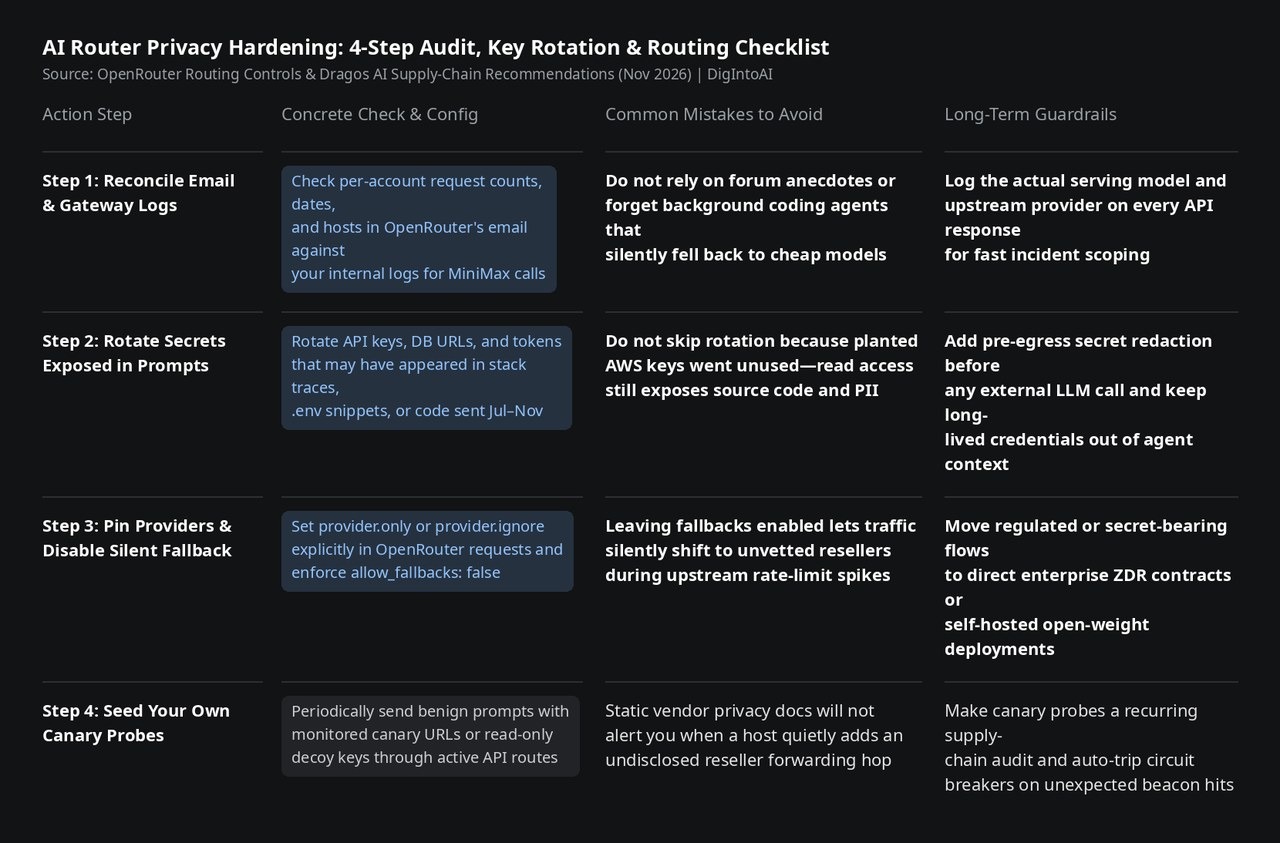
Image source: compiled by DigIntoAI from OpenRouter routing controls and Dragos supply-chain guidance.