
Published on arXiv on November 16, 2026 (arXiv:2611.22115, and ranked #1 on Hugging Face Daily Papers on November 18, 2026), Xingchen AGI Lab released 'TeleChat to Xing4: Advancing Frontier Agentic Models on Domestic Chips and Frameworks,' presenting the Xing 4 large language model series extending the TeleChat lineage alongside the TeleGym agentic post-training platform (with related open-weight checkpoints such as Xing4.0-29B-A4B and Xing4.0-29B-Intent listed under the XingChen-AGI Hugging Face organization).
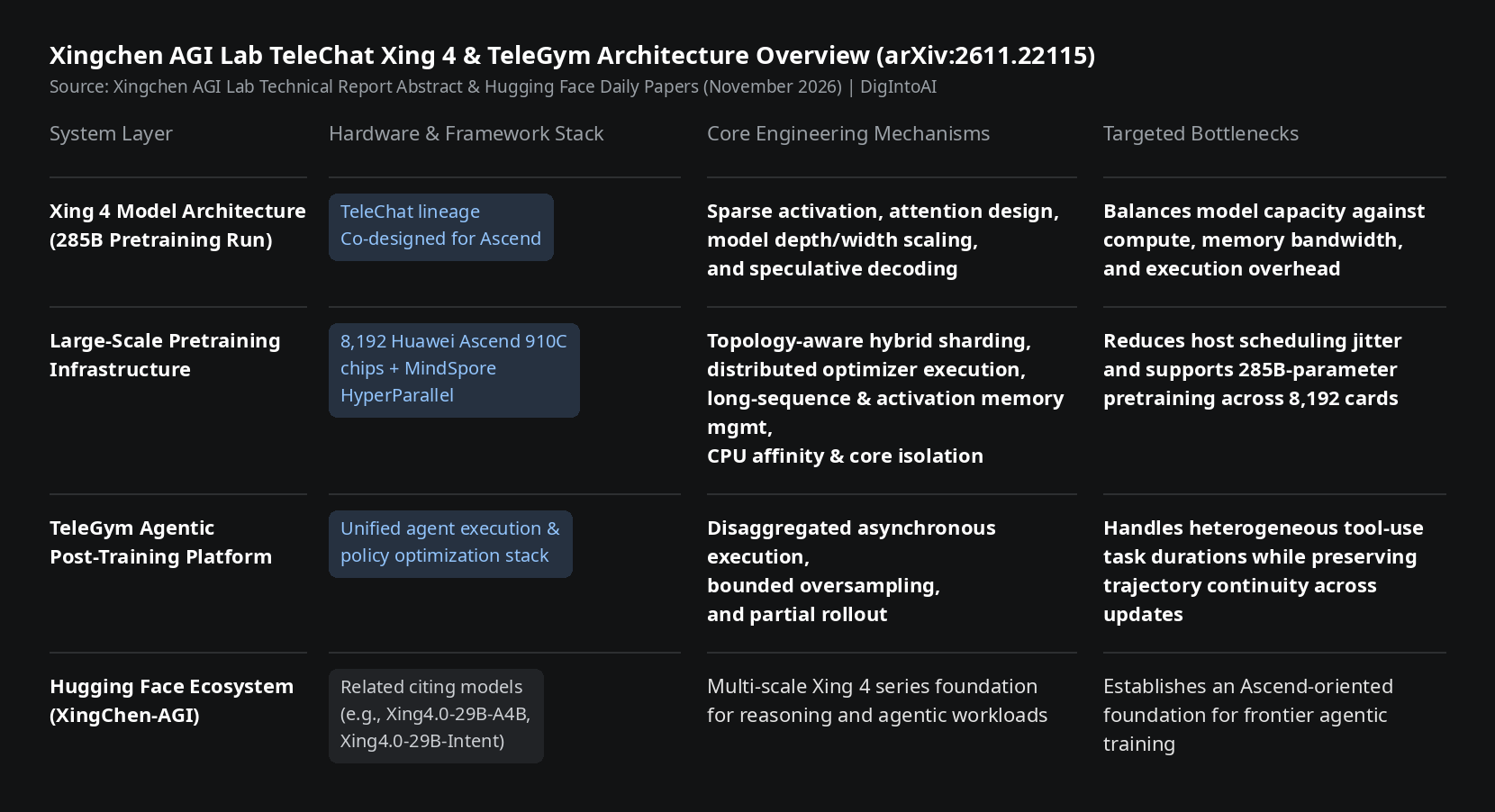
Image source: compiled by DigIntoAI from the official Xingchen AGI Lab technical report abstract.
285B Pretraining on 8,192 Huawei Ascend 910C Chips
**Co-Designed Model Architecture & MindSpore HyperParallel Stack: **To balance model capacity with compute, memory bandwidth, and execution overhead, Xing 4 pairs sparse activation, attention design, model depth-and-width scaling, and speculative decoding. Its pretraining infrastructure builds on MindSpore HyperParallel—combining topology-aware hybrid sharding, distributed optimizer execution, coordinated long-sequence and activation memory management, and CPU affinity with core isolation to minimize host scheduling interference across 8,192 Ascend 910C cards for a 285B-parameter training run.
TeleGym: Asynchronous Agentic Post-Training Infrastructure
**Disaggregated Async Execution, Bounded Oversampling & Partial Rollout: **For reasoning and agentic post-training, TeleGym unifies environment execution, evaluation hooks, and trajectory construction with policy optimization. Using disaggregated asynchronous execution, bounded oversampling, and partial rollout, TeleGym accommodates heterogeneous tool-call task durations while preserving trajectory continuity across policy updates.