
On this page
AI research lab Zyphra has released ZONOS3-Mini, a compact multilingual text-to-speech (TTS) and zero-shot voice-cloning model, across Hugging Face and GitHub. One timing detail worth noting upfront: the Hugging Face article header displays a publication date of November 12, 2026, whereas the author byline inside the post reads November 11, 2026, and related commits span November 9 to 12. Rather than treating either timestamp as the definitive launch moment, this guide focuses on the released weights, runtime repositories, and deployment specifications currently live.
Licensing is cleanly split for commercial builders: model weights—including full bf16 PyTorch checkpoints and quantized GGUF files—are released under the Apache 2.0 license, while the inference servers, in-browser WebGPU build, and Zonos Voice Studio frontend are released under the MIT license on GitHub. Teams can embed or self-host the model without per-character or per-minute royalty fees.
Architecture and 43-Language Coverage
Whereas Zyphra's earlier Zonos2 architecture paired an 8B-parameter backbone with an 86 Hz audio codec—making client-side execution impractical—ZONOS3-Mini co-designs its sequence mixer and codec to run in real time on consumer hardware:
**100M Active / 800M Total Latent MoE Backbone: **The 11-layer language model (hidden dimension 1,024) holds 800M total parameters using a sparse Latent Mixture-of-Experts design (64 experts with top-2 routing), keeping active compute at roughly 100M parameters per token. Its sequence mixer interleaves nine Gated DeltaNet recurrent layers with two global grouped-query attention layers over a 32,768-position context window, supporting continuous generations up to 10 minutes long.
**15 Hz Dual-Encoding Codec (ZAC-1) at 44.1 kHz: **Alongside the model, Zyphra open-sourced Zyphra Audio Codec 1 (ZAC-1). It tokenizes 44.1 kHz audio at just 15 frames per second across 10 codebooks—one semantic codebook distilled from Wav2Vec2-BERT 2.0 features plus nine acoustic residual vector quantization codebooks. A causal multi-resolution iSTFT head decodes frames into 44.1 kHz audio as they are generated, offering both a full quality head (full-mr) and a pruned head (keep2-plain) that Zyphra says decodes roughly 3x faster.
**43 Supported Languages Including Chinese, English, and Japanese: **The model card lists 43 supported languages across East Asia, Southeast Asia, South Asia, Europe, and the Middle East, explicitly covering Mandarin Chinese, English, and Japanese. At inference time, a Rust port of NeMo text normalization (zyphra-textnorm) handles numbers, dates, and symbols for Chinese, English, Japanese, Korean, and five major European languages before passing tokens into an 8,192-entry SuperBPE vocabulary. Speaker identity can be conditioned either on a 5-to-60-second reference audio clip or a 192-dimensional MECT-B2 speaker embedding, alongside inference-time steering for pace, emotion, loudness, and vocal texture.
Four Paths to Run ZONOS3-Mini in Browsers and Local Devices
All official runtimes in the GitHub repository expose a unified HTTP contract—including an OpenAI-compatible /v1/audio/speech endpoint and a native /v2/generate endpoint—and serve the same Zonos Voice Studio web interface:
**Path 1 — Zero-Install In-Browser WebGPU (servers/web): **Using WebGPU inside a Web Worker, ZONOS3-Mini executes entirely on the visitor's local GPU in modern builds of Chrome, Edge, or Safari with zero installation and no backend inference server. On first visit (or when launching the studio with ?api=web), the browser downloads and caches the quantized WebGPU weight shards locally so subsequent sessions run offline.
**Path 2 — Native Apple Silicon Server via MLX (servers/mlx): **On M-series Macs, developers can install Python 3.12 dependencies via uv alongside a Rust toolchain (to compile zyphra-textnorm), download the GGUF weights from Hugging Face, and launch the local MLX server on port 1919. Zyphra reports time-to-first-audio (TTFA) under 150 ms on an M3 MacBook Air and under 570 ms in-browser on a Pixel 9.
**Path 3 — Cross-Platform C++ and ggml Standalone (servers/ggml): **For Windows laptops, Linux CPUs, or desktop applications that cannot bundle a Python environment, Zyphra provides a standalone C++ and ggml server and CLI supporting CPU, CUDA, Metal, and Vulkan backends with 27 built-in multilingual default voices.
**Path 4 — NVIDIA GPU Server and Offline Python API (servers/sgl): **On Linux x86_64 machines with NVIDIA GPUs and CUDA 12.8, the Mini-SGLang backend (or upstream SGLang-Omni) serves the full around 9 GB bf16 PyTorch checkpoint. Zyphra reports 80 ms median TTFA at 8 concurrent requests and 457x real-time peak throughput on a single H100 80GB GPU, alongside an offline Python API for batch synthesis.
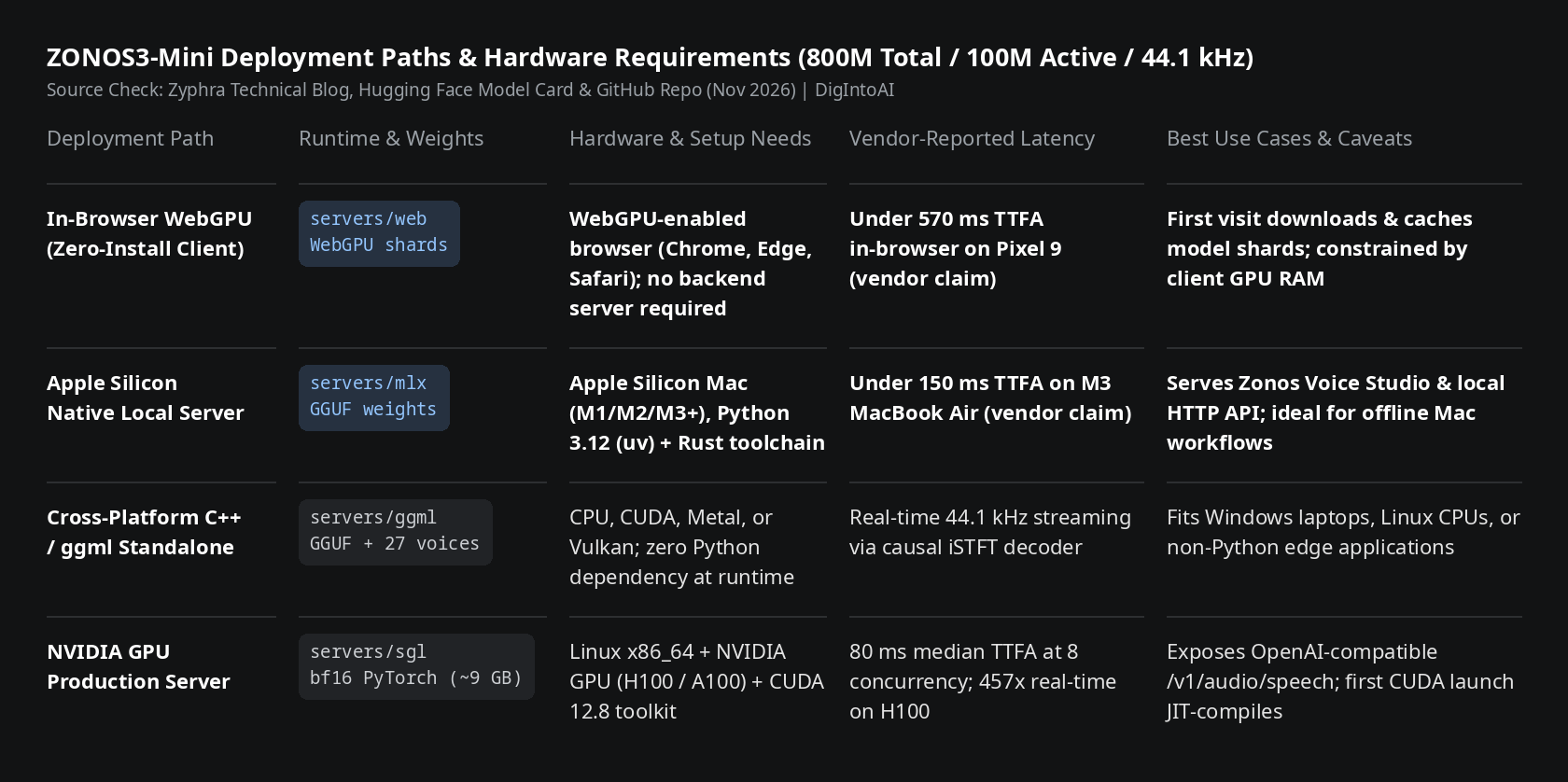
Image source: compiled by DigIntoAI from Zyphra's technical report, Hugging Face model card, and GitHub repository.
Cost and Engineering Comparison Against Cloud TTS APIs
For developers building Chinese, English, or Japanese voice applications, choosing between self-hosted ZONOS3-Mini and commercial cloud TTS APIs comes down to three practical tradeoffs:
**Marginal Token Economics vs. Fixed Compute: **Cloud TTS APIs meter every generated character or audio second. As of November 2026, OpenAI charges $15 per 1M characters for tts-1, $30 per 1M characters for tts-1-hd, and roughly $0.015 per minute for gpt-4o-mini-tts, while ElevenLabs charges $0.04 per 1,000 characters ($40 per 1M) on Flash v2.5 / v4 Turbo and $0.08 per 1,000 characters ($80 per 1M) on Eleven v4. With ZONOS3-Mini, marginal API fees drop to $0. In browser WebGPU deployments, end-user GPUs perform all synthesis compute, leaving developers only static CDN bandwidth for serving model shards. On self-hosted GPU servers, steady workloads such as audiobook narration, game dialogue, or high-frequency voice agents quickly amortize fixed hardware rent compared to per-character cloud bills.
**Data Privacy and Offline Resilience: **Cloud endpoints require transmitting every text prompt and reference voice sample over the network. Running ZONOS3-Mini via WebGPU or local ggml/MLX keeps both text and speaker audio strictly inside the user's device or private VPC, supporting air-gapped enterprise deployments and offline mobile or desktop tools.
**Cloning Flexibility vs. Extra Module Setup: **Standard cloud APIs such as OpenAI TTS restrict callers to 9 to 13 built-in voices without arbitrary zero-shot cloning, while commercial cloning tiers cap voice slots by subscription level. ZONOS3-Mini includes zero-shot cloning out of the box, though advanced speech editing and phoneme-level overrides require loading separate add-ons—specifically the edit LoRA adapter, the 1.34 GB FuseAlign forced aligner, and Qwen3-ASR-1.7B for automatic clip transcription.
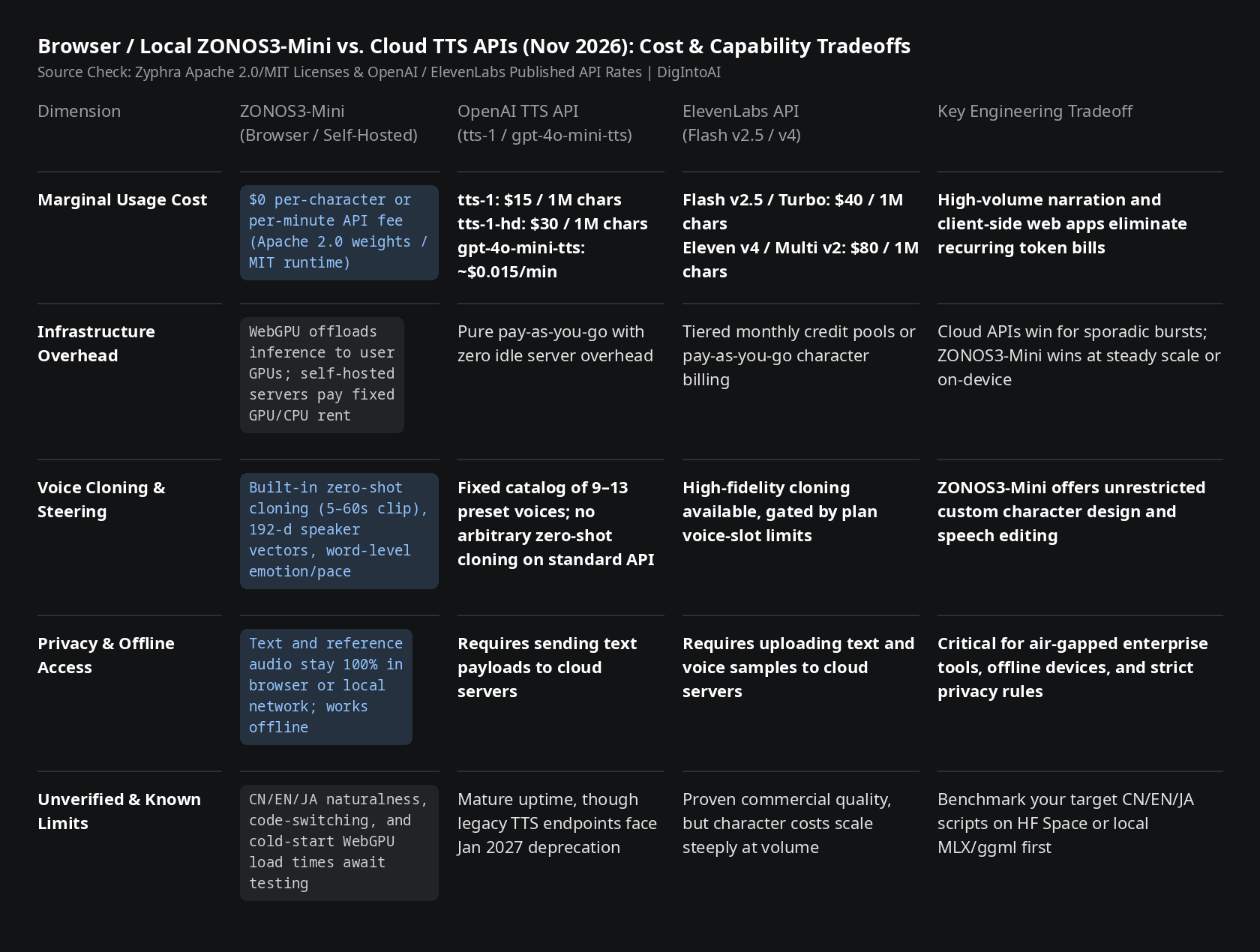
Image source: compiled by DigIntoAI from Zyphra licensing terms and published OpenAI and ElevenLabs API pricing.
What This Is Not & Items Left for Hands-On Testing
**Not a general-purpose text assistant: **Despite using an MoE language model backbone to predict 15 Hz audio tokens, ZONOS3-Mini is strictly a speech synthesis and voice-cloning engine, not a conversational LLM.
**Client-side WebGPU still has download and VRAM limits: **Zero-install browser execution still requires downloading hundreds of megabytes of sharded weights on first load, which can stall on slow mobile connections or fail on older GPUs with limited browser memory budgets.
**Real-world CN/EN/JA prosody and consumer speeds await independent benchmarking: **All latency figures (80 ms on H100, 150 ms on M3 MacBook Air, 570 ms on Pixel 9) and ZTTS2-Eval leaderboard rankings cited above reflect Zyphra's own evaluation. Actual Mandarin tonal accuracy, Japanese pitch-accent naturalness, cross-lingual code-switching, and throughput on consumer GPUs remain to be verified in hands-on testing.