
Between November 27 and 28, 2026, three practical releases highlighted China's push into edge-efficient models and robotics infrastructure: Tencent Hunyuan launched Hy3D 3.6 and open-sourced its 102-language Hy MT3 translation model, while the 2026 OpenHarmony Technical Conference in Nanjing unveiled RoboOH 2.0 for embodied intelligence.
Tencent Hunyuan Double Launch: 102-Language 3B Hy MT3 & Hy3D 3.6
**Jumping from 38 to 102 Languages Under a 3B Active Parameter Cap: **Hy MT3 expands Tencent's open translation coverage from 38 to 102 languages while keeping maximum active parameters within 3B—making offline mobile translation, live subtitling, and low-cost private translation APIs practical on modest hardware. Launching alongside it, Hy3D 3.6 pushes Hunyuan's 3D asset generation line forward for gaming, e-commerce, and prototyping (teams should verify Hy MT3's repository license and Hy3D 3.6 API availability directly on Tencent's platform).
OpenHarmony RoboOH 2.0 Targets Unified Embodied Robotics Infrastructure
**Distributed Control Stack Awaits Mass-Produced Hardware Validation: **Debuted November 28 in Nanjing, RoboOH 2.0 extends OpenHarmony's distributed architecture into real-time robotics control and multi-device embodied coordination. While independent BLEU benchmarks for Hy MT3, mesh topology audits for Hy3D 3.6, and commercial robot OEM adoption for RoboOH 2.0 remain pending, the cluster of launches shows strong momentum behind compact edge models and open robotics foundations.
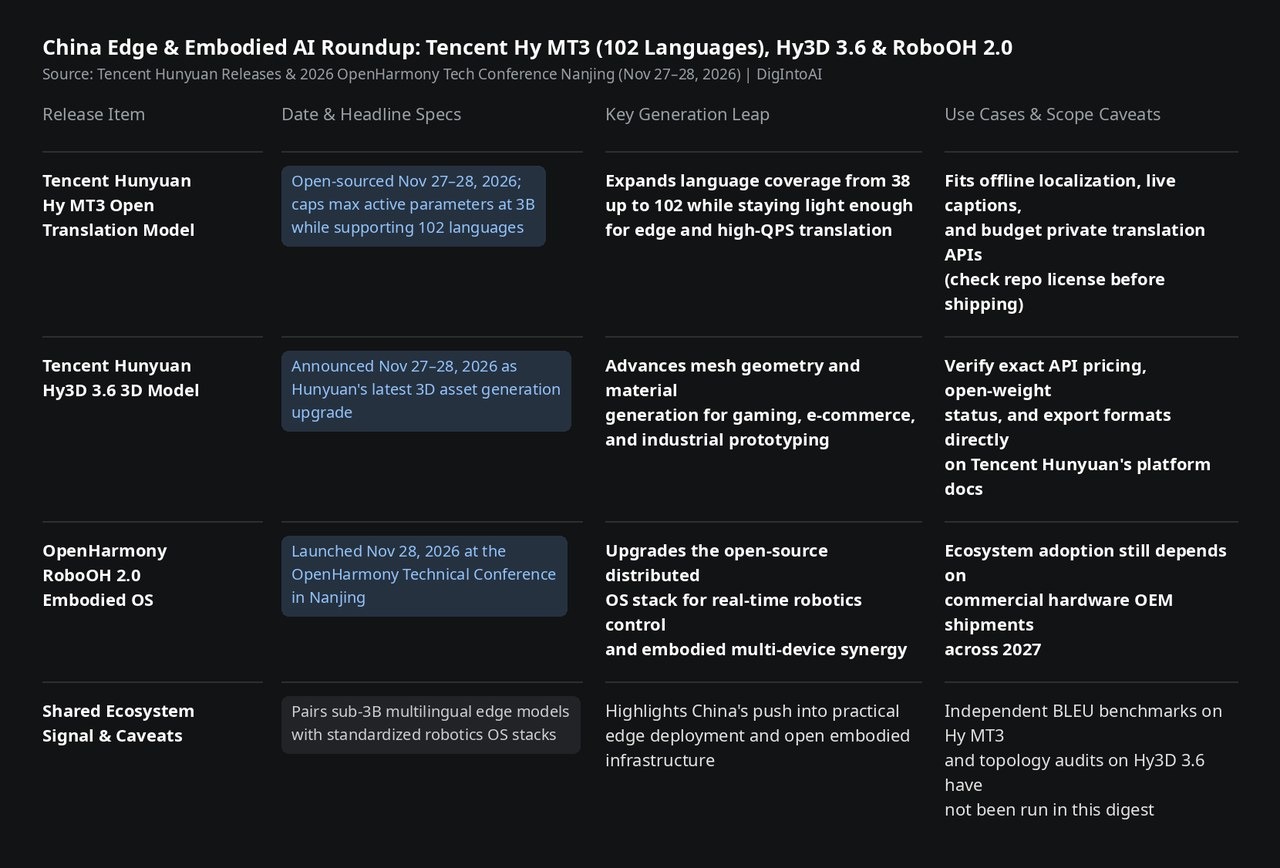
Image source: compiled by DigIntoAI from Tencent Hunyuan announcements and 2026 OpenHarmony Tech Conference disclosures.