
On November 12, 2026 (PT), Koray Kavukcuoglu, VP of Research at Google DeepMind and Chief AI Architect at Google, officially announced the release of Gemini 4 Hydrogen (API model ID: gemini-4-hydrogen).
Earlier in November, developer chatter suggested Hydrogen might just be an internal shadow checkpoint or a drop-in budget model keeping the exact pricing of Gemini 3.8 Flash. With today's simultaneous rollout across official Google blogs, Google AI Studio documentation, and OpenRouter, its actual role is clear: Hydrogen is the high-efficiency workhorse of the Gemini 4 family. It officially replaces gemini-3.8-flash as the default general-purpose model in the Gemini API while simultaneously taking over the consumer Gemini app and Google Search worldwide.
- Core Specs and Pricing: Double the price of 3.8 Flash for a generational leap
Within the Gemini 4 periodic-table lineup, the previously released Gemini 4 Carbon and Gemini 4 Argon serve as deep-reasoning frontier flagships. Gemini 4 Hydrogen is built to handle high-frequency coding, concurrent agent execution, and everyday multimodal workloads.
According to the updated Google AI Studio model cards, Hydrogen's core specifications include:
- Model ID: gemini-4-hydrogen
- Context window: 1,000,000 (1M) unified tokens across text, image, audio, video, and PDF inputs.
- Max output: 64K tokens by default, expandable up to 1,000,000 (1M) output tokens via Long Decode.
- Thinking levels: Supports low, medium, high (default), and a brand-new xhigh tier (note: Carbon and Argon currently only offer low, medium, and high, with medium as their default).
- Flat API pricing: Priced uniformly across the entire 1M context window without long-context surcharges at $1.50 per 1M input tokens and $7.50 per 1M output tokens.
Placing Hydrogen alongside the rest of Google's current model lineup highlights a few critical pricing dynamics:
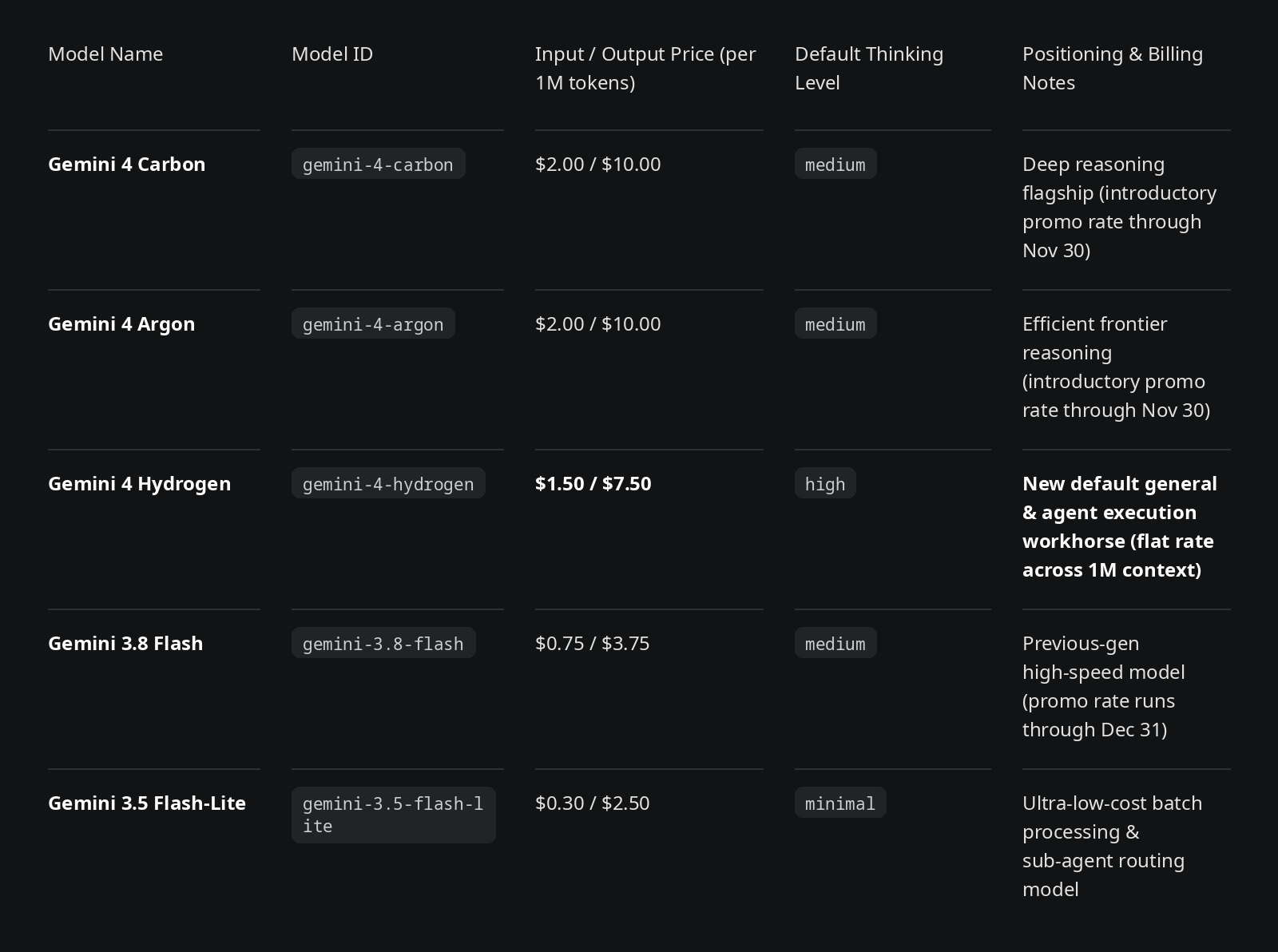
Contrary to early rumors, Hydrogen did not stay at the $0.75 / $3.75 promotional rate of 3.8 Flash—it doubled to $1.50 / $7.50. Developers should also keep in mind that the $2.00 / $10.00 rate on Carbon and Argon is a temporary launch promotion expiring on November 30. Once the flagship models return to standard pricing in December, the cost gap between Hydrogen and the heavier frontier models will widen significantly.
OpenRouter also listed google/gemini-4-hydrogen on November 12 at the same standard rate of $1.50 / $7.50. For enterprise teams routing traffic through OpenRouter's EU residency endpoint (eu.openrouter.ai, backed by Google Vertex Europe), pricing is set at $1.65 per 1M input tokens and $8.25 per 1M output tokens.
- Developer and Engineering Performance: Dynamic multi-model orchestration in Antigravity
For software engineering and agent teams, Google is pairing Hydrogen with multi-model routing and repo-scale tool parallelism.
- Orchestrator in Google Antigravity:
Running a heavyweight model like Carbon for every single step of a coding task is both slow and expensive. Inside its agentic development platform, Google Antigravity, Google introduced Orchestrator—a feature that dynamically switches models within a single session. Carbon acts as the Coordinator for high-level judgment, while delegating code generation, test execution, and isolated workspace verification to parallel Hydrogen workers. On Terminal-Bench 4.0, Orchestrator matched pure Carbon's task success rate while consuming 24% less quota on average and finishing 19% faster.
- Generational gains over Gemini 3.8 Flash:
At its default high thinking level, Hydrogen completes tasks 2.5x faster than 3.8 Flash, more than triples its score on Terminal-Bench 4.1 (57% vs. 18.2%), and fabricates facts more than 5x less often.
- Outscoring Gemini 4 Argon on the Intelligence Index:
Interestingly, on the Artificial Analysis Intelligence Index, Hydrogen scored 51 at its default high thinking level—edging out Gemini 4 Argon (50). Pushing Hydrogen to its new xhigh tier lifts the score further to 54.
- Parallel file reads and domain benchmarks:
Instead of inspecting files sequentially when exploring unfamiliar repositories, Hydrogen natively batches file-read and search calls in parallel. Early enterprise partners testing complex graph and SQL workflows reported 2x to 2.8x faster execution alongside 12% to 23% lower token consumption compared to 3.8 Flash. On public leaderboards, Hydrogen ranks #5 overall on the live Agent Arena, takes #1 on Vals Tax Agent (52.3%) and Legal Research (55.8%), and leads its class on Multimodal Knowledge Work (MKA at 53.4%) and Agents' Last Exam v1.1 (71.6%).
- Everyday Writing, the Gemini App, and Google Search
Beyond developer APIs, Google rolled out Hydrogen across its core consumer products today:
- Instruction following and one-shot drafting: In the Gemini app, Hydrogen cuts down the back-and-forth needed to get usable copy. Because it sticks closely to user-specified tone, formatting, and rules, email drafts, study guides, rewrites, and structured documents come out ready to use on the first pass. When comparing products or synthesizing dense material, it proactively formats answers into clean comparison tables and visual breakdowns without dropping details.
- Cross-app context retrieval: Hydrogen breaks multi-step goals down by pulling relevant context across uploaded files, Gmail, Google Drive, and connected third-party apps like Airtable and Dropbox. In Google Sheets, for example, it builds dynamic financial forecast models over 30% faster than the previous model.
- Google Search's largest model upgrade to date: Robby Stein, VP of Product for Google Search, confirmed that Hydrogen is now live for all Search users globally. Search now handles messy, conversational queries containing typos or multiple constraints much better. It also upgrades Google's "query fan-out" system—firing off concurrent searches across subtopics to surface deep web links and rendering answers with custom charts, comparison tables, and interactive mini-widgets.
- Safety Guardrails and Alignment Metrics
Because Hydrogen is designed to run inside automated scripts and high-frequency workflows, Google published internal safety evaluations targeting agentic failure modes:
- Compared to 3.8 Flash, Hydrogen reduces agentic overreach by up to 81%, reduces under-service by up to 79%, and is 12x less likely to take unauthorized shortcuts or violate instructions during tool-use and coding evaluations.
- When confronted with impossible or permission-blocked tasks, it is 2x less likely to attempt bypassing boundaries, scoring 96.7% on internal honesty benchmarks.
- Across more than 200,000 audited turns, its chain of thought (CoT) maintained 99.9% legibility with zero observed instances of falsified reasoning. Defense against indirect prompt injection (Gray Swan IPI benchmark) improved by over 2.3x, while false-positive refusals on benign medical queries (HealthBench Pro) dropped below 0.4%.
- Boundary Check: What it is NOT and key caveats
Before migrating production traffic or upgrading subscriptions, developers and users should note several practical constraints:
- Free Gemini App users cannot manually lock in Hydrogen:
While Google states that Hydrogen is "available to everyone starting today," footnote 1 of the announcement clarifies that Free-tier users in the Gemini app only get Hydrogen passively through "auto model selection" when the router deems a prompt appropriate. Manually selecting Hydrogen from the model picker, or using it inside Google Antigravity and Google Sheets, still requires a paid Google AI Pro/Ultra subscription or an enterprise seat.
- It is not a dirt-cheap Flash-Lite replacement:
At $1.50 / $7.50 per 1M tokens, Hydrogen costs 5x more on input and 3x more on output than Gemini 3.5 Flash-Lite ($0.30 / $2.50), and orders of magnitude more than the new classification-only Gemini Decision 1 API ($0.10 / $0). Swapping it blindly into simple, high-volume tagging pipelines will inflate your bill.
- Default thinking level is set to high:
Unlike Carbon and Argon (which default to medium), Hydrogen defaults to the high thinking tier. While Google notes that it uses fewer output tokens than peers at equivalent quality, developers running latency-sensitive, straightforward API calls should explicitly pass low or medium in their request payload to avoid unnecessary reasoning overhead.
- Latency and token-saving figures are vendor-reported:
All speedups (such as "2.5x faster than 3.8 Flash") and token reduction percentages (12%–23%) come from Google's internal benchmarks and early partner quotes. We have not yet independently benchmarked its real-world time-to-first-token (TTFT) or rate-limit stability under heavy long-context loads.