On this page
Between October and November 2026, major AI labs shipped a cluster of releases that clarify where frontier model scaling is heading: Anthropic launched Claude Fable 5.2 (alongside restricted-access Mythos 5.2) for long-horizon reasoning and engineering; Google rolled out Gemini 4 Argon, Gemini 4 Carbon, and the high-throughput Gemini 4 Hydrogen; and ByteDance updated its native video generator Seedance 2.5. Taken together, these launches challenge three common assumptions: whether code-writing models make dedicated video generators obsolete, how general reasoning models cross over into robotics and hardware CAD, and why Google—despite its vast web and video corpus—trails Anthropic on static parametric knowledge benchmarks.
Left-Brain Code Skeletons vs. Right-Brain Pixel Rendering
When Claude Fable 5.2 and Claude Motion demonstrated single-prompt creation of product walkthroughs and multi-shot 3D clips, some observers questioned whether dedicated diffusion video models such as Seedance 2.5 or Veo had taken a wrong turn. In practice, the two approaches solve fundamentally different problems.
Programmatic generation treats visual output as deterministic software engineering. For UI demos, data charts, and technical explainers, Claude writes Remotion, Manim, or vector animation code and renders clean MP4 files; for 3D scenes, Fable 5.2 writes Blender Python scripts to build geometry, assign shaders, animate camera cuts, and shift lighting from dusk to dawn. Its core advantage is determinism and line-by-line editability: text never garbles, and timing or layout values can be adjusted directly in code without re-rolling an entire clip.
However, scripts cannot conjure photorealistic human acting or continuous physical nuance out of thin air. Generating a close-up of an actor turning in falling snow with subtle micro-expressions, wind-blown hair, and synchronized dialogue requires pre-built high-poly digital humans and motion-capture rigs if attempted through code alone. Native video models such as Seedance 2.5—supporting 30-second narratives, up to 50 multimodal references, and native audio—learn spatiotemporal distributions directly from audiovisual data to render skin texture, fluid motion, and natural lighting end-to-end.
Rather than replacing video generators, code models are absorbing structured motion graphics and UI explainers while pointing toward a hybrid workflow: code models act as Technical Director to build exact 3D blocking, collision bounds, and camera paths, while native video models serve as Neural Renderers adding photorealistic flesh and sound.
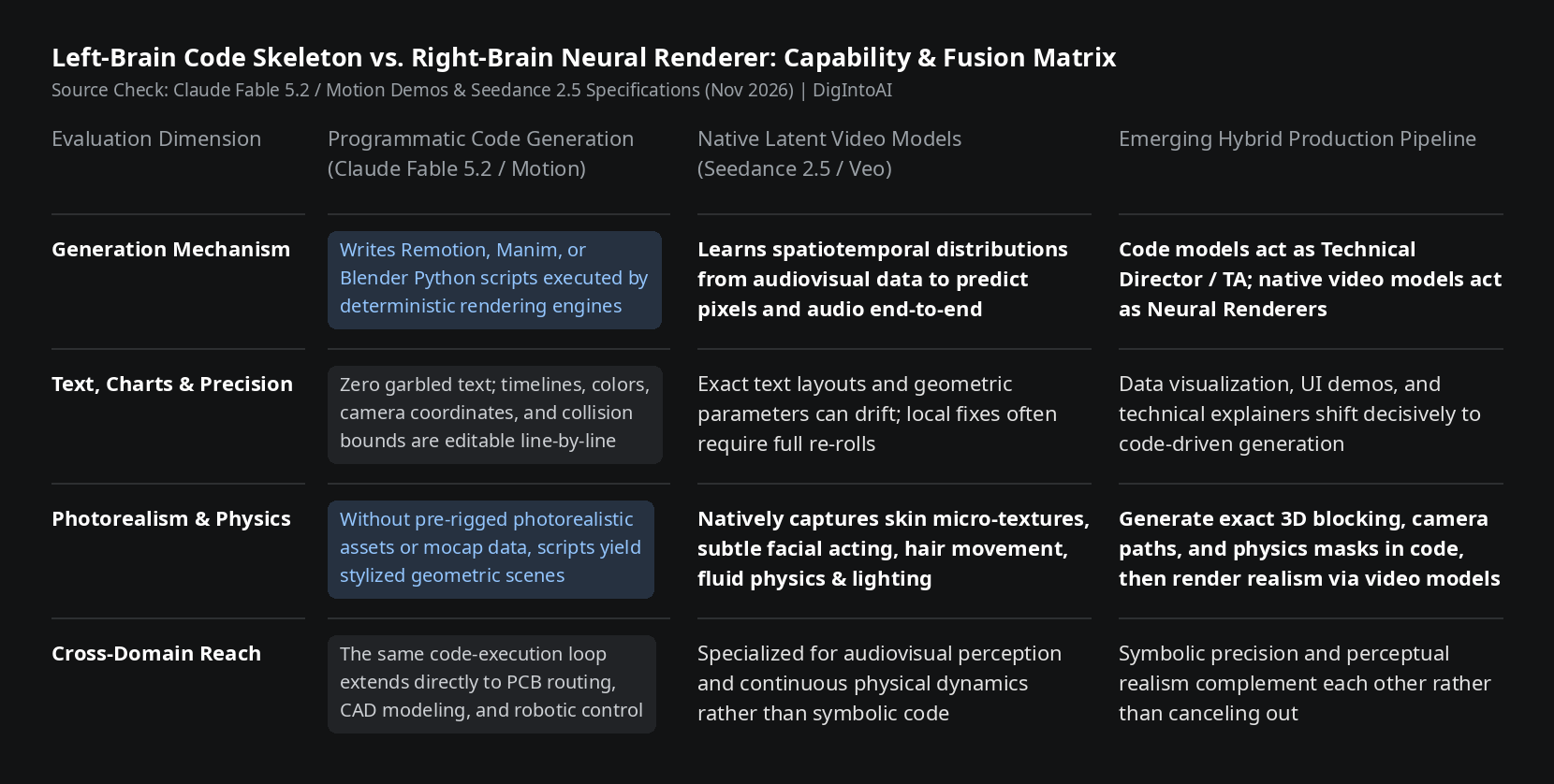
Image source: compiled by DigIntoAI from Claude Fable 5.2 engineering demos and Seedance 2.5 specifications.
The Bitter Lesson in General Reasoning: From Scripts to Multi-Day Agent Fleets
Anthropic researchers explicitly invoked Richard Sutton's Bitter Lesson following Fable 5.2's release because sufficiently strong symbolic reasoning, spatial understanding, and tool execution allow a general model to operate external engineering toolchains directly.
**Cross-Domain Gains in Robotics and Hardware CAD: **On the RoboDojo Sim manipulation benchmark, Fable 5.2 jumped from Fable 5.1's 27.6% to 64.9%, outperforming Claude Opus 5.5 (39.4%) and GPT-6 Astra (29.8%) while demonstrating zero-shot physical error recovery across 62 consecutive real-world robot steps. On BenchCAD 2.1, it scored 83.5 versus Opus 5.5's 65.3, and autonomously designed printed circuit boards and 3D enclosures that booted on first fabrication without manual edits.
**Multi-Day Autonomy and 1,000-Agent Orchestration: **Whereas earlier frontier models often stalled or produced partial stubs after a few hours, Fable 5.2 sustains multi-day execution and coordinates up to 1,000 parallel subagents—completing a Lean formalization of Fermat's Last Theorem in 30 hours (where Opus 5.5 stalled at 26% after 18 hours) and building an operating system prototype over eight continuous days. Early testers also reported single-session synthesis of a hypervisor core backed by more than 3,500 machine-checked proofs.
**Shifting Compute-Efficiency Curves: **With adaptive thinking enabled by default, Fable 5.2 at Low or Medium effort matches or beats Opus 5.5 at Max effort on several reasoning and chart benchmarks at less than one-tenth the per-task cost, while Xhigh and Max effort push open-ended scientific and systems engineering ceilings.
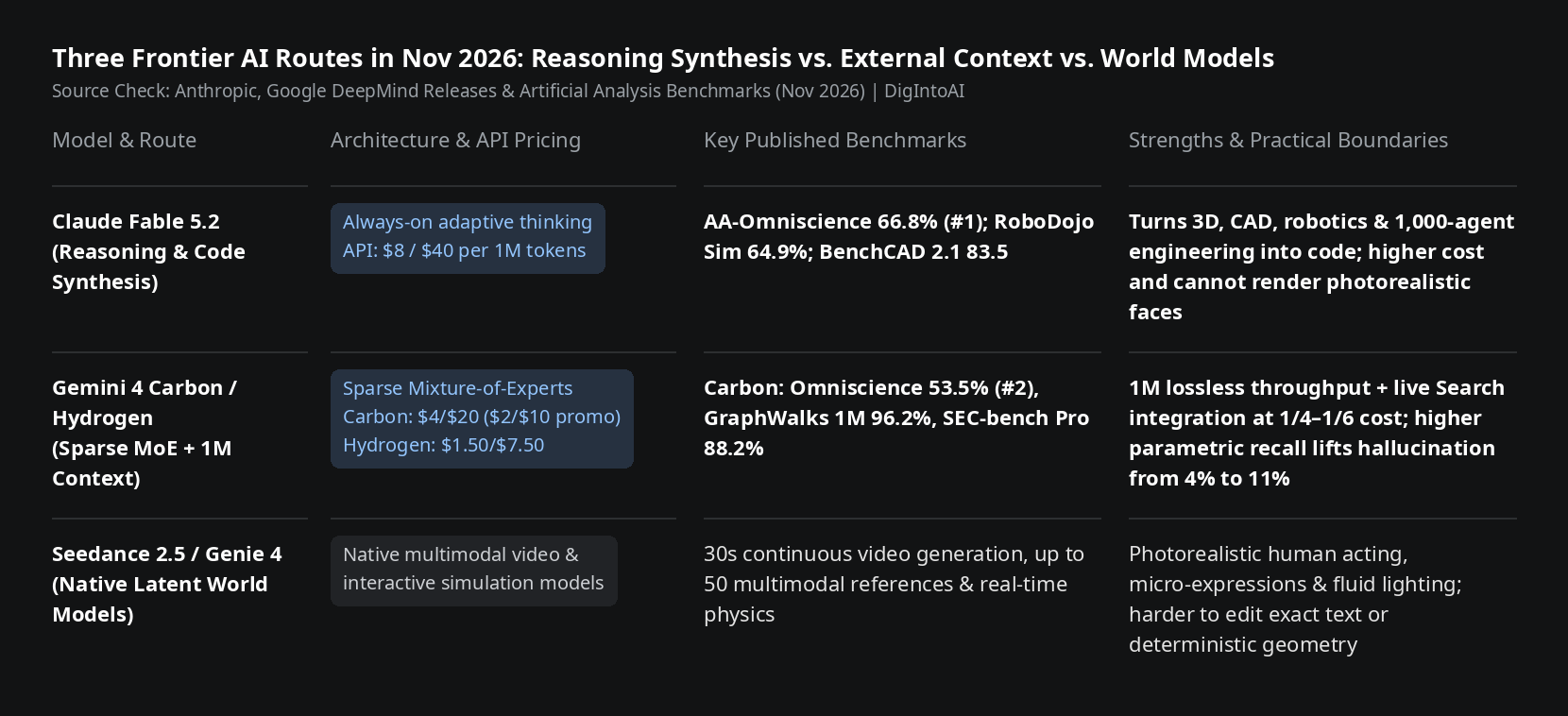
Image source: compiled by DigIntoAI from Anthropic, Google DeepMind, and Artificial Analysis public data.
De-Staticizing Knowledge: Reasoning Synthesis vs. External 1M Context
Another counterintuitive result appears on Artificial Analysis's AA-Omniscience factual knowledge benchmark. Gemini 4 Carbon briefly held first place upon its late-October release at 53.5%, only to be overtaken by Claude Fable 5.2 at 66.8% (Net Score 67 at Max effort). Why would Anthropic outscore Google on parametric knowledge despite Google's unmatched web and YouTube index?
The benchmark breakdown points to diminishing returns in stuffing long-tail facts into static weights: pushing Gemini 4 Carbon's recall higher raised its hallucination rate on unfamiliar edge queries from Argon's 4% to 11% in earlier evaluations. Beyond a certain threshold, memorizing obscure facts increases the risk of confident guessing.
The two labs have adopted contrasting solutions. Anthropic relies on deep inference-time reasoning synthesis—deriving complex domain conclusions logically rather than relying solely on memorized text—at a premium API price of $8/$40 per million input/output tokens ($16/$80 in fast mode). Google relies on sparse Mixture-of-Experts efficiency paired with massive external context: Gemini 4 Carbon costs $4/$20 ($2/$10 promotional), while Gemini 4 Hydrogen drops to $1.50/$7.50 and powers live Google Search. On the Multimodal Knowledge Agent (MKA) benchmark, Carbon ranked second in quality at one-sixth the cost of the top entry, and scored 96.2% on 256K-to-1M GraphWalks long-context reasoning—effectively treating live search and a 1M-token window as dynamic external memory.
What This Is Not & Items Awaiting Independent Verification
**Periodic-table naming inferences remain unconfirmed: **Because Hydrogen (element 1), Carbon (element 6), and Argon (element 18) all sit in the first three periods and align with Pro-tier pricing, industry observers infer Google may still be preparing a heavier Ultra-class Gemini 4 release. As of November 13, 2026, Google has not announced any model larger than Carbon.
**Benchmarks and hybrid pipelines require independent testing: **Scores cited for AA-Omniscience, RoboDojo Sim, BenchCAD 2.1, and GraphWalks come from vendor reports and Artificial Analysis disclosures across varying reasoning-effort settings. Furthermore, pairing a code-generated 3D blocking pass with a native video neural renderer remains an emerging workflow that we have not yet benchmarked end-to-end in our own pipeline.