
On November 20, 2026, security research firm NebuSec published a detailed analysis of Meta's cloud AI assistant Muse—demonstrating how a single malicious webpage could trigger container code execution, bypass Meta's Sentinel egress gate silently, and escape to root on the per-user VM. Meta's Muse team patched all described exploits prior to publication, yet the findings offer rare visibility into why even sophisticated multi-layer agent sandboxes fail under chained attacks.
Three-Stage Bypass: Lagging Chromium, Silent GET Egress & Shared Kernel
**Bundled PDF Chromium + Bodiless Read Classification: **Meta provisions each Muse user a 2-vCPU, 8 GiB Cloud Hypervisor Ubuntu VM running a systemd-nspawn container for the agent, while placing hatch-safety, hatch-authd (surrogate credentials), and Sentinel (an eBPF cgroup-scoped proxy on 198.19.0.1:3128) outside the container inside the same VM. NebuSec first targeted the bundled Chromium used for PDF export (/opt/meta-chromium/chrome), which lagged stable Chrome releases and had its IPC sandbox disabled—enabling 0.5-click container RCE via a public V8 bug (issue 554034656). Next, although Sentinel combined Rego policies, execd taint checks, Base64/entropy screening, policyguard-nvfp4 review, and 2 MiB/60-min per-domain budgets, it classified bodiless GET, HEAD, and OPTIONS requests as silent 'reads' under default settings—allowing NebuSec to exfiltrate and tamper with private chat history and memories without triggering a user approval prompt.
**Shared-Kernel Escape to Per-User VM Root (Tenant Hypervisor Intact): **Because the runtime container shared a stripped Linux 7.0.0-39-generic kernel with the per-user VM (with RANDOMIZE_MEMORY, HARDENED_USERCOPY, and INIT_ON_ALLOC_DEFAULT_ON disabled), generic kernel memory-corruption exploits (over 99.9% test reliability) yielded VM root. That exposed the unlocked 100 GiB LUKS2/Btrfs volume, Secure Credential Storage, and Sentinel itself—and because Sentinel's eBPF hook only covered the container cgroup, VM-level processes bypassed Sentinel completely. Cloud Hypervisor and KVM remained intact between separate user VMs.
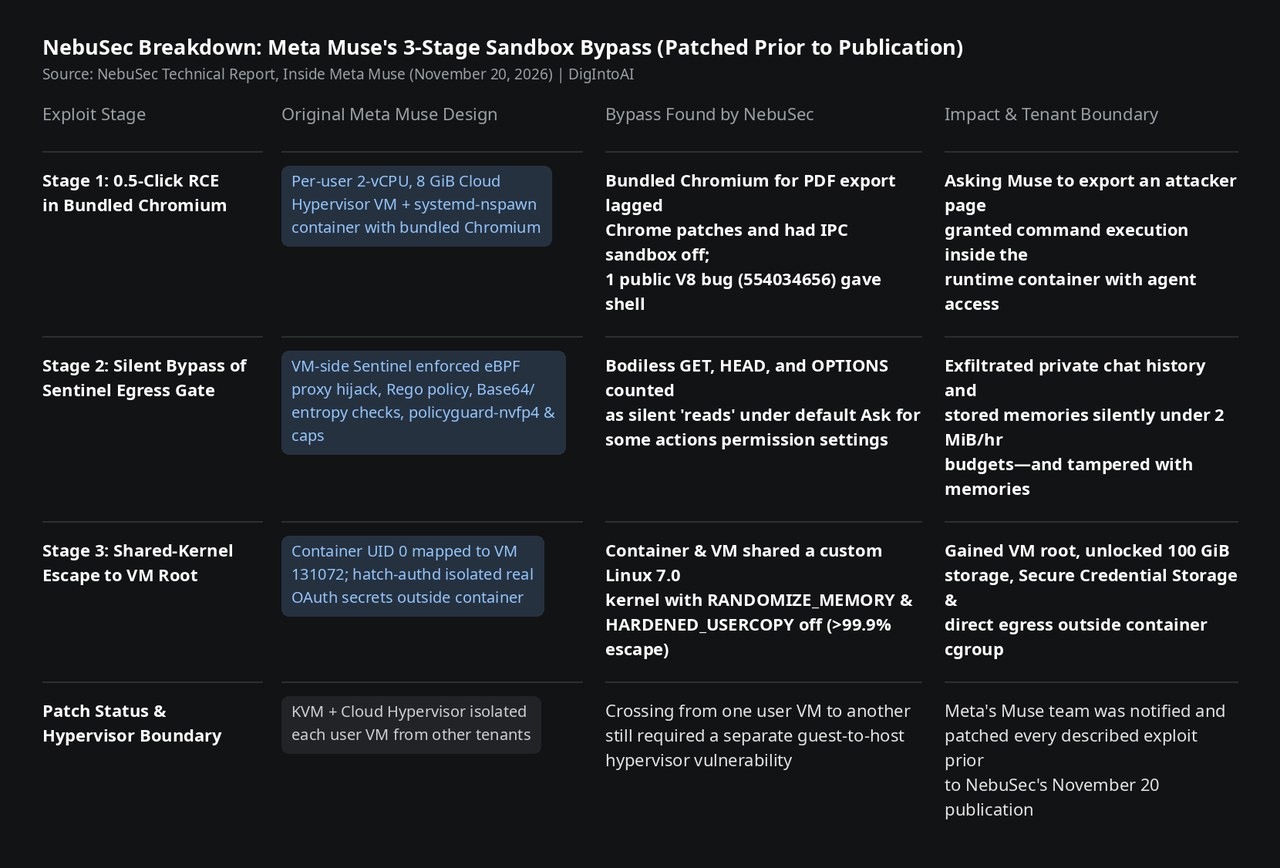
Image source: compiled by DigIntoAI from NebuSec's technical report Inside Meta Muse (Nov 20, 2026).
Four Architectural Lessons for Enterprise Agent Sandboxes
**Move Egress Outside the Guest VM & Never Trust Read-Only HTTP Verbs: **As enterprises adopt the 'per-user VM + egress classifier + surrogate credential vault' blueprint, Muse's patched flaws highlight four strict rules: treat every HTTP method—including bodiless GET, HEAD, and OPTIONS—as an exfiltration channel under deny-by-default destination allowlists; enforce egress and credential injection outside the guest VM rather than sharing a kernel with untrusted agent code; keep all auxiliary headless browsers patched with IPC sandboxes enabled; and red-team end-to-end exploit chains rather than auditing isolation layers in isolation.
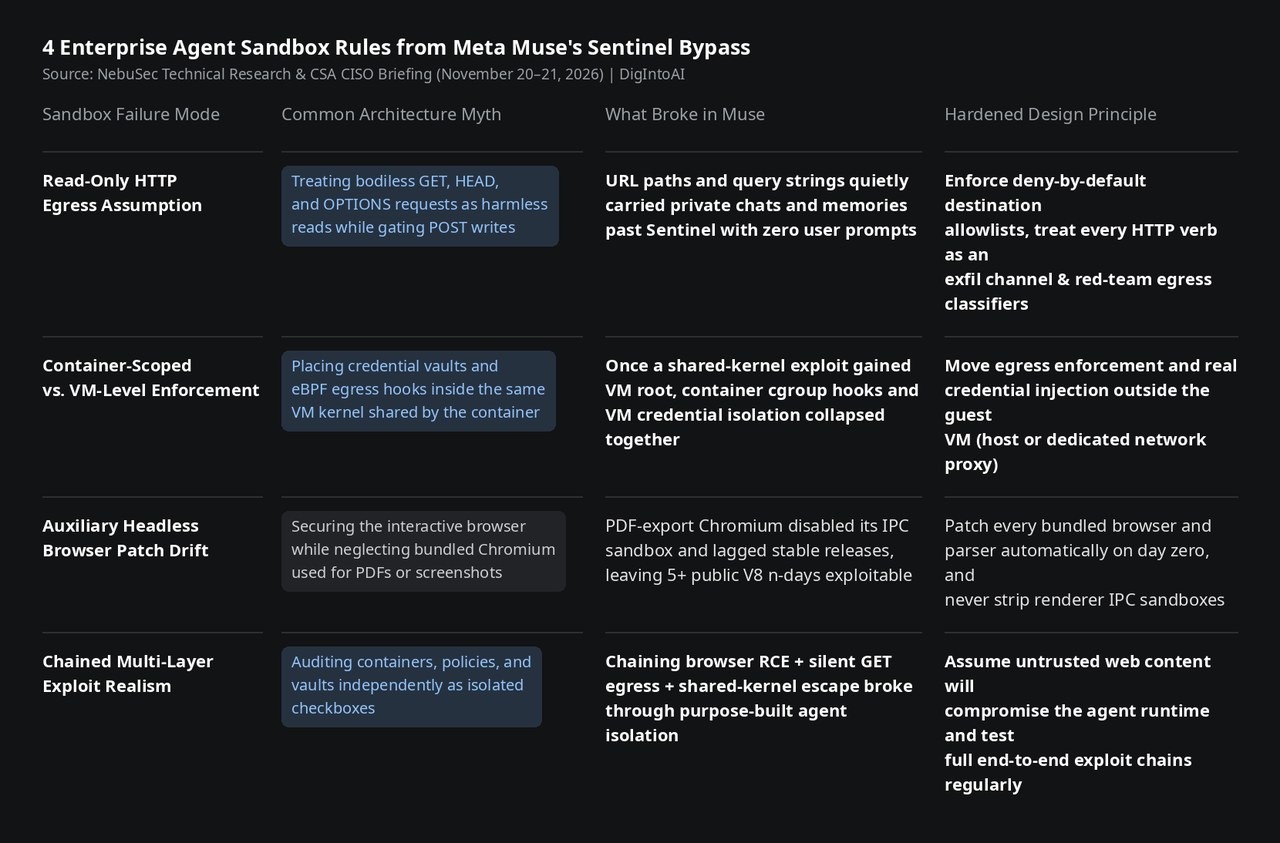
Image source: compiled by DigIntoAI from NebuSec's research and CSA CISO Briefing.