On this page
Between November 21 and November 23, 2026, a supply-chain security investigation into AI inference providers prompted OpenRouter to off-board three inference providers and revoke Zero Data Retention (ZDR) eligibility from 125 endpoints following research by industrial cybersecurity firm Dragos.
How Two Million Canary Prompts Exposed Downstream Leaks
Led by Dragos researcher HD Moore (published November 19, 2026), the five-month study sent approximately two million baited prompts containing unique canary tokens—each carrying a distinct AWS access key, DNS domain, and tracking URL—through routing gateways and inference hosts:
Automated AWS Abuse Within Hours: **Once stolen from intercepted prompts, bait AWS keys were tested within hours to list **S3 buckets, query Secrets Manager and Parameter Store, and attempt to enable Amazon Bedrock models, generating tens of thousands of logged API calls—including one October 21 canary key still active three weeks later.
"A Privacy Flag Only Binds the First Hop": **Crucially, several compromised prompts carried an explicit **Zero Data Retention (ZDR) flag. As Dragos emphasized, a privacy flag only binds the first hop—whether downstream hosting providers, resellers, or upstream model endpoints honor zero retention or prevent server intrusions cannot be verified from the API response alone.
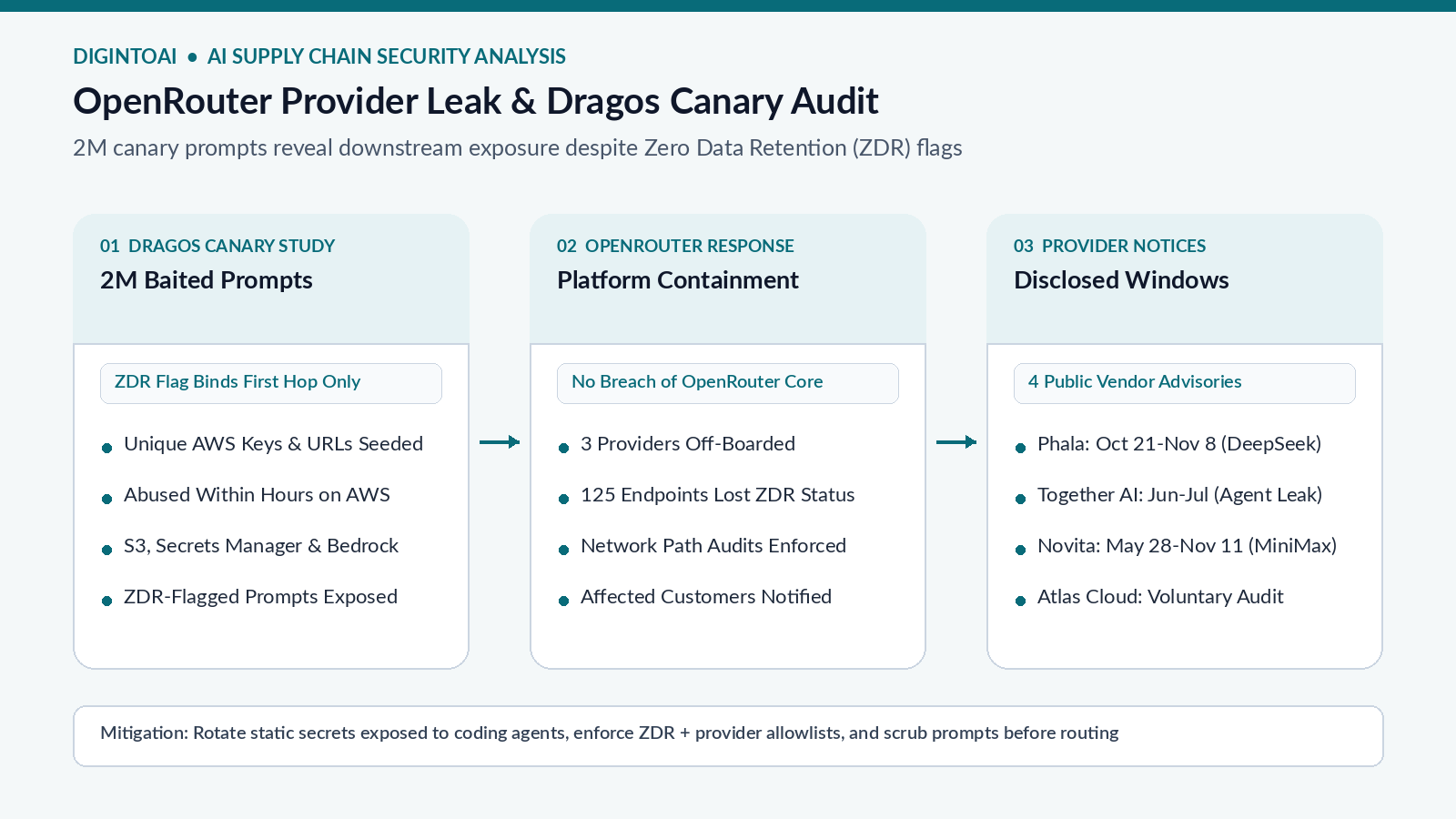
Image source: Analytical diagram created by DigIntoAI based on the OpenRouter announcement and Dragos research findings.
OpenRouter Containment Scope and the Four Provider Advisories
In its November 22, 2026 announcement ("Data Processing Incidents on Inference Providers"), OpenRouter stated that its own systems were not breached. Platform actions included off-boarding three providers, removing 125 endpoints from ZDR eligibility (covering flagged providers plus precautionary removals pending network-path verification), and notifying potentially affected customers. Neither OpenRouter nor Dragos publicly named which three providers were removed, while OpenRouter linked four separate provider notices:
Phala: **Reported an unauthorized intrusion on a production GPU server affecting **DeepSeek V4 Flash 0731 requests routed through OpenRouter between October 21, 2026 at 00:00 UTC and November 8, 2026 at 05:35 UTC (with observed canary abuse occurring on October 21 and 22).
Together AI: **Disclosed that an AI coding agent inadvertently exposed a repository credential on GitHub, enabling unauthorized downloads of stored prompt samples from **June and July 2026 involving MiniMax M3, GLM-5.2, and Kimi K2.6.
Novita: **Issued a privacy notice covering **MiniMax model requests made directly or via OpenRouter between May 28 and November 11, 2026, warning that request contents may have been accessed or retained by third parties.
**Atlas Cloud: **Published a security and privacy statement and voluntarily withdrew its models from OpenRouter while auditing network forwarding paths.
Practical Hardening Checklist for API Developers
Because coding agents routinely ingest local .env files, stack traces, and repository configs into prompt context, developers should rotate any static credentials (AWS keys, database passwords, Git tokens) sent through third-party routers since May 2026, enforce explicit Provider Allowlists alongside ZDR routing controls in OpenRouter, and strip long-lived secrets before prompts leave local workstations.