
On this page
At 10:01 AM CST on November 16, 2026, Qwen announced the official model ID qwen4-max for Qwen4-Max, making it available on QwenCloud via pay-as-you-go API and Token Plan (Personal and Team), as well as across QwenWork, Qoder, and QwenStudio.
Developers should distinguish qwen4-max from the earlier qwen4-max-preview released on November 11, 2026. According to QwenCloud's latest model documentation and Token Plan update page, the separate qwen4-max-preview model and its November 11–25, 2026 (UTC+8) preview window remain active independently, and Qwen describes qwen4-max as now available.
Qwen4 Architecture, Official Evaluations & Token Limit Details
Qwen4-Max introduces the new Qwen4 sparse Mixture-of-Experts architecture with 2.4 trillion backbone parameters (71B activated per token) and an additional 328B N-gram Embedding parameters:
Architectural Upgrades: Pairs three Gated DeltaNet (GDN) layers per Qwen Sparse Attention (QSA) layer with micro-block context indexing, four-branch dynamic Gated Residual (GR) connections, and second-layer N-gram Embedding lookups, completing pre-training at 2.4T scale with no loss spikes. Qwen also notes that smaller open-source models in the Qwen4 family are coming later (no open-weight repositories are live yet).
Official Internal Benchmark Disclosures: On Qwen's Work360 evaluation (spanning 26 Tier-1 domains, 182 subdomains, and 721 specialized fields), Qwen4-Max scored 52.69 versus 47.74 for Qwen3.8-Max, cutting average per-task cost by 62% ($4.43 to $1.67) and reducing token usage by roughly 24% at Xhigh effort and 35% at High effort (and by roughly 48% and 49% on Terminal-Bench 4.0). The blog's Footnotes also cite official evaluations on JobBench (dataset commit d43a66575635da0d3f6cb9a20976dc1a60f3ffc9 and code commit 660b33a86ed032559df0b2fdc1ad38cf7ceb83f3), APEX-Agents v1.1, AA-Briefcase v1.1, AutomationBench-AA, CodeArena, AgentArena, HLAB-Vals-1.1, Agents' Last Exam v1.1, and ChartoGraphy (evaluated at min_pixels=4096x32x32).
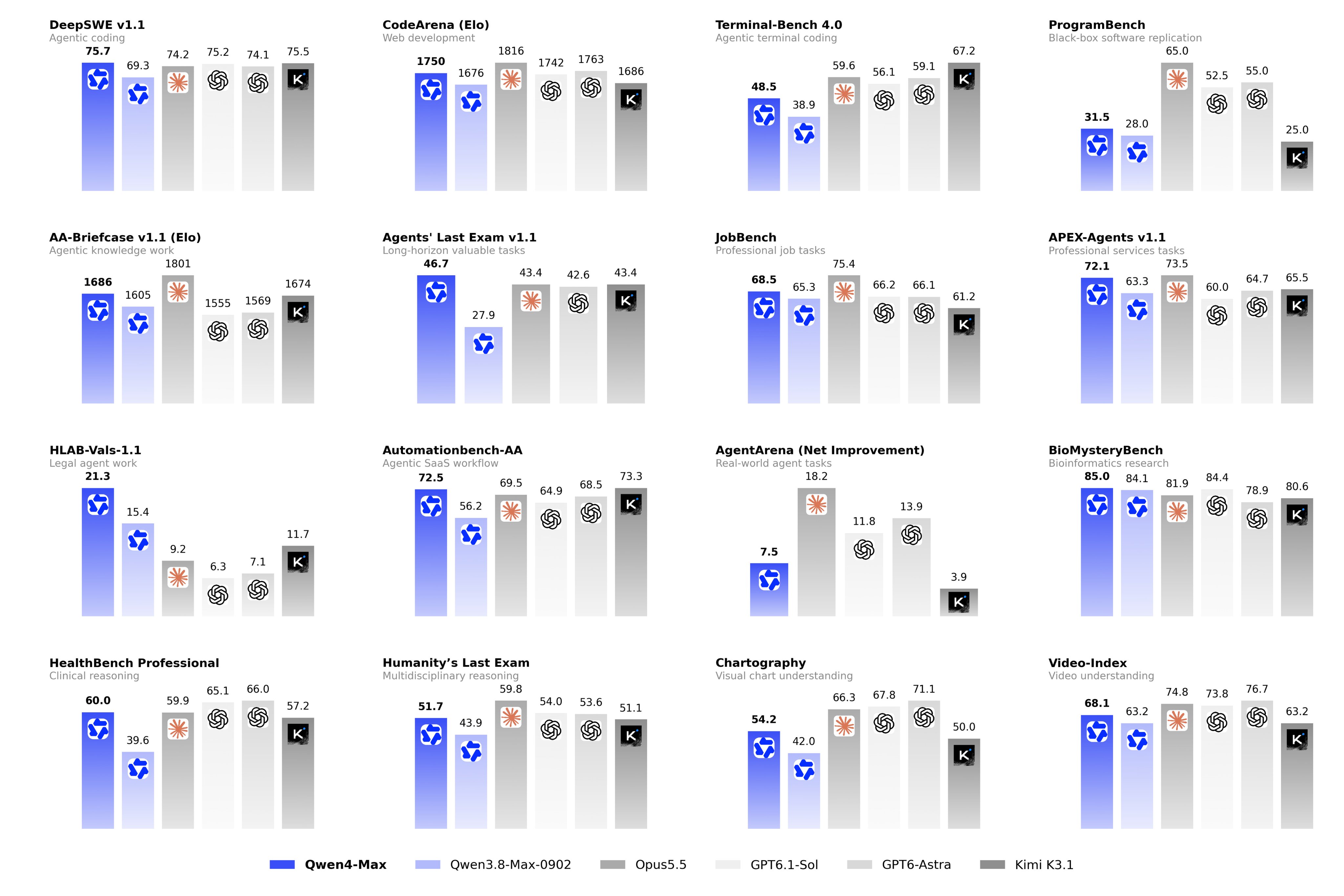
Image source: Qwen official blog, “Qwen4-Max: Your New Teammate Has Arrived” (official image, proportionally downscaled). Official internal evaluation; methodology in the blog’s Footnotes.
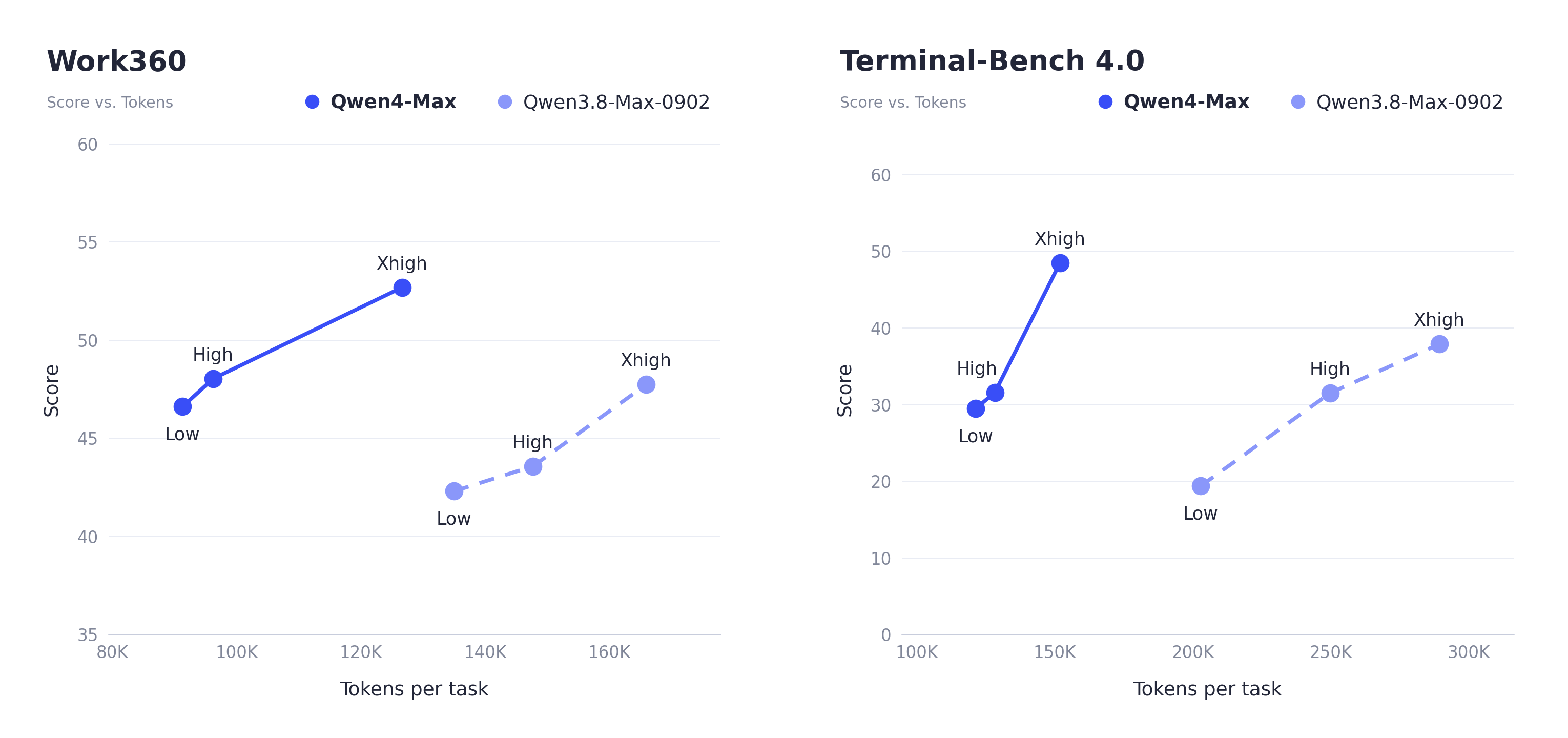
Image source: Qwen official blog, “Qwen4-Max: Your New Teammate Has Arrived.” Official internal evaluation; methodology in the blog’s Footnotes.
Context & Output Limits (Documentation vs. Product Page): QwenCloud's latest developer documentation and Alibaba Cloud's China help page both specify a 1,000,000-token context window, 131,072 max output tokens in non-thinking mode (991,808 max input), and 262,144 combined tokens for thinking plus final answer in thinking mode (983,616 max input; thinking enabled by default at high effort with low, high, and xhigh options, and preserve_thinking enabled by default). Note that the QwenCloud web product page still displays 393K max output; until reconciled, developers should size output budgets against the 131,072 / 262,144 developer guide limits.
Supported Capabilities & Exclusions: Supports text, image, and video input with text output, function calling, structured outputs, web search, PDF understanding, MCP, explicit/implicit caching, and thinking-mode code interpreter across OpenAI Chat Completions, Responses, Anthropic Messages, and DashScope endpoints. Fine-tuning, custom model deployment, and batch inference are listed as unsupported in the latest model capability table.
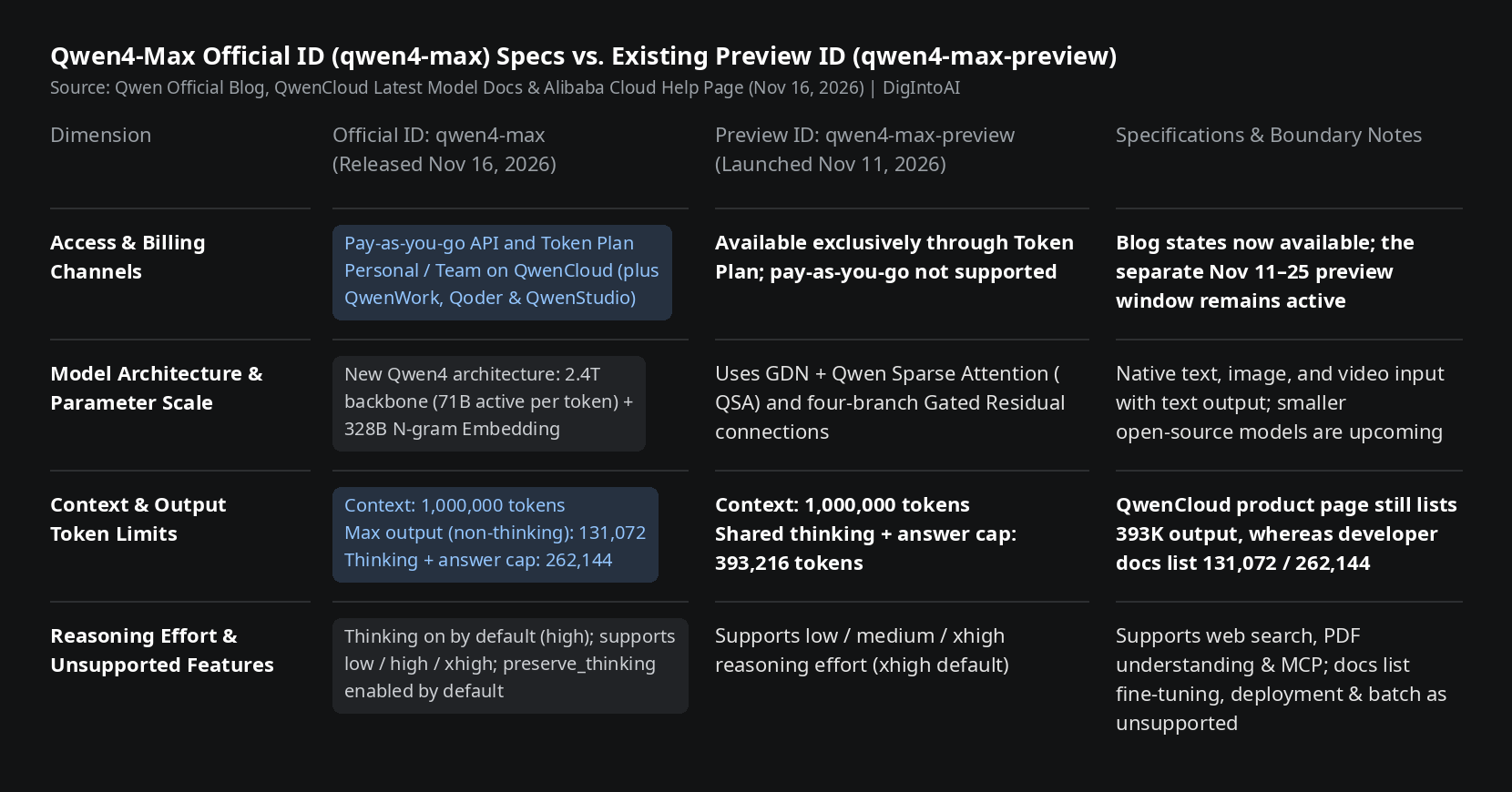
Image source: compiled by DigIntoAI from the Qwen official blog, QwenCloud docs, and Alibaba Cloud help page.
Regional USD Pricing, Singapore Free Quota & Third-Party Channels
QwenCloud bills all regions in USD at identical rates for thinking and non-thinking modes without input-length tiers:
Singapore (International) Rates & 1M Free Quota: $1.50 per 1M input tokens, $4.50 per 1M output tokens (thinking + answer), $0.075 per 1M cache-read tokens, $1.875 for 5-minute cache writes, and $3.00 for 1-hour cache writes. Under QwenCloud's new-model free quota rules, accounts using a Singapore API key on the Singapore endpoint receive 1M free real-time tokens valid for 90 days from model launch (excluding built-in tool fees such as web search; other regions do not include free quota).
Beijing & Global Region Rates: China North 2 (Beijing) and Global deployments (Frankfurt, Hong Kong, Tokyo, and US Virginia) are priced at $1.413 input, $4.24 output, $0.071 cache read, $1.767 5-minute cache write, and $2.827 1-hour cache write per 1M tokens.
OpenRouter Availability (qwen/qwen4-max): Live on OpenRouter via Alibaba as sole provider under ID qwen/qwen4-max with 1M context, a 131,072-token maximum output, text/image/video input, and reasoning effort controls (xhigh, high, low, none). OpenRouter's current listed price is $1.425 input, $4.275 output, $0.07125 cache read, $1.78125 for 5-minute cache writes, and $3.00 for 1-hour cache writes per 1M tokens. These figures are recorded separately from the official QwenCloud Singapore standard rates above.
OpenCode Go Coding Plan (opencode-go/qwen4-max): Added to OpenCode Go on November 16 across Go ($10/month), Go Plus ($40/month), and Go Teams ($20/member/month) at the same token rates ($1.50 / $4.50 / $0.075), counting toward monthly plan dollar limits (20% per 5 hours, 50% weekly) with 0-day data retention and no training on user prompts.
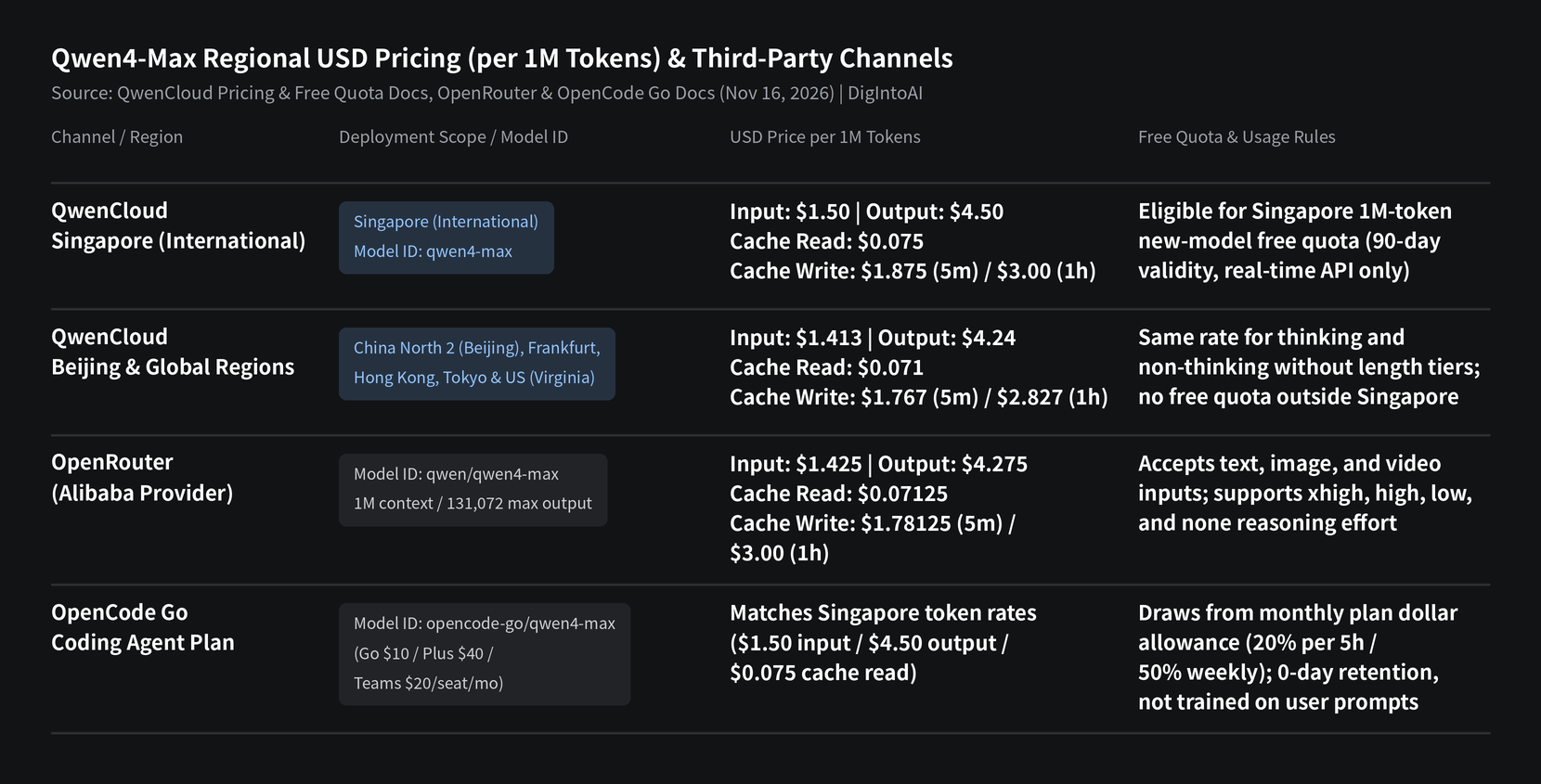
Image source: compiled by DigIntoAI from QwenCloud pricing docs, OpenRouter, and OpenCode Go documentation.
Novita AI Availability (qwen/qwen4-max)
On November 16, 2026, Qwen's official account @Alibaba_Qwen quoted Novita AI, confirming that Qwen4-Max was callable on Novita from day one. Novita's official blog was published the same day at 17:30 (Asia/Shanghai). The call ID is qwen/qwen4-max, the same string used above for OpenRouter; the official QwenCloud ID is qwen4-max. The model page offers OpenAI-compatible and Anthropic-compatible endpoints.
Novita platform pricing is $1.413 input, $4.24 output, and $0.071 cache read per 1M tokens, with cache writes at $1.767 (5-minute) and $2.827 (1-hour). These figures match the QwenCloud Beijing and Global rates already listed above, and are billed as Novita platform prices. The Novita model page displays a 977K context window, with a nominal 1,000,000 tokens.
For maximum output, Novita's blog lists 393,000 tokens and says the model page displays 384K; the current model page displays 128K, and the public model catalog and on-page API sample use 131,000 tokens.
Third-Party Community Leaderboards & Open-Source Timeline
Community Arena Placements: In third-party announcements reshared by Alibaba_Qwen on November 16, DesignArena ranked Qwen4-Max #1 in Python-PPTX and Spreadsheet tasks, while LM Arena ranked it #1 among open models in Agent Arena and #1 among open models (#2 overall) on both the preliminary Image-to-WebDev Arena and preliminary Code Arena WebDev leaderboards.
Open-Weight Timeline: No open-weight Qwen4 checkpoints have been released yet; Qwen states smaller Qwen4 models will come to open source later.
