
On this page
At 12:18 PM CST on November 23, 2026 (November 22 evening Pacific time), Zixuan Li—head of global product and model releases at Zhipu AI's international arm Z.ai—announced on X that GLM-5.4 is now available to all GLM Coding Plan subscribers. The post surpassed 270,000 views within hours, followed by a practical setup reply specifying exact model identifiers: set glm-5.4[1m] in Claude Code and glm-5.4 in all other coding tools. In parallel, Zhipu AI's domestic operations team notified Chinese subscribers that GLM-5.4 is live across V2, V3, and Team plans, with Chinese Coding Plan model selectors already displaying '1M' and 'Vision' tags.
Yet just as the top-liked reply under Li's post bluntly asked—'Where are the benchmarks?'—shipping straight to a subscription tier ahead of documentation creates real gaps that builders need to treat carefully. Cross-checking Z.ai's live developer documentation (docs.z.ai), Chinese operations relays, and public model catalogs on November 23 reveals exactly what is confirmed today, what remains undocumented, and how developers should test GLM-5.4 without over-reading early social posts.
Day-One Fact Audit: What Is Confirmed vs. What Is Still Missing
**Four Actionable Facts Confirmed Today: **Across Li's English posts and Zhipu's Chinese operations message, four launch facts are concrete. First, access is open to every GLM Coding Plan subscriber—not gated behind an invite beta—spanning international Lite, Pro, and Max plans alongside Chinese V2, V3, and Team tiers. Second, GLM-5.4 brings native vision capabilities to Z.ai's flagship coding slot, closing a major gap left by the text-only GLM-5.3 flagship (previously, screenshot debugging required dropping down to the multimodal GLM-5.3-Flash line). Third, Z.ai claims stronger all-round coding performance. Fourth, for subscribers subject to weekly quotas, running GLM-5.4 provides 50% more weekly quota (1.5x) than running GLM-5.3 on the same tier.
**Five Critical Gaps Not Yet Published: **Live checks of docs.z.ai/devpack/overview and Z.ai's public rate card show documentation has not caught up yet—official tables still list only GLM-5.3 and GLM-5.3-Flash. Five major items remain unconfirmed as of publication: first, zero public benchmark scores exist for GLM-5.4 (no SWE-bench, Terminal-Bench, or Artificial Analysis Intelligence Index v5.0.1 result yet—and readers must not confuse today's '+50% weekly quota' with GLM-5.3's August claim of '+50% coding performance vs. GLM-5.2' on Z.ai's private Code Bench); second, there is no standalone pay-as-you-go API token price page and no named OpenRouter route; third, no open-weight Hugging Face checkpoint or license has been released (for now, GLM-5.4 is Coding Plan API-only, echoing GLM-5.3's two-week wait before releasing custom-licensed weights); fourth, parameter count, max output length, and exact vision media limits (image resolution, video, or PDF support) are unpublished; and fifth, existing glm-5.3 traffic does not auto-upgrade—subscribers must manually change their model string.
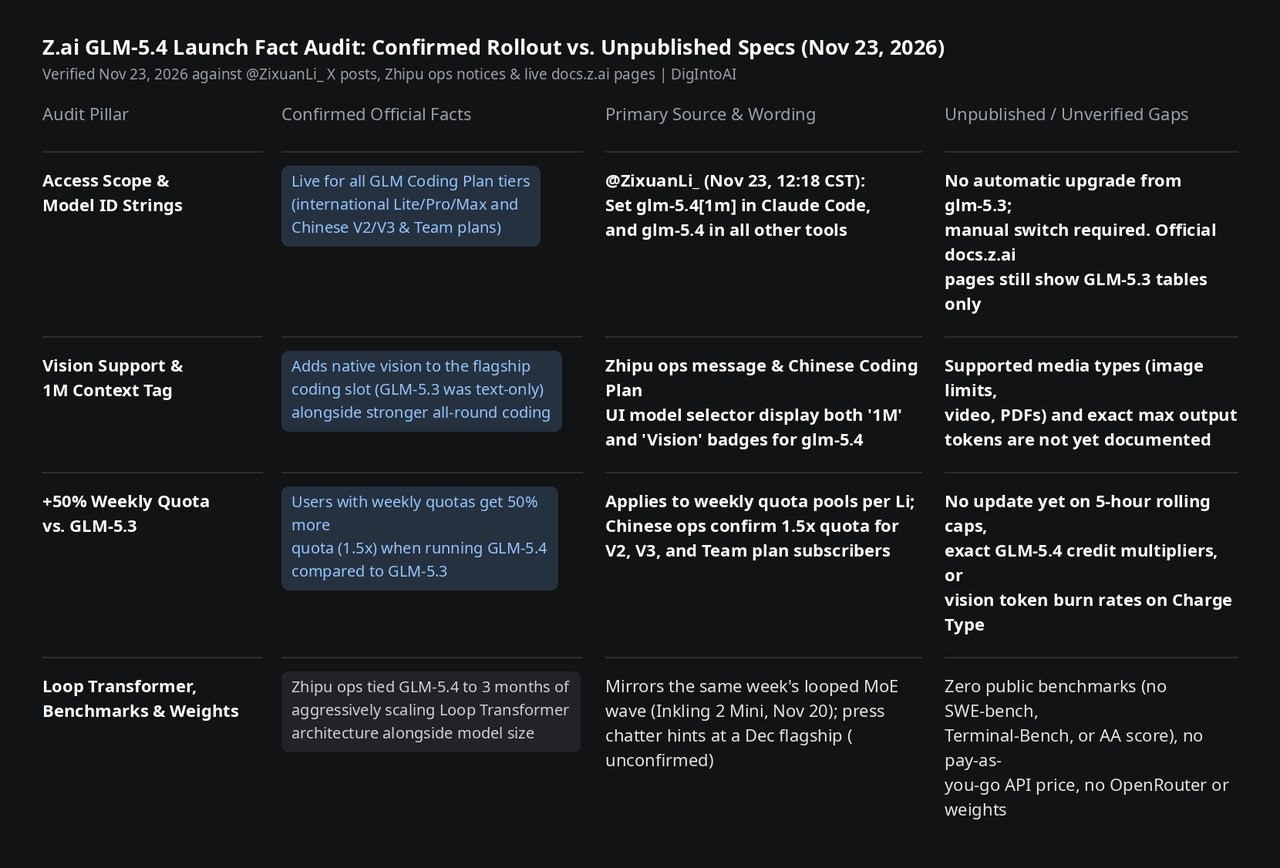
Image source: compiled by DigIntoAI from @ZixuanLi_ X posts, Zhipu operations notices, and live docs.z.ai pages.
The Loop Transformer Signal: Why Looped Architectures Are Surging This Week
**Zhipu's Operations Note Ties GLM-5.4 to 'Scaling Loop': **While the English X thread stayed brief, Zhipu's domestic operations message offered a notable architectural hint: 'Over the past three months, we aggressively scaled both Looping and model size simultaneously—what everyone is seeing first is the surprise brought by Loop Transformer. GLM-5.4 adds vision capabilities and stronger all-round coding.' That phrasing explicitly frames GLM-5.4 as Zhipu's first commercial production release showcasing a looped Transformer design.
**Same-Week Convergence with Inkling 2 Mini—and Unconfirmed December Chatter: **The timing is striking: just three days earlier on November 20, Thinking Machines Lab open-sourced Inkling 2 Mini, a 26.4B looped MoE model that runs its middle 12 weight-shared layers three times to achieve 48-layer effective reasoning depth in a 20 GB footprint. Although Zhipu has published no technical report detailing GLM-5.4's exact loop depth or active parameter count, looped architectures allow models to apply deeper per-token reasoning without linearly expanding memory weight footprints—a compelling engineering rationale for how Z.ai can offer 50% more weekly quota at unchanged subscription prices. Until a formal paper lands, treat Loop Transformer details as positioning rather than verified architecture diffs; similarly, Chinese press chatter (Kuai Technology / AIBase) speculating about a separate 3-trillion-parameter flagship in December remains unconfirmed by Zhipu.
Decoding the +50% Weekly Quota Boost Against Coding Plan Credit Math
**Dual Credit Pools, Peak Hours & Illustrative GLM-5.4 Math: **Per docs.z.ai/devpack/overview, GLM Coding Plan starts at $18/month (Lite $18, Pro $80, Max $168) and bundles Vision Understanding, Web Search, Web Reader, and Zread MCP tools. Every plan enforces two simultaneous pools: a dynamically refreshing 5-hour pool (Lite 2,000 / Pro 12,000 / Max 28,000 credits) and a 7-day weekly pool (Lite 10,000 / Pro 60,000 / Max 140,000 credits). Credits deduct via the formula (Input × Input Multiplier + Cached Input × Cached Multiplier + Output × Output Multiplier) / 10,000, plus 1.2 credits per MCP call. On published tables, GLM-5.3 uses multipliers of 6.9 / 1.7 / 24 versus 2.3 / 0.56 / 8 for GLM-5.3-Flash, while off-peak hours (everything outside Monday–Friday 14:00–18:00 Singapore time, UTC+8) bill at 50% of the standard credit rate—yielding up to 92% savings versus standard GLM-5.3 API pricing when fully utilized.
**Two Caveats Before Resizing Team Budgets: **If the +50% weekly quota boost scales evenly across the weekly pools when glm-5.4 is selected, Lite, Pro, and Max subscribers would effectively see 15,000, 90,000, and 210,000 weekly credits respectively (or roughly one-third lower weekly credit burn). Still, two unknowns matter in practice: first, Li's post specifies weekly quotas without stating whether the 5-hour rolling cap increases, meaning bursty agent sprints could still hit 5-hour ceilings first; second, multimodal vision tokens often carry separate credit multipliers, so heavy screenshot loops could burn credits faster than text-only GLM-5.3 until Z.ai updates its Charge Type table. Competitively, holding the $18 starting price while expanding weekly volume by 50% sharpens Z.ai's value proposition against Qwen Token Plan, low-cost DeepSeek V4.1 Flash ($0.15/$0.60 off-peak), Kimi K3.1 Pro ($2/$10), and closed flagships like Claude Opus 5.5 ($4/$20) and GPT-6.2 Astra ($8/$40).
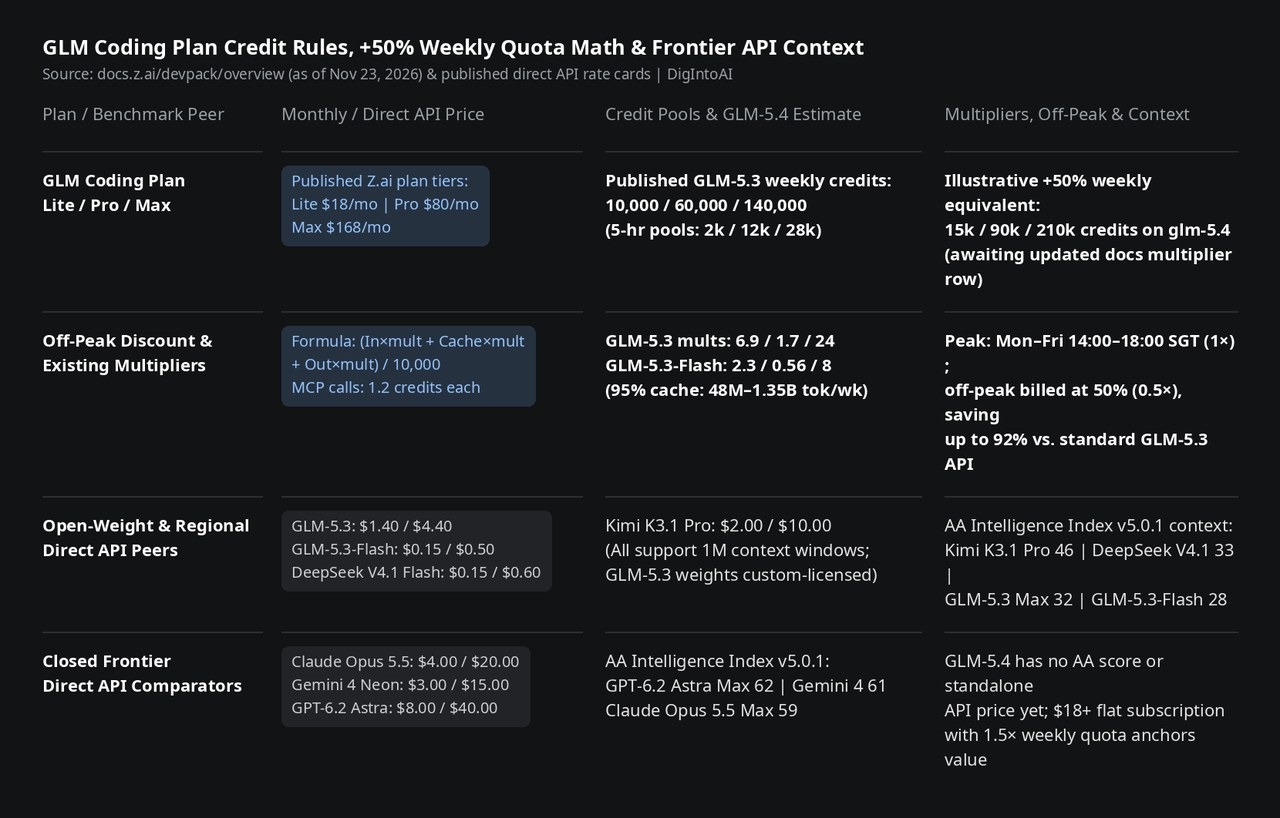
Image source: compiled by DigIntoAI from docs.z.ai/devpack/overview and published vendor API rate cards.
Step-by-Step Setup: Switching Claude Code (glm-5.4[1m]) and Other Harnesses
**Exact Claude Code Configuration Without Breaking 1M Context: **For developers routing Claude Code through Z.ai's Anthropic-compatible endpoint, Zixuan Li emphasized setting the model string to glm-5.4[1m] rather than plain glm-5.4. As documented in docs.z.ai/devpack/tool/claude, Claude Code uses the [1m] suffix alongside context environment flags to unlock the 1M-token window. Existing Coding Plan API keys continue to work without regeneration. Open your home directory's .claude/settings.json file, confirm ANTHROPIC_BASE_URL is set to https://api.z.ai/api/anthropic and ANTHROPIC_AUTH_TOKEN holds your Z.ai key, then update ANTHROPIC_DEFAULT_SONNET_MODEL and ANTHROPIC_DEFAULT_OPUS_MODEL from glm-5.3[1m] to glm-5.4[1m] (keeping ANTHROPIC_DEFAULT_HAIKU_MODEL on glm-5.3-flash[1m] if you want cheaper fast sub-calls). Retain CLAUDE_CODE_MAX_CONTEXT_TOKENS and CLAUDE_CODE_AUTO_COMPACT_WINDOW at 1000000 and API_TIMEOUT_MS at 3000000, then close and reopen all terminal sessions so Claude Code reloads the file.
**Other 20+ Agent Harnesses & Common Routing Pitfalls: **Across ZCode, OpenCode, Cline, Codex, AutoClaw, OpenClaw, and other supported tools, set the model identifier directly to glm-5.4. Be cautious if using automated helpers such as npx @z_ai/coding-helper or Z.ai's curl install script—until those scripts update, they may still write GLM-5.3 defaults into config files. Always verify after switching that traffic actually lands on api.z.ai and logs glm-5.4 on your dashboard; stale environment variables or mistyped base URLs are the leading reason developers unknowingly stay on GLM-5.3 or fall back to Anthropic's cloud.
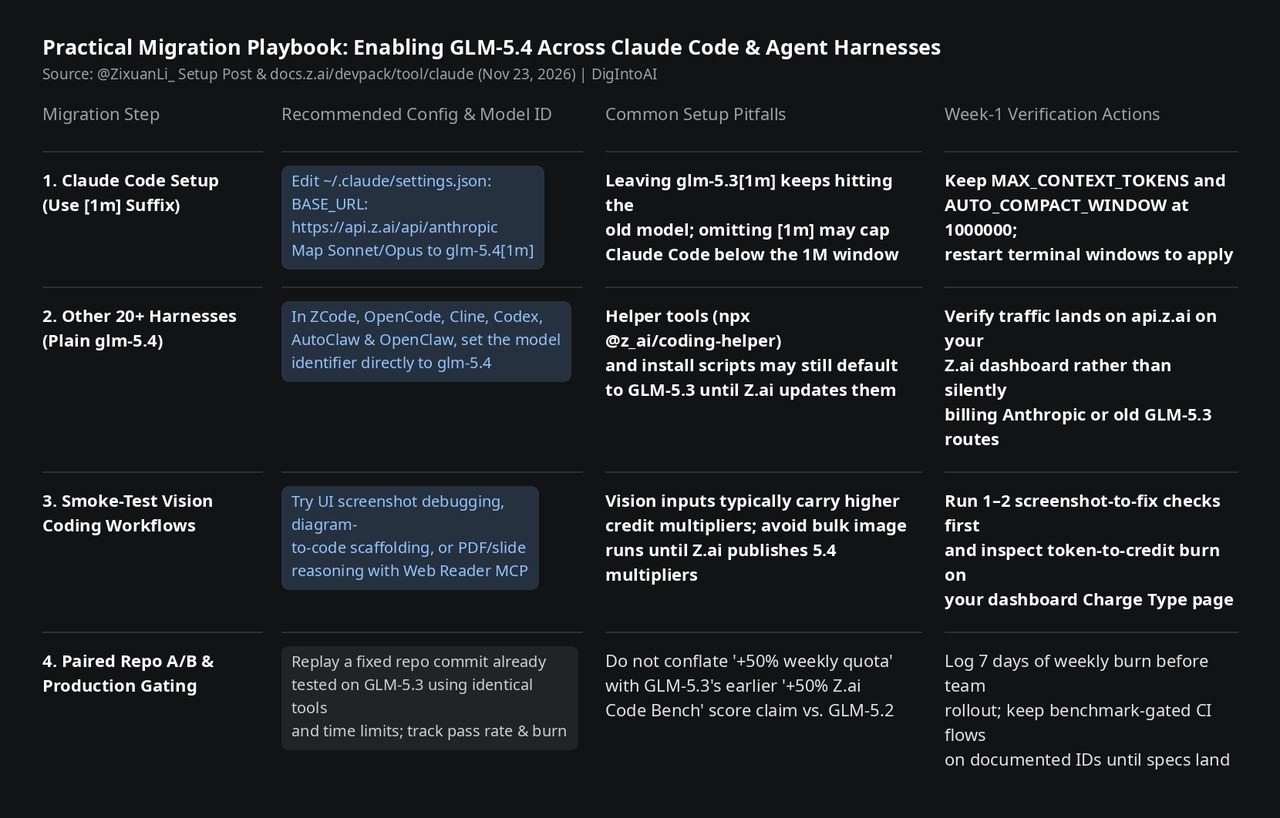
Image source: compiled by DigIntoAI from @ZixuanLi_ setup instructions and docs.z.ai/devpack/tool/claude.
Pragmatic Evaluation Playbook for Week One
**Separate Access from Proof Before Standardizing Team Defaults: **Social-first rollouts followed days later by model cards have become routine across frontier labs. Rather than taking unverified claims at face value, engineering teams should follow three pragmatic steps this week: first, replay a fixed repository commit previously attempted on GLM-5.3 using identical instructions, MCP tools, and time caps, logging first-pass mergeability, review effort, and actual credit burn per accepted patch; second, run targeted vision smoke tests—such as CSS layout screenshot debugging or whiteboard-to-scaffold generation—and immediately check credit burn on the Charge Type page; and third, keep benchmark-gated or compliance-audited production pipelines on documented model IDs until Z.ai publishes formal scorecards, token multipliers, and standard API terms.