
On November 19, 2026, Google introduced Tool Retrieval in preview inside the Gemini Interactions API, authored by Gemini API Product Manager Lucia Loher and Google DeepMind Research Scientist Nora Kassner. When agents connect to dozens or hundreds of functions, sending every parameter schema in every prompt inflates input token counts, adds latency, and degrades tool-selection accuracy. Tool Retrieval keeps long-tail parameter schemas out of initial context and loads them only when needed.
Server-Side Retrieval, Remote MCP Support & Client-Side Execution
**Names and Descriptions Stay Up Front; Schemas Load in the Same Call: **To enable server-side retrieval without building a custom index, developers add a tool_search entry to tools and set defer_loading: true on deferred function definitions. The model still sees every deferred tool's name and description so it knows what is available, while full parameter schemas remain outside initial context. When needed, the model emits a tool_search_call, receives the schema via tool_search_result, and outputs the function_call inside the same API request—all inspectable in interaction.steps. Setting defer_loading: true on an mcp_server tool also loads tools exposed by large remote MCP servers on demand.
**Client-Side Retrieval & Model Support: **For custom tool registries, embedding indexes, or per-user permission filters, developers can declare tool_search with execution: client. Client-side retrieval adds one round trip per lookup but requires no upfront tool declarations, allowing new tools to appear mid-conversation. Tool Retrieval works in the Interactions API with Gemini 3.6 and later models, including all Gemini 4 models.
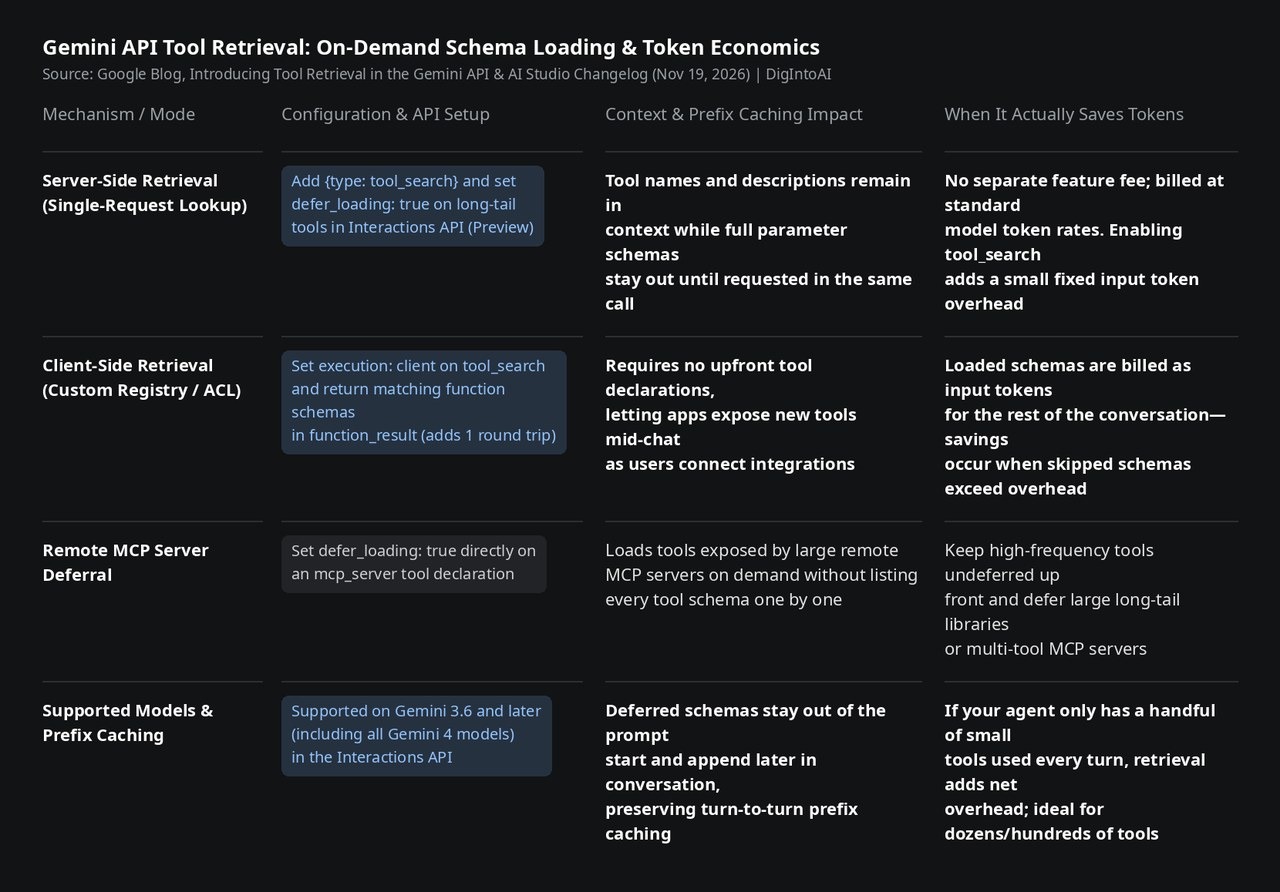
Image source: compiled by DigIntoAI from Google's official blog post and AI Studio changelog.
When Does Tool Retrieval Actually Save Tokens?
**Standard Token Billing & Prefix Caching Preservation: **Google notes there is no separate charge for Tool Retrieval—all input and output tokens are billed at standard model rates. However, enabling tool_search adds a small fixed block of input tokens, and once a schema is loaded, it remains in context and is billed as input tokens for the rest of the conversation just like an upfront tool. Net savings occur when the parameter schemas your agent never loads outweigh the retrieval overhead plus loaded schemas—making it ideal to keep frequent tools undeferred while deferring large long-tail libraries. Because deferred schemas append later in the conversation rather than altering the prompt start, prefix caching remains intact across turns.