
Real-time voice APIs remain a top priority for automotive, support, and hardware builders, yet November 2026 field reports on the Google AI Developers Forum (discuss.ai.google.dev) highlight why routing noisy or non-English production audio directly into models/gemini-3.8-live requires strict defensive engineering.
92 Live Sessions Audited: 29%–37% Errors Despite Explicit languageCode
**Local Apple ASR Scored 7% Error on the Exact Same Audio: **A developer building a Nordic in-vehicle navigation app logged 92 live sessions (134 audio turns) with languageCode explicitly set to fi-FI. Gemini Live input transcription still suffered a 29% semantic error rate—spiking to 37% through CarPlay microphones—frequently bleeding into other languages, whereas running the exact same recordings through local Apple speech recognition yielded just 7% error. For non-English or noisy acoustic pipelines, running dedicated on-device ASR (Apple or Whisper) first and feeding clean text into Gemini remains significantly more reliable than trusting Live language locking.
Handling 1011/1008 Drops, Runaway Audio & Ryzen VER=8 Timeouts
**Three Defensive Layers for Production Voice Apps: **High-traffic forum threads also document three transport hazards: mid-session WebSocket 1011 and 1008 disconnects, occasional runaway audio streams, and 15–30 second handshake drops on bidiGenerateContent?VER=8 across affected AMD Ryzen hosts. Production clients should implement exponential-backoff reconnects backed by a local rolling conversation summary, enforce client-side PCM watchdogs and hard barge-in playback flushes, and run independent health probes to fall back cleanly to standard text plus standalone TTS whenever Live handshakes degrade.
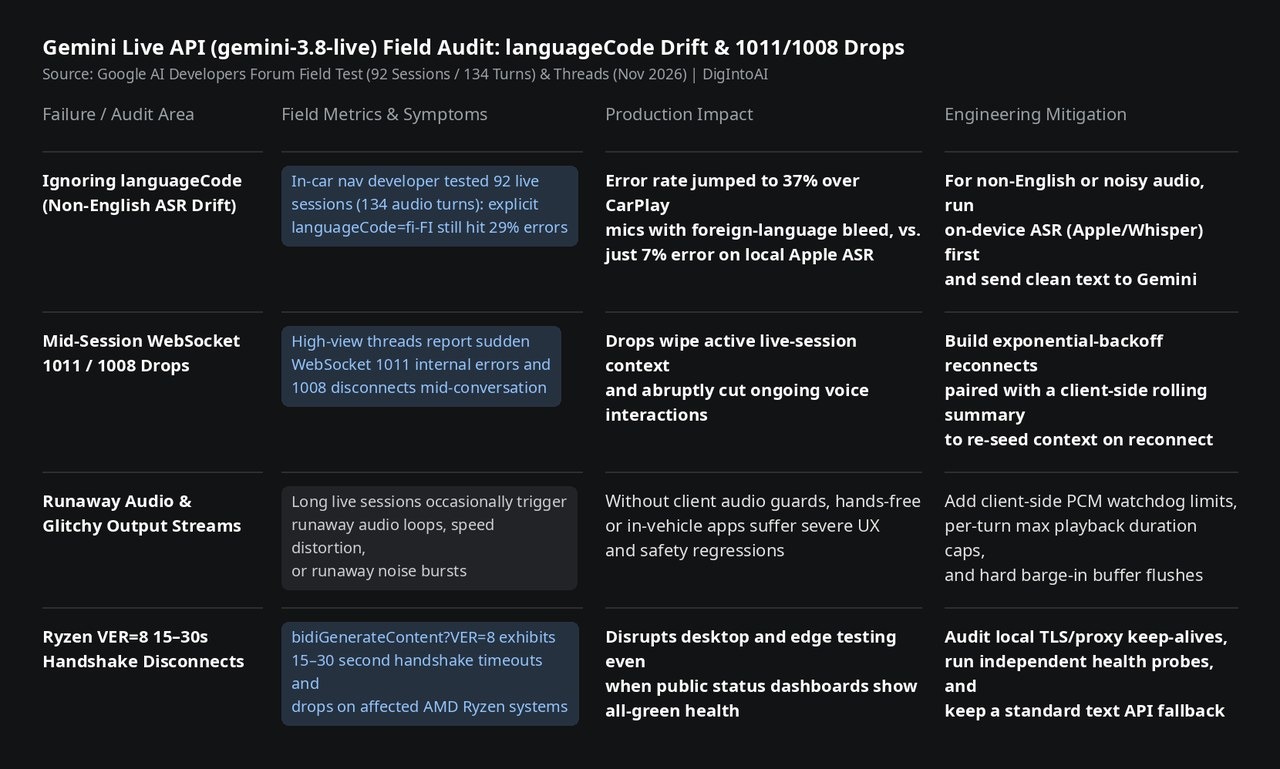
Image source: compiled by DigIntoAI from Google AI Developers Forum field tests and threads (Nov 2026).