
On this page
On November 23, 2026, Google DeepMind and Google Quantum AI published new research demonstrating how teams of Gemini 4 agents paired with the Lean 4 formal theorem prover can discover provably correct, lower-cost quantum algorithms—releasing the accompanying Lean verification framework on GitHub as google-deepmind/formal-quantum-computation.
Using Lean 4 Proofs When Quantum Hardware Sandboxes Do Not Exist
Conventional AI coding agents rely on executing candidate programs against unit tests, an approach impossible for large-scale quantum circuits that exceed both classical supercomputers and today's small quantum processors. DeepMind replaced runtime test execution with mathematical proof verification:
**Formal Problem Specifications With sorry Placeholders: **Researchers encode target quantum programs, error bounds, and T-gate/qubit resource limits in Lean 4 using classical-quantum Hoare logic, leaving placeholders (sorry) for the candidate circuit, cost bound, and formal proofs.
**Independent Agent Teams and 4-Hour Virtual Conferences: **Multiple independent Gemini 4 agent teams iterate using analytical derivations, simulation, and numerical optimization. Only candidates verified by Lean 4 enter a shared notebook, and every four hours agents convene in a virtual conference to trade, debate, and refine ideas.
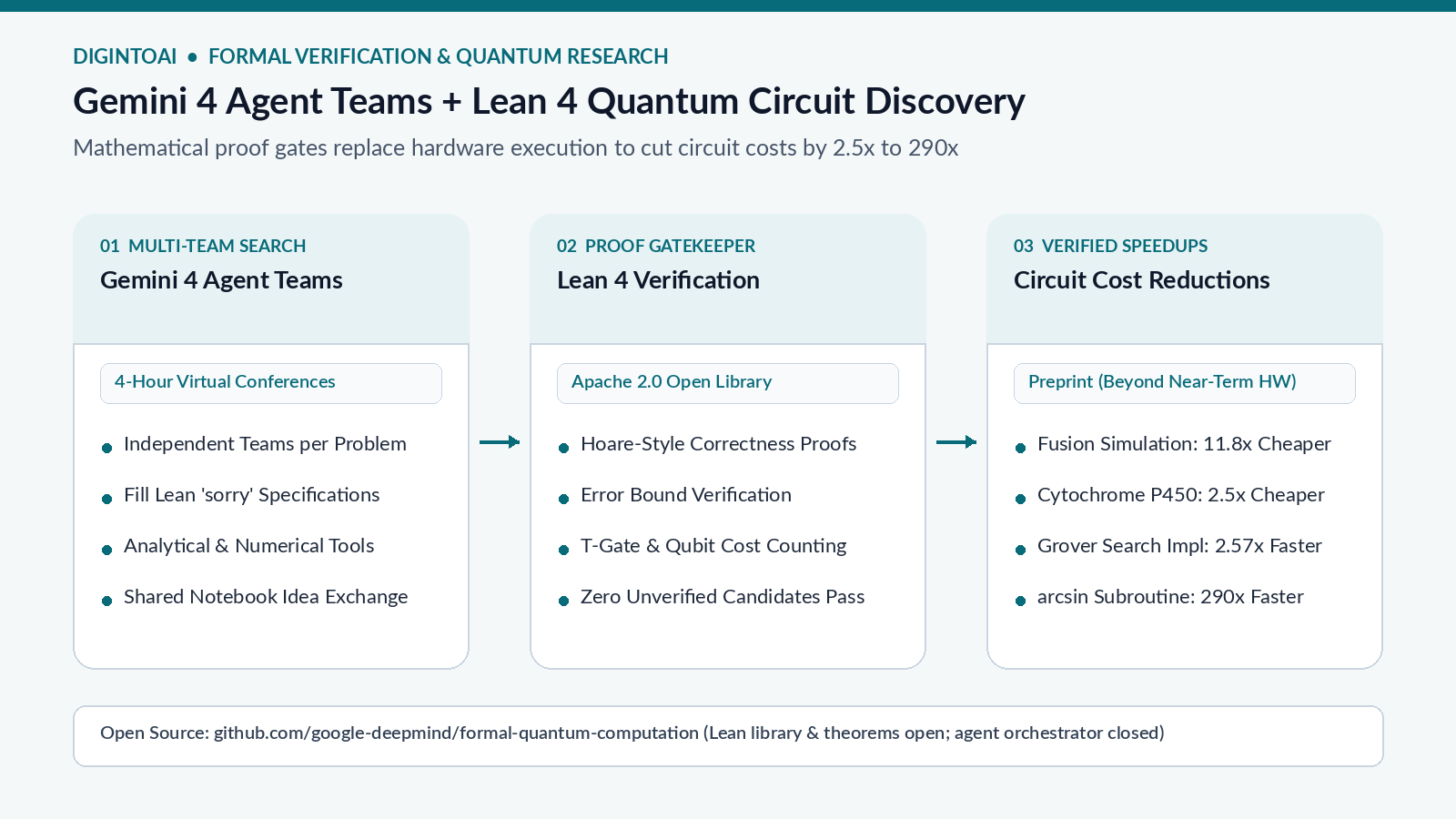
Image source: Technical diagram created by DigIntoAI based on the Google DeepMind blog post and arXiv preprint.
Verified Resource Reductions From 2.5x to 290x
Across scientific simulation targets and foundational quantum subroutines, Lean-verified circuits discovered by the agent teams delivered substantial resource reductions:
Inertial Confinement Fusion (11.8x Lower Cost): **Cut combined qubit-and-operation computing cost by **11.8x for calculating electronic stopping power in warm-dense hydrogen fuel, lowering memory requirements from 5,650 to 4,338 error-corrected qubits.
Cytochrome P450 Drug Metabolism & Photochemistry (2.5x and 8x Cheaper): **Reduced simulation cost by **2.5x (and memory from 481 to 333 qubits) for Cytochrome P450—an enzyme central to human drug metabolism—by eliminating bulky memory lookups, and cut simulation cost by 8x for a light-sensitive photochemical molecule.
Grover Search & arcsin Subroutine (2.57x and 290x Speedups): **Achieved a **2.57x speedup on a specific implementation of Grover's search algorithm and a 290x improvement for arcsin, a core arithmetic routine used across quantum algorithms to load classical numbers into quantum states.
Scope Boundaries: Open-Source Artifacts, Preprint Status, and Hardware Limits
Three boundaries frame the practical takeaway: first, the Apache 2.0 repository (google-deepmind/formal-quantum-computation) open-sources the Lean 4 Hoare-logic and resource-counting library, problem specs, and verified theorems, whereas the underlying Gemini 4 multi-agent orchestration system remains proprietary; second, the accompanying paper (arXiv:2611.09822) is currently an arXiv preprint that has not yet undergone peer review; and third, DeepMind explicitly notes that running these full scientific simulations still demands more resources than first-generation error-corrected quantum hardware is likely to provide.