On November 18, 2026, Google DeepMind published the Genie 4 Model Card and concluded its closed research preview, opening Genie 4 in Project Genie to eligible Google AI Ultra subscribers alongside a waitlist for Google AI Pro subscribers. On November 19, 2026, Google AI Studio followed by releasing Genie 4 (models/genie-4) to general availability (GA) on the paid tier of the Gemini Interactions API (v1beta).
Real-Time 24 fps World Simulation with Synchronized 48 kHz Audio
**Gemini Omni Flash + Gemini Reasoning Architecture: **Per the model card, Genie 4 builds on Gemini Omni Flash to anchor simulations in real-world visual appearance and physics while leveraging Gemini reasoning models to maintain continuity during live steering. Seeded from text, a 16:9 reference image, or both, worlds are navigable via WASD or arrow keys and modifiable live via mid-session text prompts. Over WebRTC and WebSockets, models/genie-4 streams 720p 16:9 video at up to 24 fps paired with synchronized 48 kHz stereo audio—generating music, ambient sound effects, and adaptive interactive dialogue simultaneously.
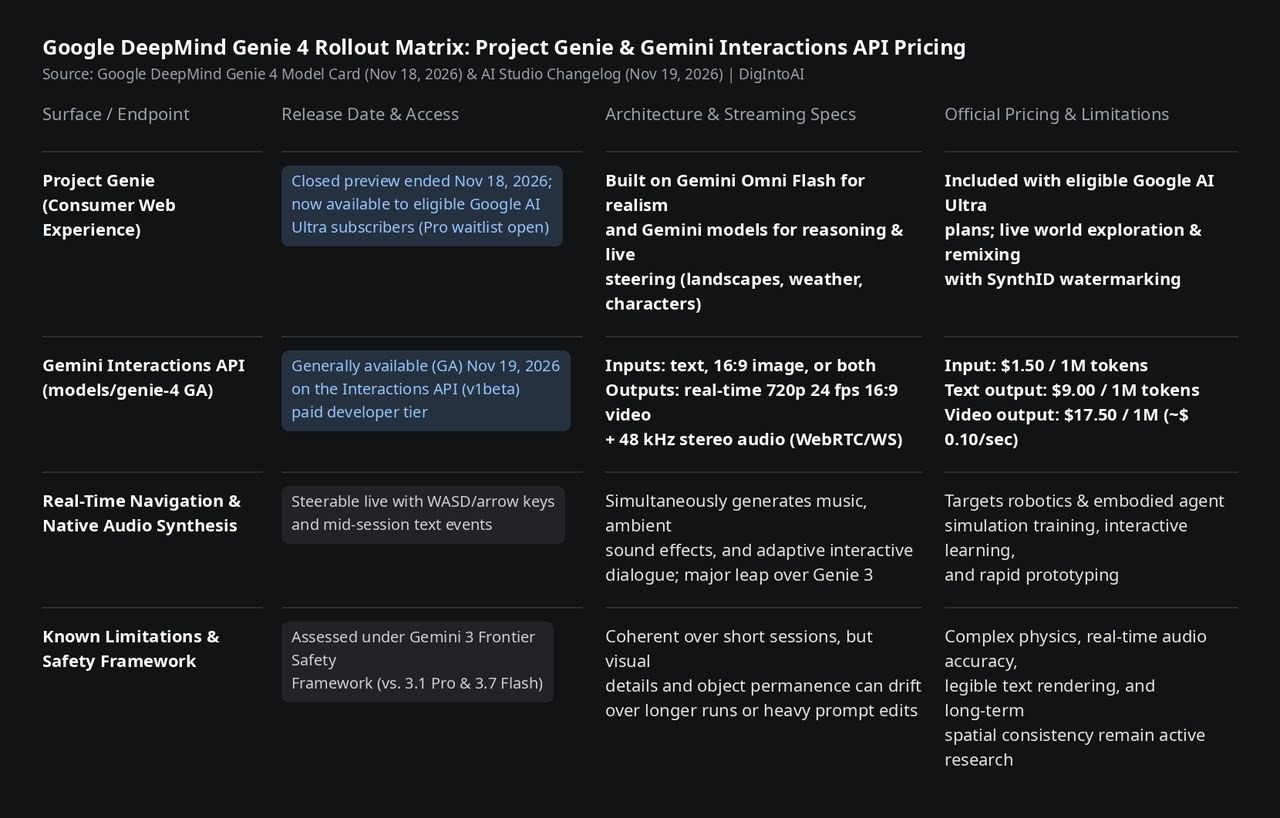
Image source: compiled by DigIntoAI from Google DeepMind's Genie 4 Model Card and AI Studio changelog.
Official API Pricing & Model Card Limitations
**Token Pricing (approx. $0.10/sec Video Output) & Known Research Boundaries: **On the Gemini Interactions API paid tier, models/genie-4 is priced at $1.50 per 1M input tokens, $9.00 per 1M text output tokens, and $17.50 per 1M video output tokens (approx. $0.10/sec, stereo audio included). DeepMind notes that while Genie 4 sustains coherent environments over short sessions, visual details and object permanence can still drift over longer runs or after multiple complex prompt edits, with complex physical interactions, legible text rendering, and long-term spatial consistency remaining active research areas. Outputs carry SynthID watermarking under Google's Gemini 3 Frontier Safety Framework baseline.