
On this page
Hours after rolling GLM-5.4 out to GLM Coding Plan subscribers on November 23, 2026, Z.ai (Zhipu AI) published its formal technical blog, 'GLM-5.4: Toward Generalized Coding with Our First Loop Transformer' (z.ai/blog/glm-5.4). For the first time, the lab detailed the model's exact looped architecture, 750B serving modifications, 30B iso-parameter ablation findings, live throughput numbers, and key limitations.
While the engineering disclosure is unusually candid, rapid social summaries have already blurred several critical distinctions—mistaking the '2T–3T' capability claim for actual parameter count, or applying the 30B experiment's token savings directly to the 750B flagship. Reading the primary post line by line clarifies both what Z.ai actually built and where the evidence stops.
Three Critical Boundaries Before Citing GLM-5.4's Headlines
**Boundary 1 — 750B Continued-Training Adaptation, Not a Pre-Trained 2T–3T Model: **GLM-5.4 is NOT a 2-to-3-trillion-parameter model trained from scratch. Z.ai explicitly discloses that GLM-5.4 adapts the existing 750B GLM-5 base model through continued training, looping 28 weight-shared layers for two iterations. The team openly notes why it skipped pre-training from scratch: although weight sharing improves parameter efficiency, looped models trained from scratch still trail unshared models under identical pre-training compute budgets. Converting a pre-trained base via continued training lets Z.ai raise reasoning depth with comparatively modest added compute.
**Boundary 2 — '2T–3T' Is a Capability Equivalence Claim, Not Parameter Count or Public Benchmark: **The blog's exact claim is that GLM-5.4 reaches 'intelligence levels comparable to 2T-3T parameter models.' That wording is a vendor capability positioning statement—not a parameter count and not an independently audited leaderboard score. Nowhere in the post does Z.ai publish benchmark scores for the 750B GLM-5.4 flagship (no SWE-bench, Terminal-Bench, GPQA-Diamond, or MMLU-Pro tables for 750B), and domestic statements citing '200 real-world coding evaluations' offer qualitative positioning without releasing numerical scores.
**Boundary 3 — '10%–14% Shorter Output' Comes Strictly from a 30B Ablation, While 750B Suffers 'Marathon Thinking': **In a controlled iso-parameter ablation on a 30B model matching the 750B architecture (with approx. 10% more total training compute, evaluated after 200K long-context SFT with thinking mode enabled), Z.ai observed that average output length on benchmarks like GPQA-Diamond and MMLU-Pro dropped by 10%–14%—suggesting part of explicit chain-of-thought reasoning shifted into implicit loop depth. However, readers must NOT extrapolate that 10%–14% token reduction onto the 750B GLM-5.4 flagship. Right at the top of the blog, Z.ai candidly warns that GLM-5.4 'tends to get caught in overly long marathon thinking loops,' even though prolonged self-correction raises accuracy beyond its parameter count. Developers testing GLM-5.4 in coding agents should therefore measure real token burn rather than assuming lower per-task consumption.
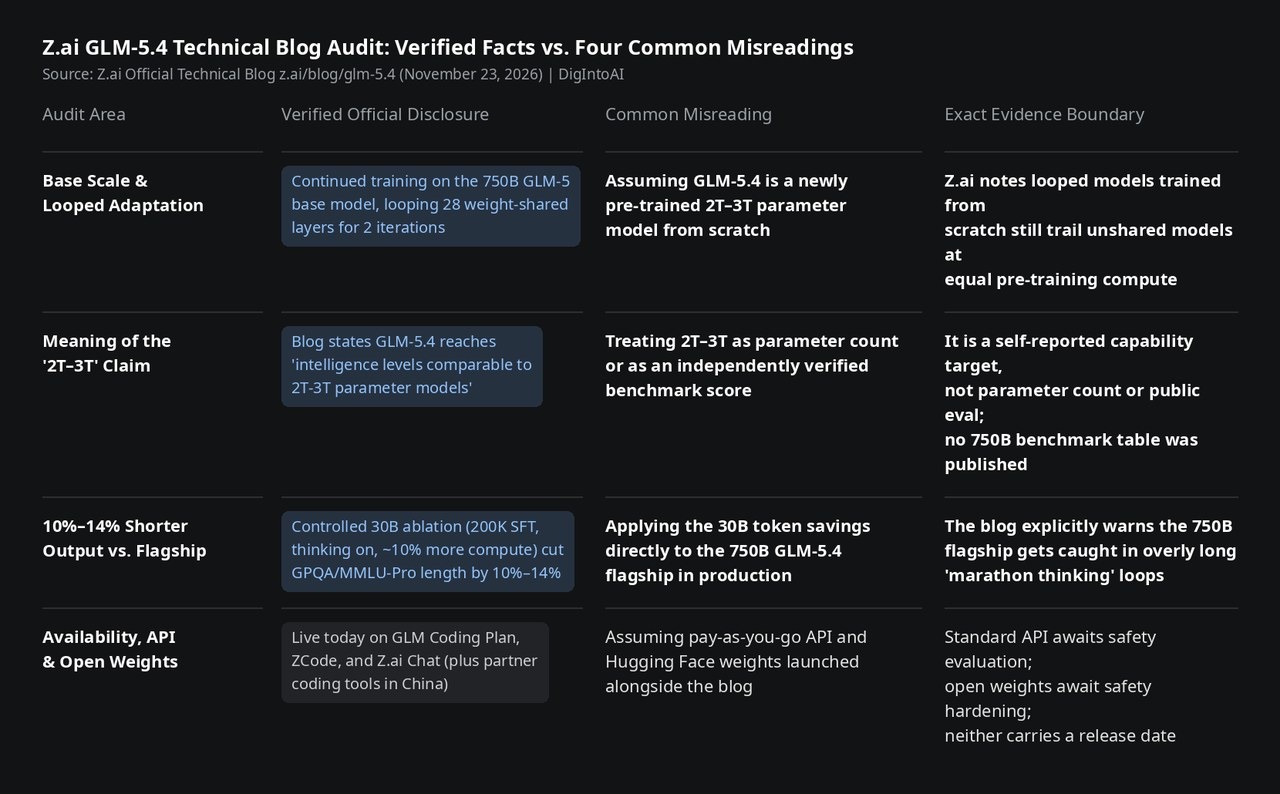
Image source: compiled by DigIntoAI from Z.ai's official technical blog (z.ai/blog/glm-5.4, Nov 23, 2026).
How Z.ai Made a 750B Loop Transformer Practical to Serve
**Gated Progressive Updates Stabilize Multi-Pass Continued Training: **Directly overwriting hidden states when converting middle layers of a pre-trained model into a loop causes activation norms to blow up, feeding out-of-distribution scales to downstream layers. GLM-5.4 introduces independent per-token gates for each iteration to write candidate updates proportionally into the residual stream. After training, Pass 1 writes conservatively with small gate values to establish global context while Pass 2 opens gates to refine outputs—dynamically adjusting step sizes so harder tokens receive stronger Pass 1 updates.
**Hybrid KV Cache & Sparse Attention Index Reuse Contain 1M-Context Costs: **Naively storing a separate full KV cache per loop multiplies memory usage with loop count—prohibitive at 1M context lengths. GLM-5.4 solves this with cross-loop KV sharing paired with an independent local sliding window: Pass 2 reuses the sparse KV selected in Pass 1 while keeping its own fresh KV only inside the sliding window, with overlapping streams letting attention inspect both global first-pass context and refined local states. As a result, the second pass costs only one sliding window of KV cache rather than a full context cache. Because the GLM-5 base uses sparse attention, Pass 2 also directly reuses Pass 1's attention indices at zero extra indexing overhead with nearly identical quality.
**Kernel Fusion, Scaling Correctness & 200 Tokens/s Off-Peak Throughput: **To counter the fragmented intermediate memory reads and writes amplified by multi-pass looping, Z.ai fused core kernels at the systems level—delivering up to 200 tokens/s off-peak and 70–80 tokens/s at peak load. Before committing the flagship, the lab validated 'Scaling Correctness' step by step across 1B, 4B, 30B, and 750B base models, noting that longer reasoning chains (math, scientific reasoning, and long-context coding) benefit most from looping.
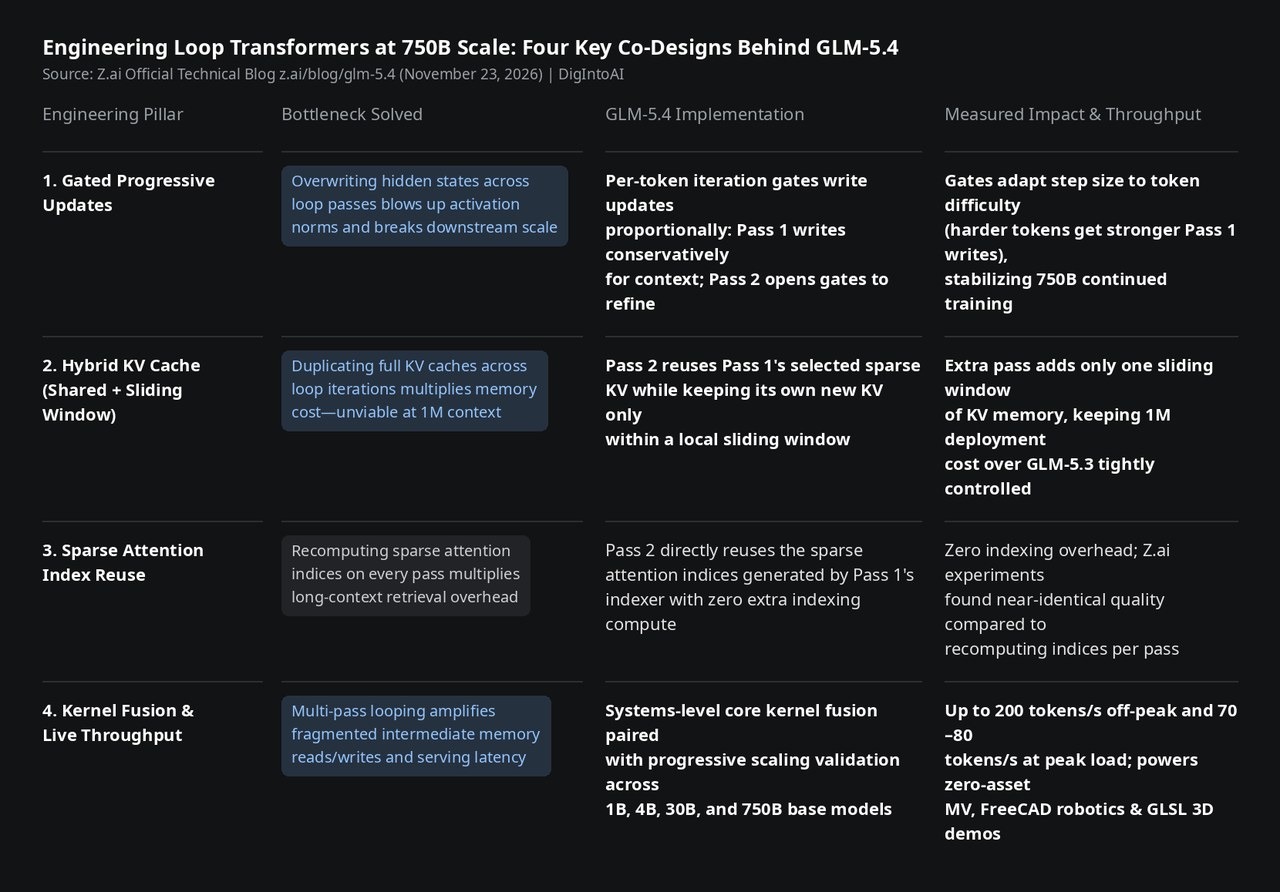
Image source: compiled by DigIntoAI from Z.ai's official technical blog (z.ai/blog/glm-5.4, Nov 23, 2026).
Generalized Coding Demos, Access Status & What Ships Next
**Code as a General Engine—and Unscheduled API/Weights Releases: **Combining coding and vision upgrades, Z.ai frames GLM-5.4 as the starting point of 'Generalized Coding,' showcasing four code-driven demos: a 2m44s self-narrated music video ('Hello World') rendered purely in frontend code with zero image assets, engineering-grade 6-axis robotic arm CAD modeling in FreeCAD, end-to-end game generation, and a scratch-built 3D macro bird-watching scene using pure math geometry and custom GLSL shaders. GLM-5.4 is live today on GLM Coding Plan, ZCode, and Z.ai Chat (alongside partner Chinese IDEs), while standard pay-as-you-go API access awaits safety evaluation and open weights await safety hardening—with neither carrying a firm date. Looking ahead, Z.ai confirmed it is scaling both depth and size in parallel, teasing that 'our next, significantly larger model will carry forward everything we learned here' and arrive soon.