
On November 27, 2026, OpenAI filed formal counterclaims against Apple in the U.S. District Court for the Northern District of California (Apple v. Liu, Case No. 5:26-cv-07078), escalating a dispute Apple initiated in July against OpenAI, io Products, and former Apple employees Tang Tan and Chang Liu. The filing brings intensifying AI hardware talent and supply-chain rivalry into full public view.
Three Pillars of OpenAI's Countersuit—and Apple's Flat Denial
**Trade Secrets, Shared Hardware Suppliers & One-Year Mobility Restraints: **OpenAI's counterclaims center on three allegations: first, that Apple misappropriated OpenAI trade secrets; second, that Apple leaned on shared hardware suppliers, prompting vendors to reschedule or relocate meetings with OpenAI to avoid Apple scrutiny; and third, that Apple's one-year non-compete and non-solicitation restrictions unlawfully impede talent mobility under California law. Apple publicly denied the counterclaims, stating it had uncovered no evidence of stolen OpenAI secrets.
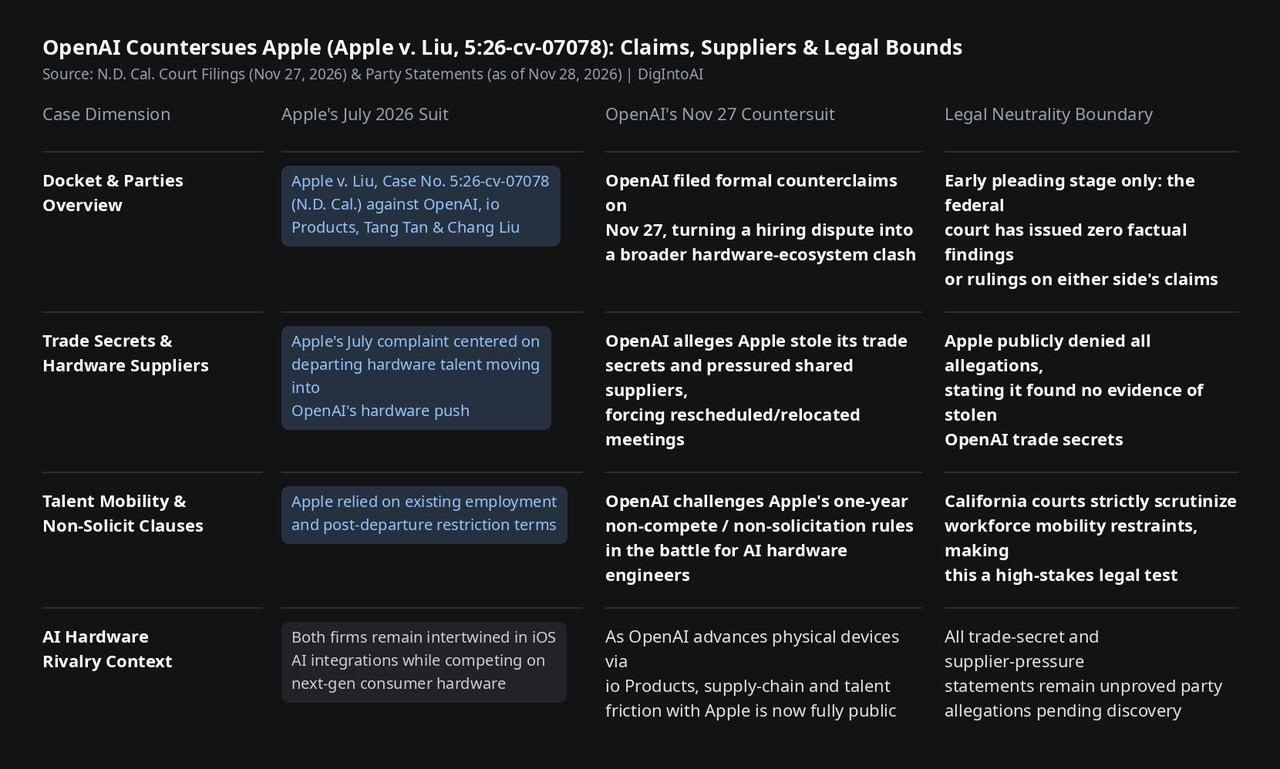
Image source: compiled by DigIntoAI from N.D. Cal. filings (Nov 27, 2026) and public party responses.
Strict Legal Neutrality & AI Hardware Rivalry Context
**Unproven Pleading-Stage Allegations with Zero Court Findings: **Both Apple's July complaint and OpenAI's November 27 counterclaims remain unproven unilateral allegations at the early pleading stage—no federal judge has issued factual findings or rulings. Strategically, the clash underscores a striking paradox: even as both companies overlap across iOS AI integrations, OpenAI's push into physical devices via io Products has placed it on a direct collision course with Apple for industrial designers and precision hardware suppliers.