
On November 20, 2026, OpenAI announced general API availability for GPT-Live-1.1 (model ID: gpt-live-1.1), bringing the full-duplex voice model that has powered ChatGPT Plus and Pro since October 15 directly to developers. Alongside the model release, OpenAI introduced a new Standby billing state designed to slash idle costs during quieter moments on WebRTC voice calls.
Full-Duplex Upgrades & $0.02/min Standby Mode
**Higher Transcription Precision, Consistent Accents & Seamless Delegation: **Compared with GPT-Live-1, gpt-live-1.1 retains full-duplex operation—listening while it speaks—while improving transcription accuracy for exact details like letters and numbers, maintaining more consistent voices and accents across languages, and following instructions more reliably. Developers can also describe in plain language when the voice model should delegate reasoning or tool-heavy workflows to a chosen backend model without interrupting the live conversation.
**60% Lower Idle Cost with Configurable 5–60s Silence Timeouts: **Available for both GPT-Live-1 and GPT-Live-1.1, Standby lets applications configure an idle timeout between 5 and 60 seconds. Once silence exceeds that threshold, inference temporarily pauses while the WebRTC session remains open—resuming automatically as soon as someone speaks again. Voice sessions are billed by duration at $0.05 per minute while active and $0.02 per minute in Standby, with delegated backend models and tools billed separately.
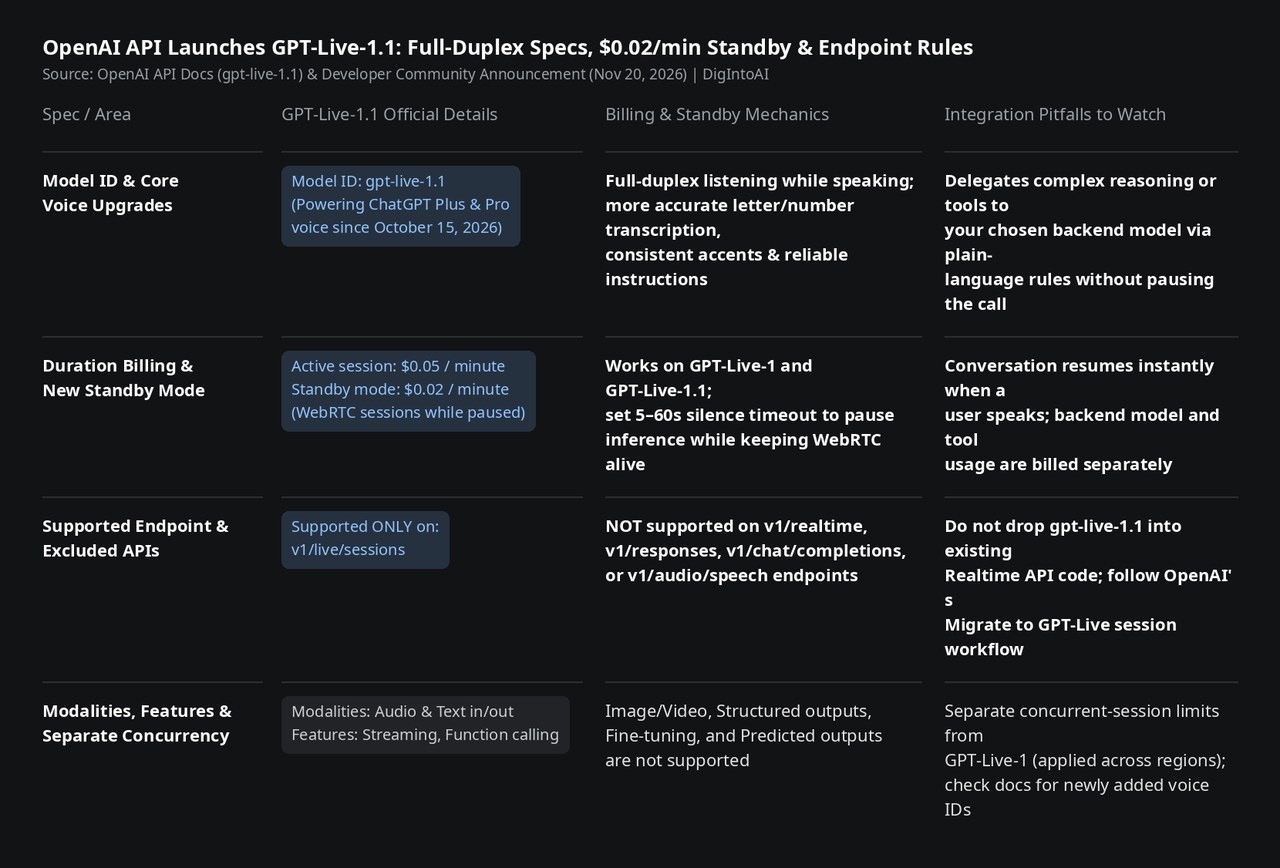
Image source: compiled by DigIntoAI from OpenAI API docs and the November 20, 2026 developer announcement.
Key Endpoint, Modality & Rate-Limit Boundaries
**v1/live/sessions Only—Not a Drop-In Replacement for v1/realtime: **Per OpenAI's official model documentation, gpt-live-1.1 is supported exclusively on v1/live/sessions; it is not supported on v1/realtime, v1/responses, v1/chat/completions, or standalone speech/transcription endpoints. It supports audio and text input/output, streaming, and function calling, while excluding image/video inputs, structured outputs, fine-tuning, and predicted outputs. Finally, GPT-Live-1.1 carries separate concurrent-session limits from GPT-Live-1 across inference regions, and developers should test any newly added voice IDs before shipping them to production.