
On November 20, 2026 (shared via @OpenAI at 03:33 Asia/Shanghai on November 21), OpenAI published 'Combatting adversarial distillation,' outlining how it protects internal chain-of-thought reasoning across GPT-6.2 Astra and GPT-6.2 Sol, presenting an internal cybersecurity distillation study, and detailing how API-level controls and coordinated account enforcement disrupt unauthorized capability extraction.
Why Exact Reasoning Traces Matter & Adaptive Red-Teaming Results
**Dual-Use Cyber Capability Transfer on ExploitBench & SEC-bench Pro: **In an internal distillation experiment starting from the same pretrained student model, OpenAI created supervised fine-tuning datasets using Astra-level teacher trajectories on benign coding and defensive cybersecurity tasks. Comparing students trained on user-visible outputs (final responses, reasoning summaries, and tool interactions) against those also given exact reasoning traces, OpenAI reports that exact-trace students generally outperformed summary-trained students after SFT—and still scored higher at the largest tested inference budget on ExploitBench and SEC-bench Pro even after lightweight reinforcement learning (while summary students scored higher at lower budgets, echoing prior Anthropic findings on SWE-bench Verified).
**Extraction Attack Success Rate Falls Below 1% on GPT-6.2 Astra: **Aggregated across six attacker models in OpenAI's internal adaptive black-box red-teaming evaluations, the average attack success rate (ASR) for extracting protected reasoning from an earlier request dropped from 54.0% on GPT-6 Astra with original safeguards to 0.2% on GPT-6.2 Astra with updated safeguards, while extraction from the current request fell from 22.9% to 0.9%. OpenAI is also backporting selected improvements to GPT-6 Astra.
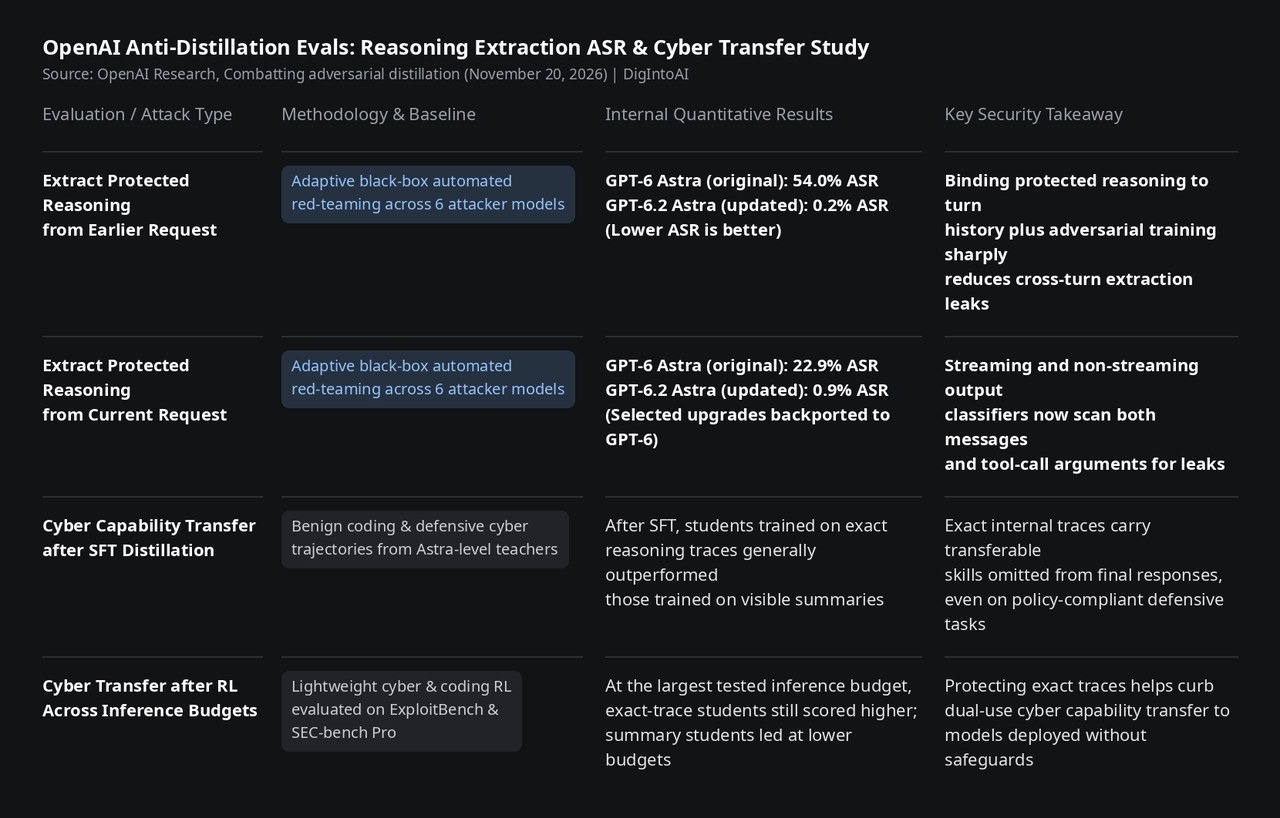
Image source: compiled by DigIntoAI from OpenAI's research post Combatting adversarial distillation.
Two-Layer Defense Stack & Developer API Changes
**History-Bound Reasoning, Cross-Model Locks & Tool-Call Scanners: **At the request level, OpenAI combines adversarial defensive training, input/output classifiers, and API boundary controls. Three API changes matter directly to developers building with GPT-6.2 Astra and Sol: first, protected reasoning is bound to the conversation history that produced it—rewriting an earlier message causes the API to drop subsequent reasoning; second, stricter user, workspace, organization, and model-family boundaries block older model families with weaker safeguards from reading GPT-6.2 protected reasoning (closing replay vectors disclosed in September); and third, streaming and non-streaming output classifiers now inspect tool-call arguments alongside assistant messages to stop leaks hidden in tool parameters.
**Campaign Enforcement Scale & Policy Statements: **At the campaign level, OpenAI states its weekly enforcement actions against unauthorized distillation networks range from thousands to tens of thousands of accounts—accelerating since summer 2026—supported by partner-wide consistent-standards policies and indicator sharing across model providers and the Frontier Model Forum. In its national security section, OpenAI reiterated its February briefing to Congress alleging distillation activity by DeepSeek, reiterated its September attribution of a disrupted campaign to individuals associated with Moonshot AI (developer of Kimi), and voiced support for U.S. legislative proposals including the Chip Security Act, AI OVERWATCH Act, and MATCH Act.
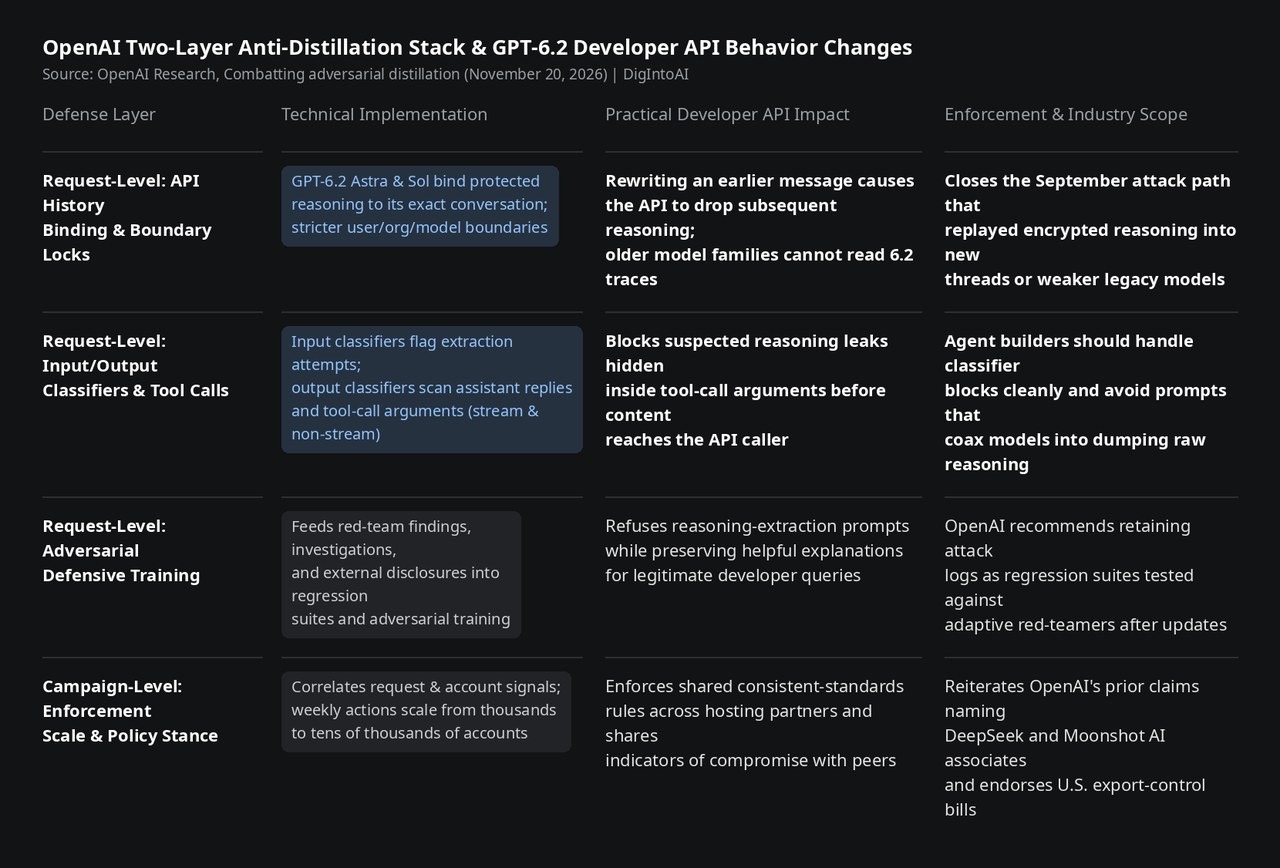
Image source: compiled by DigIntoAI from OpenAI's research post Combatting adversarial distillation.