
On November 19, 2026, OpenAI Members of Technical Staff Okay Zed and Cyrus Forbes published 'How OpenAI's Performance Factory keeps ChatGPT fast,' detailing how OpenAI automates investigating and resolving production performance regressions. Over slightly more than three months, its initial Regression Workflow tracked more than 1,700 investigations and root-caused over 600 cases—averaging 17 automated investigations per day.
From Human Proxy to Four-Part Agent Factory
**Capturing 30+ Profiling Tools Inside a Stateful Cloud Loop: **OpenAI traced six stages from manual profiling (over 30 custom CPU and allocation tools) to packaging its team's playbook into a shared perf-forensics Codex skill—until engineers felt like human proxies shuttling alerts between Slack and Codex. Performance Factory closes the full lifecycle through four parts: a Task Service configured with config.toml state machines and Markdown stage prompts (persisting state outside any single agent's context); a Dispatch Loop assigning focused Codex turns to ready tasks; a Cloud Codex API running inside OpenAI's network under an audited service identity with access to repos, logs, traces, and profiles; and Event Subscriptions that pause waiting tasks until GitHub review comments, CI failures, or deployment events wake them back up.
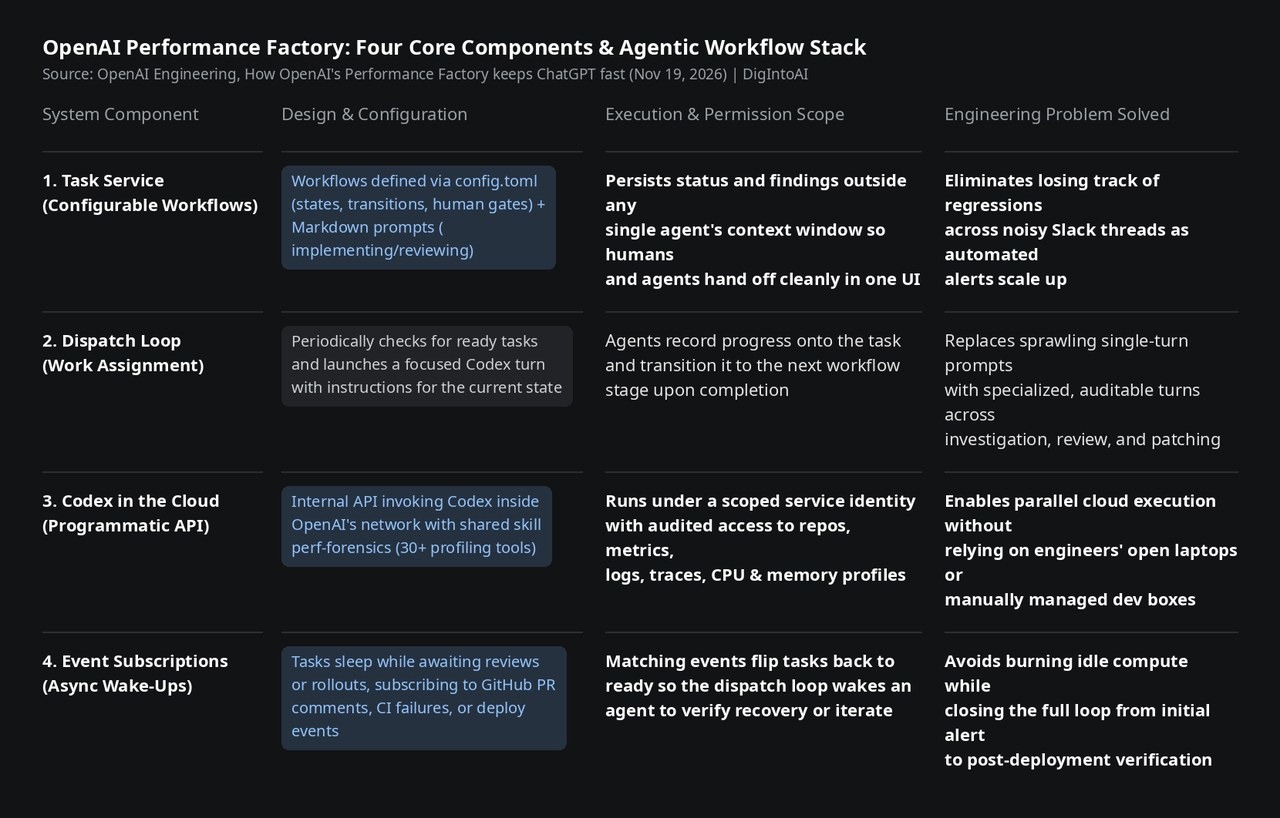
Image source: compiled by DigIntoAI from OpenAI's engineering post How OpenAI's Performance Factory keeps ChatGPT fast.
Adversarial Peer Review & Why Humans Still Own the Ship Gate
**70% Root-Cause Audit Accuracy & Architectural Trade-Offs: **Because early agents sometimes stopped at the first plausible explanation, OpenAI added an adversarial review turn: a separate Codex session actively attempts to disprove the diagnosis via counterfactuals (for example, checking whether unexposed traffic stayed healthy or whether a suspected internal dependency had already recovered while failures continued). In a manual review of 100 root-cause suggestions, OpenAI graded 70% as accurate and 30% as needing further refinement or lacking full causality. Crucially, OpenAI notes that fixing regressions remains the hardest stage—architectural trade-offs like caching versus stale data still require human engineers to decide what ships—while the factory protects engineer attention by deduplicating related alerts, adding synthetic pre-review benchmarks, and turning recurring harness failures into self-repair PRs.
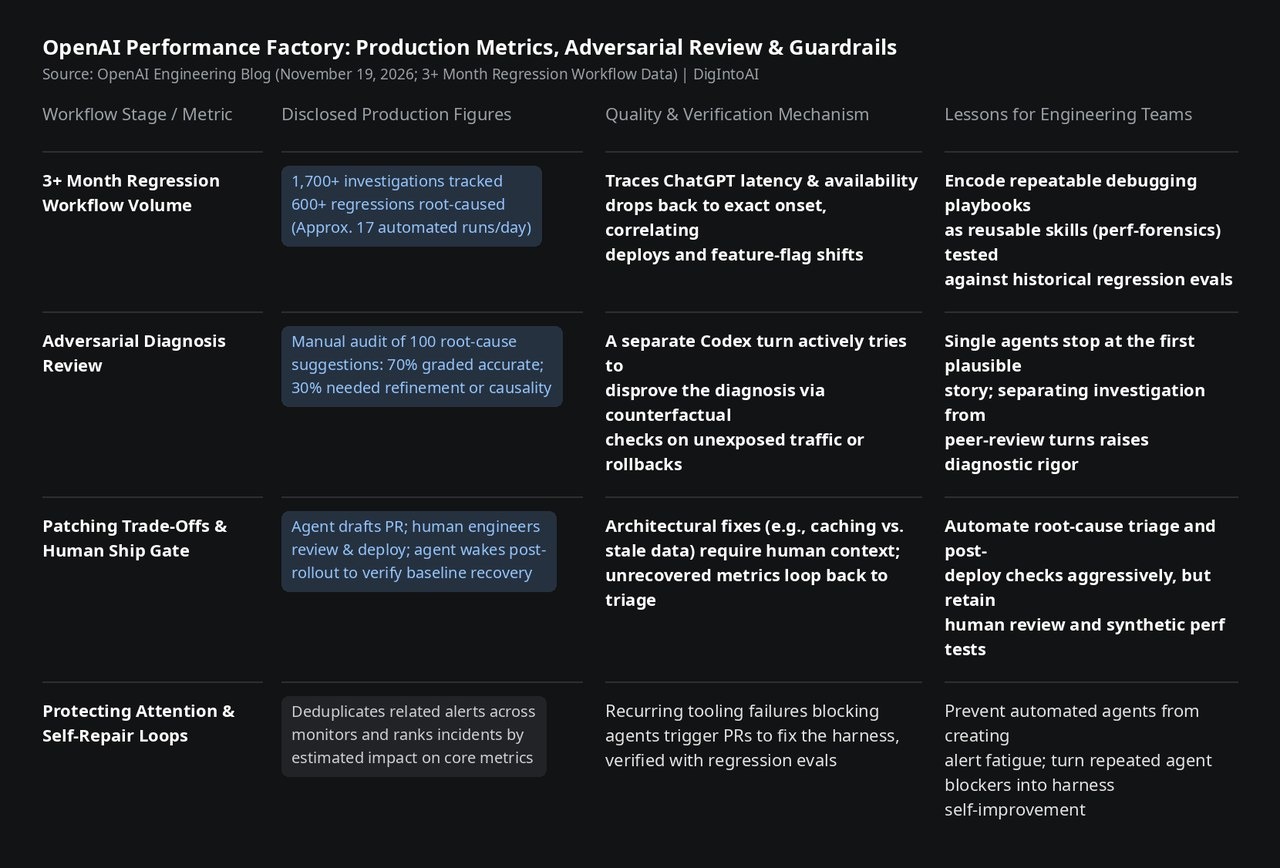
Image source: compiled by DigIntoAI from OpenAI's engineering post.